A hospital bed or medical furniture, or any bed (not a couch) with medical items. At least 6 floor tiles. It works with a medical tool and supplies too.
A workbench, anvil, forge or craft station starts it, with at least 6 floor tiles. Tools alone do not make one. Three different kinds of tools make it stronger.
Two of them in a room without a bed. One is enough in a closet, a clothes shop or a room with no other furniture. In a hall only clothing racks count. Never a kitchen or bathroom.
You do not draw the field. The settlers lay it out in the garden on grass or dirt: beds two tiles wide with a path between, 12 tiles for the first worker.
Pick a house and settle in. From then on, the settlement window shows how your home is doing.
Settling in
There are two ways to start. Both ask you for a name.
By hand
Right-click a floor inside a building (under a roof) and choose Settle here. The room you clicked becomes the home.
At a ham radio
Place a two-way ham radio, right-click it and choose Found settlement (also a button in its radio window). The radio's room becomes the home; if you built a wall across it, only the radio's side. A walkie-talkie will not do.
Right-click a floor indoors: Settle here founds your first home in that room.
A home without a radio hears and sends nothing: no survivor calls it, no rumours reach it, and it cannot trade. The settlers ask for one. Place it anywhere in the home and the home joins the world within the hour.
Tip. Changed your mind? While the home has no settlers and no radio, right-click a floor elsewhere and choose Settle here instead.
A second settlement needs a ham radio, at least 100 tiles from any other home of yours, and only once your first home has its radio. See Several homes & trading.
The settlement window
Right-click anywhere in the settlement and choose Settlement › Open (name). It shows how your home is doing. The settlement window goes through it tab by tab.
Radio messages
The ham radio only works while it is switched on and has power from the grid or a generator. Switched off, the home is silent. Settlement messages reach you within 15 tiles of the ham radio, or anywhere while you carry a switched-on walkie-talkie on the same channel. A basic walkie-talkie only reaches 75 to 150 MHz, so tune the ham radio to a channel your walkie-talkie covers.
Only vital messages show above your head: a death, no food or water, an attack, a settler leaving or about to leave, a bite, no fuel in winter. Missed ones are not repeated; read them in the History tab. When you come home after settlers left, one line above your head says who left and why, radio or not. While you sleep you hear nothing: no messages and no settler talk.
Start
A stable settlement
Settlers stay when they are fed, warm, safe and well. Work down this page in order. The settlers decide how they live, but all of this is yours to bring.
1. A bed for everyone
Each settler wants a bed of their own and 10 indoor floor tiles. Without a bed of their own they look for a free bed, then a free sleeping bag or mattress, then a couch, and only then sleep on the floor. Having no bed of their own costs morale. A bunk bed or double bed counts as two. A sleeping bag or mattress put down indoors is a bed too, but costs a little morale.
More than 3 people in one bedroom (4 on Gentle, 2 on Hard) and the latest arrivals look for a quieter room, so plan on more than one. Bedroom guide
A couple, and close friends, like to sleep in the same room. A newcomer takes a free bed in their partner's or close friend's room first, and a couple who sleep in two rooms move together once a bed is free there. The room limits and bunk beds always come first.
Two settlers who are rivals or enemies will not keep sleeping in one room: the later one moves to a free bed in another room. If none is free, they ask for one, which weighs on them meanwhile, and they may want a room next door with a bed, as settlers already ask for rooms when beds are short.
2. Food that lasts
Each settler eats 2000 kcal a day by default. Put food in containers in the rooms of the home. Food in your own room does not count. Hover the food bar on the Overview to see how long it lasts.
A kitchen with a good cook makes it last, up to 45% less food eaten.
The ration slider on the Overview changes how much they eat.
A Farmer lays out a field. A Fisherman works up to 6 rods, about 1000 kcal a day each. A Park Ranger works up to 12 traps, about 150 to 500 kcal each by the woods. A Rancher looks after animals, whose eggs, milk and meat feed the home. Garden, field and animals
3. Water after the shutoff
While the town's water runs, water is free and its bar stays hidden. After the shutoff each settler drinks 2 litres a day at the default ration. Wells, rain collectors, barrels and filled bottles all count. Set this up before the taps run dry. After the water shuts off
4. A closed home
A closed home counts most for safety. Every outer side must be a wall, a closed door, a tall fence, a boarded window or water.
Open the Home tab. One coloured line says if the home is closed, weak or open.
Press Show perimeter. Every way in turns red on the floor you stand on.
Close it: add the room behind an open doorway, build the wall, or shut off the stairs.
Bring melee weapons, one per settler, and people who can defend. Improving defence
Attacks happen only while every player is away. If the radio calls for help, come back within about twelve hours.
5. Ready for winter
Warmth matters in December, January and February. In late November the settlers remind you. You need three things:
A fireplace or wood stove inside the border.
Fuel in a room of the home: logs, firewood, branches, twigs and planks.
One warm coat per resident. Coats wear slowly in the cold; a Tailor slows that.
A Lumberjack with an axe and 5 trees nearby brings in firewood all year. A Tailor with needle and thread makes winter clothing. Keeping warm
6. Clean and healthy
Medical supplies. Keep bandages, disinfectant and antibiotics in the home. A deep wound, fracture or bite is urgent and has a deadline: 2 game days on Normal. Infirmary guide
Cleaning. Bleach or soap, with gloves, a mop or broom, and a sponge or cloth to make them go further. A filthy home makes people ill and leave. Cleaning and hygiene
A toilet. A home without one gets dirtier, and the settlers ask for it. Bathroom guide
7. Good spirits
Food and water weigh most. After that, bring many different comfort items rather than many copies, and bring settlers the things they ask for. The Morale tab lists every cause. Morale and comfort
When morale stays very low for three days (two on Hard), settlers start to leave, in waves. The first two residents always stay, and nobody leaves on Gentle. About a day before anyone could go, the one who would leave asks for help on the Requests list and says why.
When something slips
You see
Do this
Food bar short
Bring food, check it is not in your own room, or lower the ration for a while.
Settlers on the floor
One more bed each. Keep some floor free too.
Home says open or weak
Show perimeter, then close what turns red.
Hygiene dirty or filthy
Bring cleaning supplies, a mop or broom, and clear corpses and rotten food.
A red request
It is urgent. Read it on the Overview, and bring what it names.
Morale still low after a fix
Morale drifts over game days. Check the Morale tab for red entries that remain.
Start
The settlement window
Everything the settlers can tell you about the home, on one window with a tab for each subject.
Opening it
Right-click the ham radio and open the settlement from its radio window. It closes when you walk more than 10 tiles away. Or right-click anywhere in the settlement and choose Settlement › Open (name): that window stays open while you are in or near the settlement.
Far from home, hold a walkie-talkie, switch it on and tune it to the ham radio's channel. Its radio window then has a Settlement section with Open (name) for every settlement whose ham radio is on that channel, so homes sharing a channel each get their own button. The window stays open while the walkie-talkie is in your hands or on your back, on and on that channel. From afar you can look; anything that needs you at home still does.
Most tabs show coloured icon tiles; hold the mouse on one to read its explanation. A tile that names a settler can be clicked and opens the Settlers tab on them.
The window also works with a controller, in split screen too, where it opens in your part of the screen. LB and RB switch tabs, the D-pad moves a yellow outline from one button, slider, drop-down, link or icon to the next (an icon's explanation shows beside the outline), A presses and B closes the window. On the Settlers tab, up and down pick a settler and right opens their page. Drawing rooms, walls and gardens on the map still needs a mouse.
In split screen each player is their own: what you choose in the menu or the window is done for you, messages show above your head, and settlers greet, ask and sit with whoever of you is nearest. The home counts as lived in while any of you is there. Only the item icon above a settler who wants something and the arrows to a calling radio still show in the first player's part of the screen.
Tab
What it shows
Overview
Population, the need bars (food, water, power, warmth, morale, medical, hygiene, security) with the refresh icon, the ration slider, the open requests (calls for help first, urgent ones red), recent attacks, and Rename, Pack up and move and Abandon. Arrows beside a bar show whether it is getting better or worse. Water, power and warmth show only when they matter.
Home
A map of the home seen from above, a chip for every room use, buttons for the garden, the wall, Check for security and the perimeter view, then Stay inside today (everyone stays in for 12 game hours), the Runs row (who is out on a salvage run, or why none goes), I'd rather nobody went out (no salvage runs for a while), Keep the outside dark at night (no outside lamps or yard fire) and How it stands: weak spots, house rules and every room.
Morale
The morale bar and three lists: what keeps spirits up, what would help, what brings them down.
Settlers
Each resident: profession, traits, how they seem to feel about you, their bed, their wish and their story. Beside the portrait a row of icon tiles shows what they do, under For the settlement and, to the right of it, For you. Green helps, red costs the settlement, grey means they could but there are enough. Hold the mouse on a tile to read what it does; some open the Home or Morale tab when clicked. A food maker's tile says how much food they bring a day, or what they lack, and why it is little (few trees, little water, the season). Under the top a People line names the ties you have learned about, in words that follow how the two get on now (Close to Rita, Can't stand Julie): green for the good ones, red for the bad. Up to five show, strongest first, the rest as +2 more (hold the mouse on it to read them); click a name to open that settler. Their story opens with a line (Mechanic from Muldraugh. With you for 23 days.) and then short chapters; click a chapter to open or fold it. The two newest start open. A small yellow dot after a name in the list means something new in their story (hold the mouse on it to read what); it goes once you open their story. The heading says how many chapters are new (1 new): a new chapter starts open, with a dot before its title and a gold line beside its text. Each chapter learned at the settlement says how and when you learned it: told you, today, overheard, 2 days ago (it came out in a quarrel), their diary, 6 days ago, brought back (a thing of theirs, or a relative) or seen (a habit). Some older chapters show only the date. The three chapters about their life before they came come out over time (see talking to them); until then the story ends with There is more she isn't ready to tell you yet. In a shared game each player has their own marks. Their own bed (or No bed yet) and Keeps a diary sit to the right of their traits, under the buttons. Buttons: Send away, Find and transfer to another settlement.
History
The settlement's radio messages, newest first. A death says why.
The Overview: how the home is doing, and what the settlers ask for.
People
Finding survivors
Survivors wait in buildings you have not entered. Shout, follow the reply, and bring them home. They are a finite resource: use them well.
Where to look
Survivors wait indoors, outside your border, from the first day. A building you have already entered never holds one. Near a living survivor you may see You hear someone calling out nearby. The kind of building hints at who is there, and so does the area: countryside survivors are more often farmers, lumberjacks, rangers and fishermen, those in big towns more often police, mechanics or nurses.
Clinics, hospitals doctors, nurses
Garages, industry mechanics
Farms, countryside farmers
Diners, kitchens cooks
This message means a survivor is close: tap Q.
Survivors are not safe where they wait. When a zombie comes near they get up and defend themselves with their bare hands. The brave go at it, the timid back away, and against several they all back off. A zombie behind a wall or a closed door does not make them get up. They can die before you get there.
Shout with Q
Standing
heard 40 tiles
Crouching
heard 15 tiles (a whisper)
Reply
an arrow for about 3 seconds
Waiting survivors in range answer Over here! An arrow appears close around your character. It points the way the voice came from, not at the exact spot. Two yellow arrows up or down beside it mean the survivor is on a floor above or below you.
Some are shy: a few answer only a whisper, a few never answer. A Deaf survivor hears no shout or knock, a Hard of Hearing one no whisper. Crouching keeps the noise down, so you draw fewer zombies.
Tip. A locked door with a survivor behind it: right-click it and choose Knock on the door, or just try to open it, or shout right beside it. They come and open it, unless zombies are close. If nobody opens, you are told why. Knocking crouched is quieter, and so is a whisper. A locked window works the same way (Knock on the window): they open it and you climb in. A window stuck for good stays shut; they will tell you so.
Inviting someone
Walk up, right-click the survivor and choose Talk to. The panel shows profession, traits and the trip home. With several settlements, pick which one they go to.
Choice
What happens
Invite
They travel home off-screen, alone. The risk of going missing grows with the distance.
Travel with me
They do not follow as a body. Reach your border within 12 game hours and they arrive safely, with no risk.
The trip takes about an hour per 1,000 tiles plus a few hours to set off, two days at most. While they walk, the Overview shows the time left beside the settler count, for example (2 away, the last in about 7 h); hover it for each person's own time. The Settlers tab shows On the way: 2, ~7 h. If someone is not there when the time is up, they never made it: the radio says so and they count under Missing.
Someone already inside your border, such as a survivor in a house you just claimed, joins at once. A settlement that is out of food refuses invitations until there is food again. A group of friends comes as one: see visitors at the door.
Talking before you have a home
You can talk to a survivor before you settle. All you can say is I don't know where to go either. But if I find a place, I'll let you know. From that talk they stay a few more days and then move on. Remember the place and come back once you have a home. Someone you never talked to keeps waiting until you settle.
Survivors wait half again as long on Gentle and a quarter shorter on Hard.
Missed someone? The radio
A survivor nobody recruits calls once on the radio before giving up, then waits one or two more days, heard or not. You hear the call at your ham radio. A line Someone is calling on the radio... stands above it until you open the settlement window, and the Overview then lists the caller first, with distance (to the nearest 100 tiles), direction and kind of building.
I'll look for them shows the direction for three seconds. Carry a walkie-talkie (in hand, on your belt or in your main inventory, not inside a bag) that is switched on and has battery left, and they keep talking you in: the direction stays for as long as they are within its range (a better walkie-talkie reaches farther), also when you are close. A search arrow, labelled only You hear someone over there, also points at the building once you are within 60 tiles. The walkie-talkie arrow carries their first name. Without a walkie-talkie it goes when you are within about 10 tiles and does not return: from there you shout and look.
Ignore this takes the call off the Overview. The survivor still waits as long as before.
Only a home with a ham radio that is switched on and has power hears calls, rumours and tips. While it is off, survivors move on without calling. See settling in.
A place goes on your own world map only when you take it on: press I'll look for it (I'll look for them for a person) under the request on the Overview or the Settlers tab. The settler says I've marked it on your map. and the row reads On your map. The mark is drawn like the map's own markings: an arrow from its own side, a little tilted as if drawn by hand, with a handwritten note at its tail. Blue ink is a settler's own search, red a burglar's tip, green the radio. A radio call is marked when you press I'll look for them. Radio rumours show on the Overview of the home nearest to them (Heard on the radio: a survivor (Chef) was seen about 400 m north of here.) with the same button. The mark stays after the search ends; take it off with the map's Remove Marking tool. In co-op only the player who pressed gets the mark; the other player gets it by pressing too. Nobody sees who took it on. Nothing is drawn when the server does not allow the world map.
Survivors on the radio
Rumours
The radio says a survivor with a named trade was seen in a kind of building, at a distance and direction. They come when nobody has joined for ten days, and at random every few weeks. The arrow points at the building for two weeks, until you have been there.
A burglar's tips
A burglar among your settlers knows places. About weekly the radio names a building nobody has entered, far enough out that no salvage run reaches it, and what it holds. You fetch it yourself. When a settler wishes for an item, about half the time the burglar also knows a kind of shop nobody has been in yet, such as a pharmacy for painkillers, where it is likelier than in an ordinary house. It shows under the wish in the settlement window. When you are home and near, the burglar walks up to you once and offers to show you where; right-click them and choose Show me where to find the thing, and they mark it on your map. For things any house has, the burglar says nothing. The others keep an eye on their things, which costs a little morale.
Those who fled
When a home falls, settlers who got away hide in empty buildings 300 to 1,500 tiles off. Every few days they call the nearest home, with the building and an arrow. They join any home with room. After 30 days unfound they are gone.
Those who left
A settler who left over a grudge waits in a building and can be invited again, unless your morale is low.
A survivor you meet face to face may also point a stranger toward a safe place: the nearest standing home, in tiles and direction.
How many there are
Survivors are finite. When part of the map first loads, about one in twenty unvisited buildings gets one waiting survivor, more in the countryside. The sandbox option Initial survivor population scales that from 0.25 to 4 times. Nobody is replaced.
Late in the game a rare newcomer may turn up outdoors near you. Others find you: see visitors at the door.
People
Visitors at the door
Not every survivor is found. Once your home is established, strangers come to you: alone, in groups, as a whole camp. You answer, and every mouth has to be fed.
Who comes
Callers at the door
One person, a couple or a small group stands a few tiles outside the border and asks to be let in. Groups of three or more come from 8 residents.
Friend groups
Two to five people who survived together wait in one building. All come, or none. Once home they are friends; when one leaves, the rest follow half a day later.
Lost kin
A resident asks you to look for a relative, maybe a wife or husband, at a real building. You may find them alive, or one of the dead with a ring or a note.
A camp
At a home of 10 residents or more (Gentle 9, Hard 12), delegates of a failed camp of 6 to 10 ask you to take them all.
Someone followed you
After a trip, a settler says someone watches the home. Days later the stranger knocks.
A leaver comes back
Someone who left over a grudge may knock once and ask to return.
Answering the door
With a ham radio the radio says Anna stands at the border and asks to be let in. Without one, only the History tab does. Right-click the stranger and choose Talk.
When you come back, a caller walks up to you, never over the border, and once beside you asks above their head: Hey! Is it okay if I join your settlement? In a group one of them speaks for all. A moment later they add what they bring or need, in their own words: a cook offers to cook, a starving group begs for safety, a wary one says they understand if you have no room. If you stand inside the home they wait just outside and call across. They ask again every game hour while you are near and have not answered.
The panel shows who they are, how they seem to feel (glad, wary, hesitant), what shows of them (coughs now and then, carries an instrument case), and the cost: beds free or how many would sleep on the floor, how long your food would last, a strained home.
Let in: they join at once. A wary one may look around and go.
Turn away: callers come a quarter as often for 10 days. Some residents mind it.
The panel does not tell all. A newcomer may be sick, a bluffer, a poor sleeper, or a gift.
Troubles, gifts and carried goods
Some newcomers bring a hidden trouble or a gift. It comes out after a few days, with a radio line.
Troubles eats far more at first, falls ill, has nightmares, smokes, talks the others down, an old grudge, was no good at the trade claimed (their story then says so)
Gifts a knack, a kind soul, keeps the peace
Visitors may also bring something: some food, a book or smokes, rarely a weapon, rounds or an instrument. It is put into the home's rooms on Let in (Anna brought Guitar).
When you are not there
Someone at the border waits about 6 game hours for a player. Answer in that time and your answer counts. After that a settler answers for the home, whether you are asleep, in the yard or far away. The panel says so. It is a random settler who may answer the door; guards more often, so a kind settler sometimes lets someone in and takes the blame.
The History says who: Bob answered the door and let Anna in. A settler who would not take a camp in without you leaves the delegates waiting a while longer. The gatekeeper then owns the choice: if the newcomer's trouble comes out, the others blame them.
Careful. Danger scares people off. With 4 or more zombies or a raider near them, or an attack on the home, those at the border run off. They may come once more as if unanswered.
A camp asks
At a home of 10 or more, settled for 10 days or more and fed, one or two delegates stand at the border for a whole camp of 6 to 10. The panel shows the camp's size and the cost for all of them, or how many you have room for.
Take all: only with room for everyone. A few hours later the whole camp arrives.
Ask for fewer: once; half, the leader choosing who.
Turn away: they go elsewhere and never return.
Unanswered for 3 days, they leave and may come once more.
Lost kin
A resident of a week or more may ask after a relative at a building near their home town (a settler found on a map from another mod has no home town of Kentucky: then a building around your home). A search arrow shows within 60 tiles, and once you press I'll look for them the building is marked on your map in blue ink (see the map marks). There the relative waits like any survivor (invite as usual), or a body lies with a note. Give the note to the asker or bring it into the home and they know.
Nobody goes: after 20 days the wish runs out quietly. A relative brought home has a story naming the asker. Looking for kin is one of a settler's own stories (see Getting on with each other), so it comes at the same pace.
The relative may be a wife or a husband. One who did not make it can be one of the dead at the place: a zombie in the clothes of their work, such as a doctor's coat or a farmer's overalls. Put them down and they leave what they carried where they fell: a wedding ring or a last note. A son or daughter is never one of the dead.
Bring the ring or note home and hand it over with a right-click, as before. From one of the dead you get a second choice: hand it over and tell them what you did. They grieve longer, but trust you more, and when the grief lifts they think warmly of you. They may write about it in their diary. A wife or husband found alive and brought home is a couple again at once.
Someone followed you
After a trip of a couple of hours or more, a settler may say someone has been watching the home. Two to four days later, if the home looks fed, calm and safe, the stranger knocks: I saw you out there. I followed you. Answer as any caller. If the home looks bad, nobody knocks and the watcher is gone.
Calling out on the ham radio
At a home with a ham radio, right-click an electrician, police officer, fire officer, park ranger or security guard and choose Ask to call out on the ham radio. They decide, and refuse if the radio is off or has no power, if they are not that trade, too nervous, cold to you, or the home is hungry, low on morale, besieged or just attacked. In small homes they sometimes call on their own.
The operator is busy at the radio for 6 game hours, then tells you what came of it:
Static. Nobody answered. Calls come back as static more often until the region fills again over days.
A meeting place. A voice waits at a building far off for a few days. An arrow shows from 10 to 60 tiles. About one in six is lying; there is nobody.
An ambush. A body, blood and a scrawled note. On Hard, two or three hostile bandits.
A visit first. Someone comes to look at the home; the stranger knocks days later if it looks well.
A leaver comes back
A settler who left over a grudge and still waits in their building may, after a week and while morale is good, knock once: I left Haven over Bob. Will you have me back? Let in, and they and the one they fell out with make it up, or that one minds it. Turned away or unanswered, they never knock again.
How often
Difficulty changes arrivals. Gentle: more visits, smaller groups and camps (5 to 8), fewer troubles, more who bring something. Hard: fewer visits, bigger groups and camps (7 to 12), more troubles, fewer tells, more who turn back at the door.
The sandbox option Newcomers at the door has Off, Rare (half as often), Normal and Often (twice as often). Off stops callers, camps, kin wishes and returning leavers; people already at the door still get an answer. Changing it needs a full game restart.
People
Living with settlers
Settlers are people, not workers. They have moods, wishes and an opinion of you, and they can leave or die. You never give orders; you listen, bring things and see what they do.
What makes a settler
Every settler has a temperament and two cares. Some take a bad day hard, others shrug it off. A care is something they notice: food, warmth, cleanliness, room, quiet, music, drink, the garden or company. They praise it when it is good and grumble when it is not.
Events leave marks, such as a friend who died or a wish you met, that colour their mood for a few days. The Settlers tab shows profession, traits, what they do and their story; the Morale tab shows the home as a whole. Under Their story a settler can also tell how they know someone in the home, in one sentence of their own: Doug borrowed my truck in '91 and brought it back without the tailgate. It only appears once they have told you (see talking to them).
What they think of you
Each settler has an opinion of each player. The Settlers tab shows it as a quote in their own words beside a coloured bar. Their opinion drifts back to neutral when nothing happens.
Your deeds move it. Visiting, meeting requests and wishes, and bringing people in warm them up. A long absence or a death left untreated cools them. A settler who likes you greets you and sits with you. A cold one does not greet you and answers briefly.
Careful. What happens when your hand kills a settler depends on when.
In a fight (zombies or raiders near, the alarm on, or an attack within the hour): the others blame you. They turn cold, more with every such death; the dead person's friends take it hardest and may leave after two days unless you win them back. It heals with time and what you do for the home. Right-click a settler and pick Say you're sorry about ...: they decide whether to hear it, once a day and only a few times.
In peace: the settlers who lived there remember it wherever they go and tell newcomers. They refuse to talk to you, the settlement window answers with one line, and they keep away from you. If no other player is welcome there, the window offers to abandon the settlement.
Again, after they shut you out: they turn hostile for good, and armed settlers fight you inside the border while you are the only player near.
A new character does not carry any of this.
Talking to them
Settlers speak in text above their heads. What they say follows the home: hunger, cold, a recent death, an attack, low or good morale. Danger is said first and nothing is repeated for hours.
Point the mouse at one of your settlers and they get a white outline and their name above their head, one name at a time. Strangers get none, and a settler you are looking for with Find keeps the gold outline.
Stand close. Right-click a settler who is awake.
Open their name in the menu and choose How are things? They say how they feel, then their most pressing problems and what is needed to fix them. They name the one person who weighs on them most, and you now know that tie: it shows under People on their page.
Missed a line? Choose What did you just say? They repeat their last words in their own way ("Oh, I just said: ..."); a settler who dislikes you is curt about it. It is greyed out like the first option when they are asleep or too far away.
Ask again later. The same question within the hour gets no new answer.
A walking settler slows down while the mouse is on them and while their menu is open, so they are easy to click; a running one is never slowed. Ask either question and they stay with you until they have finished: a walking settler stops and turns to you, one who is sitting or busy carries on where they are but does not wander off. Walk away and they stop talking and get on with what they were doing. A cold settler answers briefly and keeps walking. They never stop on stairs, in a doorway or in danger, and this works the same for every player in co-op.
You only learn a tie by hearing or seeing it: a settler naming who weighs on them, a row you see, a quiet scene between two, a diary page you read, a note left on a table about how two settlers get on (not one about a newcomer or a death), or a shared past that comes out. A tie you have just learned shows a yellow dot after both names in the list, like a new chapter, until you have looked at them. Family, friends in a group and couples are known from the start. Nobody gets a list of everyone's feelings.
How much they tell depends on what they think of you: a warm settler names up to three problems, a plain one two, a cool one one. A cold settler brushes you off.
A settler who is friendly or warm to you may also tell you a shared past when you ask, a few days after it began: Ask Doug where my tailgate is. Go on, ask. Once told, it becomes a chapter in their story. A couple of pasts come out in a week at most. A past also comes out other ways: thrown at the other in a row (It was ONE tailgate, Alton! Let it go!), or written in a diary by a settler who keeps one; read that diary page and you know it too. Either way it then shows under Their story, marked told you, overheard or their diary.
A settler's own past, three chapters about life before they came, comes out in turn. The first is told when they join. The second comes after about three days with you, once they are friendly to at least one player; the third about five days after that, once they are warm. Even someone who likes you from the start needs about eight days to tell it all, and one who never warms up may only ever tell the first. A newly told chapter shows as new. With Settler stories off, they tell it all at once.
When you come home, a few settlers walk over to welcome you and tell you one thing that happened while you were out. Sit down at home and one or two come to sit with you.
Wishes and requests
The Overview lists one row per open request under the need bars. Urgent ones come first, in red. Hold the mouse on a row for a hint and the accepted items.
Kind
What it is
Community need
Food, water, warmth, medicine, hygiene, beds or room run short. Closes itself when the supplies are there.
Emergency
Illness, injury or a bite. Urgent, with a deadline.
Personal wish
A settler asks for one item, a piece of furniture, or the one piece a room is missing.
Standing offer
No deadline: a settler offers to make something if you bring an ingredient.
Something the home lacks
Open stairs, no drinks, missing tools. A settler says it and it joins the list.
Personal wishes
Right-click the settler and choose Give, or leave the item in a settlement room. Furniture wishes are met when you place the piece anywhere inside the border. Done in time, a wish lifts morale; a wish that runs out costs a little. A settler with an open wish is marked in the Settlers tab, and the item floats above their head while you are near.
Wishes range from medicine and books to a deck of cards, coffee, a photo album or a harmonica. Some fit a trade or a trait: a whetstone for a lumberjack, a comic book for someone who cannot read. A burglar at home sometimes names a shop nobody has entered yet where the wished item is likelier.
Some wishes are for something made by hand, such as a carved spoon or a hand-sewn toy bear. Only one you made yourself counts. These wait three to four weeks and cost nothing when they run out. About half ask for something you can already make; half are one level above.
Standing offers
The cook asks for fresh fish, a rabbit, venison, a vegetable or an egg. The doctor or nurse asks for healing herbs, the tailor for a deer hide, the farmer for worms. Hand it over with Give. In return most settlers leave one thing in a settlement room: a pot of soup or stew, a pie, a poultice or a hide coat. Offers sit at the bottom of the list, at most three at a time.
The radio announces when a request opens, gets worse or is solved, and repeats urgent ones once a day. The History tab keeps the rest.
Their corner, notes and diaries
Each settler has a bed of their own. Right-click it to see whose it is. Around it they build a small corner, one piece at a time: a bedside table, drawers, a chair, a lamp, a plant, a rug, a picture. A carpet of two to six pieces comes whole, in its own shape; a bigger one stays where it lies. The History tab says who did it. You choose what they may take with the house rules on the Home tab. They never take pieces you placed or anything from your own room.
Settlers also leave paper behind. Notes appear on tables, about the home or a friend. Some keep a diary beside their bed. A few have a photo from before. Read a note or diary like any other. Take a diary away and the keeper is upset until it is back; it shows in the Morale tab.
Each settler: what they think of you, what they wish for, and what they do.
What they wear
Clothes you leave in a wardrobe, drawer or clothing rack in any room, or in any container of a bedroom or store room, belong to the home. Now and then a settler turns up in something from there, by their own taste: a denim lover takes the jeans, the military one the camouflage. Clothes nobody likes stay where they are. Your own room is never touched.
Some things stay on the rack. Nobody takes a dress or a skirt from the home, and only women take crop tops, bandeau tops, strapped shoes or the summer flower hat. Party hats, bunny ears, Santa and witch hats, chef and fast-food hats and the like are left too, unless a settler is an eccentric (about one newcomer in fifteen), who likes exactly those and wears ordinary clothes as well. A settler only wears a mask from the home if they already wore one when they arrived, and may then swap it for another.
What they took off goes back as the same garment, in the state it was in, on a clothing rack, in a wardrobe or a drawer when one has room, a dressing room's first; the first time, that is the clothes they came with. Bloody, dirty, torn or worn-down clothes stay on the rack. Each settler has a habit of their own: some keep the same clothes for weeks, most change every few days, a few dress for comfort and the weather.
A room with two clothing racks, wardrobes or drawers and no bed is a dressing room. Its clothes are taken first, loose clothes are put away there, and when you are home a settler walks there to change: they stop at the rack a moment and come out in the new clothes.
From December to February a settler without a warm coat takes one from the wardrobe and puts it back when it gets warm. A coat they wear counts for the home's warmth like one lying in a room. They talk about it: something they found, their style, nothing in there that fits, a coat falling apart.
What a settler wears is theirs. It goes with them when they leave, and they still wear it when they die. You never dress anyone; you only bring clothes home.
What they do all day
By default up to 30 settlers are visible while you are near (a game setting); the others live there just the same. What you see is for show: gestures use and change no supplies.
Morning
up around 06:30, a wash at the sink, breakfast around 07:00
Work
around 08:00 to 12:00 and 13:00 to 17:00 at their own place; lunch around 12:00 at the table
Evening
dinner around 18:30, then free time; inside around 20:00
Bed
around 22:00
Rain, snow, cold
indoors within about ten game minutes
Nobody keeps the clock to the minute: each settler is a little early or late, the same one is usually first at breakfast, and the times shift a little from day to day. Low morale shows: later to work, longer breaks, done sooner, a skipped breakfast. A farmer may work through lunch at harvest time. Dinner is the meal everyone comes to, one after another over half an hour or so; seated, they hold a bowl and spoon; each settler has a chair of their own, friends sit side by side, and two who do not get on sit apart. Without food they still sit together. Each also keeps an evening seat and a work spot of their own, so you know where to find them. In the morning and at bedtime someone close by may hear a "Morning." or a "Night." With a rod or net and water inside or at the border the fisherman fishes there; with a bucket and animals the rancher tends the troughs from outside the pen.
They sleep in their own bed. Without one they take a free bed, then a free sleeping bag or mattress, then a couch, and the floor last. On the floor they take the bedroom first, then the living room close round the couch, then other rooms; hallways, bathrooms, closets and kitchens only when everything else is full. Each room takes about one sleeper per two free tiles, and they keep a little space between them. For the night they may also use a free bed in the infirmary, or the bed of the settler who keeps watch that night. Resting settlers sit in the sitting room, or outside on a warm, dry day, and chat in pairs. A settler with nothing to do does not sit down in a hallway, doorway or stairwell: they walk to the nearest room on the same floor first. In the evening, settlers without a bed sit on the chairs and couches of the house, not on the floor. A few like the hallway and rest there anyway. If the walk fails, they sit where they are. A settler who sits on the floor lowers themselves to it, and gets up again before walking off; with danger near they get up twice as fast. They do not rest within about 7 tiles of an animal pen, so the animals stay calm.
A settler who arrives with their back to their work turns round to it before starting. At their station they hold what the work needs: a book to read, a pencil and notebook, a cloth to sew, a screwdriver for electronics. You can see how they are doing: an ill settler coughs or sneezes, a hurt one holds an arm or stomach, in a cold home they shiver, and early in the morning or late in the evening someone yawns, and the person next to them may catch it. Sitting, they stay seated for it. It is rare, and never with a zombie near. Whoever sits, on a chair or on the floor, shifts now and then, wipes their brow or brushes off an arm or a leg. Sick, hurt and cold settlers show that first. Otherwise, on a warm day outdoors they pull at the collar or wipe the brow; a worried settler, or one in a home on alert, chews their nails; a grieving or low one rubs the bridge of the nose; and now and then someone shifts their weight.
You come first. Switch on a television or radio, light a fire or sit down, and the nearest settlers come over. When you sit, they leave the seats right beside you free: the game stands you up when someone is that close. At a door they step aside and let you go first. A settler sitting or standing on the floor in your way, or anyone else's, steps aside to let them pass. Someone asleep on the floor is not pushed aside: you and the settlers step over them. They never lock anything. Defenders run at zombies inside the border; the rest fight what comes close. A settler never turns on you and never infects you. Settlers in view never stop you from sleeping; a zombie still does. Fast-forward drops back to normal when a settler comes close; in your own room with the door shut it holds. A settler without a bed may sleep on the floor of your bedroom; Make this my own room keeps them out.
Getting on with each other
Settlers get on along one ladder: enemies, rivals, at odds, neutral, friendly, friends, close. It moves slowly, over game days. While the home's morale is low, pairs fall out and sink a step at a time. Once it has been calm for a couple of days, they make up, a step at a time. Friends under one roof can grow closer over the weeks.
Two who were once rivals or worse keep an old wound: they fall out again faster.
Some settlers knew each other before the outbreak. When someone joins, now and then they turn out to know a settler already there: they worked the same night shift, went to school in the same town, were neighbours, played in a garage band, or one pulled the other from a car wreck. Some are sour: one owes the other money, or borrowed a truck and returned it without the tailgate. Others are cousins, a godparent, or two who were once married. The past fits who they are, each one happens once in a world, and it still counts if one leaves and is invited back. A warm past starts them as friends, a sour one as rivals; calm days can still bring them round. It stays hidden at first. Settlers already at home get the same chance once, and their pasts come out over the following weeks. Now and then a newcomer turns out to be from the same town as someone already living there, or to have worked the kind of job a past with them needs, so the two may turn out to know each other.
Each settler also brings two or three small stories of their own from before. Once they have lived in your home a few days, one may ask you for a thing of theirs at a real place: a granddad's pocket watch in their old house, a crucifix at the church, a knife in a restaurant kitchen, a letter they never sent. The request names the building, distance, direction and town. The search arrow leads there, then to the very spot. When you press I'll look for it, the settler says I've marked it on your map, and the thing's name is the note on the map in blue ink.
The thing lies there with its name; a letter has its writing on it. Bring it home and hand it over (right-click the settler), put it in a room of the home, or drop it inside the border. They thank you, are in a better mood for days and think better of you, and it becomes a chapter under Their story in the Settlers tab.
If nobody goes, the request runs out quietly after some days and they are a little unsettled; the thing stays where it lies and still counts if you bring it later. Once a settler's stories are told they have none left, so these asks come often early on and rarely later. At most two are open in a home, one per settler. Settler stories (off, few, normal, many) sets how often; off means none.
Now and then one of your settlers and someone in a settlement of strangers you have met turn out to know each other from before. Ask your settler How are things? and they tell it like any shared past, and say where the other lives now.
Rarely, a settler who is unhappy at home, or very close to that person, says they are thinking of going to live with them. If nothing changes, a day later they set off on their own and go. If things get better, they stay.
Just as rarely, that person comes to your gate instead, to be near your settler. You decide at the door, as with any caller. Let in, the two are friends or closer.
You hear it. They speak of each other by how they get on: Doug's alright.Don't talk to me about Doug.Doug is family now.
You see it. Friends sit and chat together. Those at odds keep apart. Rivals and enemies have rows.
They feel it. A close friend under the same roof lifts a settler's mood. A rival or enemy weighs on it.
Couples
Two settlers who have been close for a while may become a couple. Any two adults can; now and then it is two of the same sex. It never happens between relatives, between two who came together as friends, or between cousins and the like. You hear them speak of each other as partners, and a partner under the same roof lifts a settler's mood. A couple that falls out is no longer a couple. The radio says when a couple forms or ends, and when friends fall out.
Working together
Two settlers who do the same job work a little better together if they are close friends or a couple: a tenth more. Two who are rivals or enemies work a little worse: a tenth less. The requests list says so, for example Ann and Doug can't cook together: the work goes slower. It goes away once they make up or one of them takes another job. It counts for every job: cooking, mechanics, carpentry, electrics, tailoring, repairs, doctors and nurses, and the field workers. The job panels show the changed amount.
Small scenes
Now and then two settlers who sit together, on a seat or at a table, have a short exchange. One says a line and the other answers: That's my chair, Doug.Funny. It's got my shape in it. A warm one brings the two a little closer. Each scene happens once in a world.
Bigger scenes happen too: a role-playing night with dice around a table, a settler's birthday, or a sulk after losing at cards or dice.
The sandbox option Settler stories (Off, Few, Normal, Many) sets how much happens between settlers on its own: friendships growing, walking out, small scenes, habits and moods, big choices, and how often a newcomer turns out to know someone. Off, no new pasts, scenes, habits or mood changes appear, and they still fall out when morale is low and make up when it is calm. Other mods can add pasts and scenes of their own.
Habits and moods
After a while you notice what a settler does and says over and over. These show in what they do, and a chapter under Their story keeps them.
The tidy one tidies first and grumbles about it.
The hoarder keeps a pile of the home's things by their bed: books, clothes, comfort things. Take them back and they grumble.
Chairs and kitchens. One always takes the same chair. One raids the kitchen at night.
The sulker sulks after losing at cards or dice.
What happens to them changes them. After an attack on the home someone may flinch at every bang. After a death someone may start drinking. It shows after a few days, as a chapter under Their story.
Small costs
These are rare, and each has a way out:
Food missing in the morning. A note or a grumble says who.
A drinking day. A few of the home's drinks are gone, and that settler does no work that day. The requests list says so.
A scuffle between two who can't stand each other. One gets a bruise: a light limp for a few days, never worse.
The hoarder's pile, as above.
Tip. Food and drink in your own room are never touched. Ask the culprit How are things?: they own up and behave for a week.
Hair dye
A settler who longs for a new hair colour may ask for hair dye. Give it and their hair shows the colour.
Big choices
A few times a game, settlers with real history together put a big choice to you. A notice says so, and the requests list holds it with a hint until you answer.
Doug or me. Two settlers who are enemies (or rivals who once were) share a home, and the one in a bad mood comes to you. Right-click them: Answer Doug holds their words and three answers: "Doug goes.", "Then you go." or "Neither of you goes." Sending either one away from the Settlers tab answers it too. Leave it three days and the one who asked walks out.
A thief named. Someone whose night snacks or drinking days took from the home twice is named by a settler who is not their friend. Right-click the one who asks: "Doug goes." or "Let it go this time." The thief then leaves the stores alone for two weeks. Sending the thief away answers it too. Ignore it and the one who asked feels unheard.
Family at the gate. A sister, brother or father of one of your settlers knocks, and someone else in the home has a bad past with them. You answer at the gate as for any caller. Let in, they join as family and the two with the past start out as rivals or enemies. Turned away, your settler grieves it. Nobody answers, and they leave and don't come back. A home that cannot take anyone in, for example with no food, gets no such visit.
Everyone in it remembers how you answered, even after they leave: a chapter under Their story in their own words. Friends, partner and family of the one it went against remember it too. Their mood and what they think of you move.
It is rare: at most one is open at a time, never in the first ten days, and weeks apart. The sandbox option Settler stories scales it; Off means none.
Leaving and dying
These bring spirits down: hunger, thirst, a dirty home, cold, too few beds, a crowded home, smokers with nothing to smoke, a death, an open home. When morale stays very low for three days (two on Hard), settlers leave in waves: one, two or three people go within about 2 days. Then the others have decided to stay for now, and the radio says so. The next wave comes no sooner than 10 days after the last began (7 on Hard), and only if the trouble goes on. Bringing what is missing can stop a wave. Starving, no water, a filthy home or deep cold can drive someone away too. The first two residents always stay through all of this, and on Gentle nobody leaves this way. A feud can also end with one leaving: two settlers who stay enemies for two days. The radio tells you.
Low morale can also make one settler walk out alone. They need a reason of their own: a rival or enemy in the house, something they care about gone bad (no music, nothing growing, never a quiet night), or no liking for you. They first say on the requests list that they are thinking of leaving. A day later, if morale is still low and the reason is still there, they go, and the radio says why: Anna Bell walked out: they couldn't stand Doug any more. Otherwise they say they will stay for now. At the very bottom of morale, the one with such a reason leaves before the newest settler.
The usual rules hold: nobody walks out on Gentle, the first two residents stay, the home is never left below the size it can look after, and there is a wait between departures. Like other unhappy leavers they may take goods with them, and they wait in a building nearby where you can find them and invite them back.
A settler driven away by neglect or low spirits, with no good word for you, may leave with a bag's worth of the home's goods: food that keeps first, then medical supplies, maybe one weapon. The radio and the History tab say what went. It never happens on Gentle and never from your own room.
Settlers die of untreated illness or injury, bites and attacks. The radio says so, the History tab says why, and the home's mood dips. Friends mourn for a couple of days.
The settlers choose a quiet spot in the garden to remember their dead. After the first death the carpenter makes one wooden cross there, with a hammer, two planks and two nails from the home; never more than one, however many die. The cross lists who is remembered. That evening the settlers stand there for a few quiet minutes, friends come back in the days after, a settler who died is laid there and buried by the next morning, and their chair at the table stays empty for a week. With no carpenter or no materials, the settlers say what is missing. You can also build a wooden or rugged cross yourself anywhere in the garden: within an hour it becomes the home's cross and the quiet spot moves to it. Right-click the spot and choose Settlers: not here to have them pick another place, as long as no cross stands.
To send someone away yourself, select them in the Settlers tab and click Send away. Their friends take it to heart.
When a settler leaves, walks out or is sent away, their partner often goes with them, and a close friend sometimes. Whoever stays grieves for a long time. A partner who dies leaves a long grief too.
People
Professions
Who lives in the home decides what it can do. The Settlers tab says what each person adds.
Multiplies what the kitchen saves by 3 (by 3.5 with the Cook trait), with something to cook on. Works in the kitchen and cares about food.
Keeps 4 meals a day ready in the fridge of your own room, if they like you and food is not running low. The only one who bakes: bread, pies, cakes, muffins and pizza, with a powered oven. Names a dish of the day.
Lays out and works the field; crops ripen twice as fast. Treats sick crops and cleans the hens' hutch. Food from the field comes all at once, at harvest. Little grows in winter.
Keeps every fourth crop and every fourth egg in the fridge of your own room.
Works up to 6 fishing rods or nets. Each brings in about 1000 kcal a day, so 6 feed about 3 people. Needs water inside the border or within 20 tiles of it. Fish bite best from 60 water squares; 15 squares feed one person, at most 7. Fishes by day, the same all year. Catches are lumpy: a poor week is luck, not a fault.
Keeps 4 feeding troughs filled: water topped up, feed from the house. Milks cows and ewes, shears sheep, and butchers one dead animal an hour that you lay in a room of the home. Brings in no food without animals. All this happens while you are home, not while you are away.
A quarter of the milk, and all the wool, go to your own room.
Works up to 12 traps. Each brings in about 150 kcal a day in a town, up to 500 in full woods, so 12 feed about 1 person in a town and 3 in a forest. A mouse trap stays near 150 everywhere and a stick trap near 90, because they catch only mice, rats or birds. Better traps go to work first. Half as much in winter. Uses a gun in attacks, and can keep an armory. Can keep the gate, and can make a radio call out.
Generators wear more slowly. Refuels them with petrol from a room of the home, or from a powered fuel pump with a petrol can there. Can keep a workshop room. Makes metal crates for the storage room.
Repairs a car you park in the settlement, fills its tank from the rooms' petrol and replaces worn parts. Works at full speed in a garage. Right-click the car to stop that, or to keep the mechanic from refuelling it.
Generators wear more slowly. Refuels them with petrol from a room of the home, or from a powered fuel pump with a petrol can there. Can keep a workshop room, and can make a radio call out.
Charges the car batteries you leave in your own room, 6 a day. Needs a charger with power.
Generators wear more slowly. Repairs attack damage, keeps a workshop room, and looks after the tools in use. Builds wooden crates for the storage room.
Repairs worn tools and weapons you leave in your own room, 6 a day.
Boards up windows, repairs attack damage, rebuilds broken wooden doors and gates, and builds the wall. Can keep a workshop room. Makes wooden crates, and takes furniture apart on salvage runs.
Keeps your doors, fences and barricades repaired, 6 repairs a day. Right-click to ask.
Boards up windows, repairs attack damage, rebuilds broken wooden doors and gates, and builds the wall. Makes wooden crates, and takes furniture apart on salvage runs.
Keeps your doors, fences and barricades repaired, 3 repairs a day.
Boards up windows, repairs attack damage, rebuilds broken metal doors and gates, and builds the wall. Makes metal crates, and takes furniture apart on salvage runs.
Fewer deaths from illness and injury; a full medic. In an infirmary, routine illness of up to 10 settlers costs no supplies. Can be sent to help another home.
Treats your wounds at home, about 6 treatments a day: glass, bullets, stitches, burns, fractures.
A defender: raises security, runs at zombies inside the border, takes a melee weapon first, and carries a gun from an armory. A good gatekeeper, can make a radio call out, and speaks for a group of survivors.
A defender: raises security, runs at zombies inside the border, takes a melee weapon first, and carries a gun from an armory. A good gatekeeper, and can make a radio call out.
A defender: raises security, runs at zombies inside the border, takes a melee weapon first, and carries a gun from an armory. A gatekeeper, and can make a radio call out.
A defender: raises security, runs at zombies inside the border, takes a melee weapon first, and carries a gun from an armory. Trains the others: everyone's melee weapons count 25% more per veteran, at most half more. A good gatekeeper, and speaks for a group of survivors.
With an axe and 5 trees in the border or just around it: firewood for 6, all year, without felling them. With a saw in a working workshop: about a plank a day. Fells trees for the wall and on salvage runs, and takes furniture apart there. Cares about warmth.
With needle and thread: winter clothing for 6. Warm coats wear more slowly. Mends torn clothes around the house after yours, while thread and strips are to spare.
Mends torn clothes you leave in your own room, 6 holes a day, twice as fast on a mannequin, then washes the dirty ones.
Costs a little morale: the others distrust a burglar. Every 5 to 9 days names a building nobody has been to, and what it is good for. You fetch it. When a settler wishes for something, sometimes knows a shop nobody has been in where it is likelier than in a house.
A settler has up to two traits. Light Eater and Low Thirst use less. Brave lifts morale. Handy looks after tools (details in all traits). Keen Hearing makes a lookout. Organized cleans and sorts. Bushcrafter, Hiker and Former Scout forage, Target Shooter fights with a gun, Brawler and Baseball Player hit harder, and fit or quick settlers make salvage runs safer.
New settlers come with their profession's free traits: a Veteran is Desensitized, a Nurse or Security Guard a Night Owl, a Chef or Burger Flipper a Cook. Now and then one also rolls a free trait (Marksman, Night Owl, Desensitized, Burglar or Axeman). Settlers who already live with you keep theirs.
Some cost: Hearty Appetite, Smoker, Cowardly, Disorganized, Prone to Illness. Pills in the house ease some of them. See all traits and talents.
How effects add up
Effects are for the whole settlement. They come from who lives there, not from who is working at the moment, and they count while you are away.
Two people with the same skill help less than twice as much: the second counts half, the third a quarter, more add nothing.
High morale makes skills help 10% more; low morale, a quarter less. Hunger slows them too: a quarter less once the settlers are weak (5 days without food coming in), half when they starve (10 days).
A room with no matching settler is idle and helps less. A settler who fits brings it back to full.
Two settlers in the same job work a tenth better as close friends or a couple and a tenth worse as rivals or enemies (working together).
Tip. Variety beats numbers. A third cook adds almost nothing; a first mechanic adds a lot.
Complete equipment sets
Some professions let the settlement partly provide for itself. A set is complete when a settler with that profession lives there, the right equipment lies in a room of the home (not your own room), and the place for it is inside the border.
Profession
Needs
Covers
Farmer
A digging tool and seeds, a garden with grass or dirt (10 squares); a scythe for grain
About 150 to 500 kcal a day per trap, by the woods
Tailor
A needle and thread
Winter clothing for 6
Lumberjack
An axe; 5 trees in or near the border
Firewood for 6; the trees are never cut down
A second set of the same kind covers three quarters of that, a third and later half. For water, a rain collector covers 3 settlers and a well 10 while it holds water.
A settlement that provides for everyone this way, with morale not low and the place not filthy, loses nobody through neglect. The tools of a set wear with use; a settler with the right trait together with a working workshop room stops that. See all equipment sets.
Professions · Food and land
Chef
The best cook there is: the kitchen saves the most food, and you get the most meals.
For the home
Multiplies what the kitchen saves by 3 (by 3.5 with the Cook trait), with something to cook on.
Works in the kitchen and cares about food.
For you
Keeps 4 meals a day ready in the fridge of your own room, if they like you and food is not running low.
The only one who bakes: bread, pies, cakes, muffins and pizza, with a powered oven.
Names a dish of the day.
Teaches you Cooking and Butchering: at home the skill grows faster and the work takes half the time.
Asks for a box in your own room, ingredients, bowls, and for stew heat, water and a pot.
Traps game around the home, with up to 12 traps. In the woods they feed far more than in a town.
For the home
Works up to 12 traps. Each brings in about 150 kcal a day in a town, up to 500 in full woods, so 12 feed about 1 person in a town and 3 in a forest. A mouse trap stays near 150 everywhere and a stick trap near 90, because they catch only mice, rats or birds. Better traps go to work first.
Half as much in winter.
Uses a gun in attacks, and can keep an armory. Can keep the gate, and can make a radio call out.
For you
Teaches you PlantScavenging and Trapping: at home the skill grows faster and the work takes half the time.
A settler who can do something for you says so now and then when you stand near, until you take it up. It is only a reminder.
Tip. Mark a room as your own first: right-click it and choose Settlement › Make this my own room. Put a fridge in it for the chef and the farmer, and a mannequin for the tailor.
Mechanic and your car
Park a car in the home's garage and a Mechanic who lives here works on it without being asked: repairs and a full tank. Anywhere else inside the settlement, right-click it: Mechanic: repair engine and tyres (no parts swapped), or Mechanic: repair, and swap worn parts for better spares. While the car stands there, stopped, engine off and nobody at the wheel, the mechanic works on it, also while you are away.
You bring
tools and parts, left in the settlement's rooms
They do
pump tyres (tire pump), fill the tank (petrol in gas cans), repair the engine (engine parts, wrench), swap badly worn tyres, brakes or suspension (jack, lug wrench)
Pace
a few jobs a day; a second mechanic adds half; all of it in the garage, all of it at half speed at the mechanic's repair spot
The garage is a room of the home with a garage door in its wall and at least 6 floor tiles. The game's own garage rooms and car tools make it stronger, but without the door it is no garage. There the mechanic does everything at full speed. Anywhere else they only pump up the tyres and fill the tank, at half speed, and ask you to park in the garage.
Outside, the mechanic keeps a repair spot of their own. Drive a car home and park it outdoors in the settlement, clear of the doors, the field and the plants, with room around it: the mechanic may take that place, and History says so. A car parked there is serviced without asking, all of it, at half speed. To move the spot, right-click a car parked somewhere else and choose Mechanic: could you work on it here?; the mechanic says yes or why not. A field or plants on the spot, or the settlers' wall cutting through it, makes them give it up. The settlers' wall goes round the spot, and the field, the remembrance corner and the pile of the dead keep off it. The Home tab's map shows the spot in blue-grey, and the Repair spot chip beside it lights it on the ground.
The mechanic then wheels a spare tool cabinet (the red one on wheels) from the house out beside the spot and fills it with one of each car tool: the wrench, lug wrench and screwdriver inside, the jack and tyre pump beside it. Old parts taken off a car there and emptied gas cans lie around it. The tidying leaves the spot alone, and its tools still count for every job of the house. No empty tool cabinet in the house: the settlers ask for one. When the spot moves, the cabinet goes along.
During work hours you can see them at the car, crouched at a wheel or bent over the engine.
The mechanic only works on the car of someone they like; a car in the garage counts as its last driver's. Tools are kept; parts and petrol are used up. The old part goes back where the new one was. What lay on a swapped seat goes back on the new seat, and a swapped tank's fuel into the new tank; what does not fit stays in the box or the cans, and the message says so. A tanker's cargo tank is never filled or swapped. Drive the car out and servicing stops; right-click it to stop earlier. Mechanic: don't refuel this car keeps the tank as it is while the repairs go on. A request names what the mechanic lacks.
Chef and your meals
With an own room you get meals: a Chef, Cook or Burger Flipper keeps three ready in a fridge there. With no fridge they go into another container, where they spoil sooner, and the cook asks for a fridge.
The cook shares only with someone they like, and only while the settlement is not running low on food. Do things for the settlers to win them over. When food is short the cook says so; a cook who does not like you may tell you, or may just say nothing.
Stew: an empty pot, at least two pieces of meat, fish, vegetables or dried beans, some water, and something to cook on (fireplace, wood stove, barbecue, or a kitchen stove or oven with power; a cook with a stove but no power tells you so).
Salad: from fresh vegetables, or fruit when there are too few.
Other dishes: soup, stir fry, sandwiches, burgers, pasta, rice, omelettes.
Baking: only a Chef bakes, with a kitchen stove or oven with power: bread, pie, cake, muffins, pizza.
Food and tools come from the settlement's rooms, never your own; food going stale goes first. Rotten or burnt food is never used.
Pace
Chef 4 meals a day, Cook 3, Burger Flipper 2; a second adds half
Pause
right-click a container in your room: Chef: no meals for me for now
The dish of the day
Once a day the chef may name a dish that lacks one thing: "If you'd like a stir fry, I need a frying pan." It appears on the requests list. Bring it the same day and the chef makes that dish first.
Farmer, Rancher and your produce
With an own room you get a share of the harvest: while a Farmer works the field, every fourth crop is kept for you and put in the fridge of your room (else another container there), as much as fits. Players with an own room take turns. A crop kept for you does not feed the settlers. If there is no room, the produce waits. Without a fridge the farmer asks for one. As with the cook, a Farmer or Rancher shares only with someone they like and only while food is not running low; otherwise your share feeds the settlement. Pause with Farmer: no produce for me for now.
Animals
You find the animals, build the hutch and troughs and bring the feed. The settlers work them while you are home.
Eggs: with feed in a trough the hens can reach, every fourth egg goes to your room while a Farmer lives here.
Milk: a Rancher milks cows and ewes into a bucket from the house; a quarter goes into an empty bucket, bottle or jug you leave in your room.
Wool: with shears in the house and an own room, a Rancher shears sheep; all the wool goes to your room. Eggs, milk and wool also need a Farmer or Rancher who likes you; eggs and milk also enough food in the settlement.
After a trip the settlers take only an hour's worth of what waited; the rest is left for you. When feed, a cleaning tool, a bucket or shears is missing, a settler asks. Butchering is in the garden chapter.
Carpenter and your walls
Right-click a door, wall, fence or barricade inside the settlement: Carpenter: keep doors, fences and barricades repaired. One switch for the whole settlement. A Carpenter or Construction Worker then repairs damage, the outer edge first.
They repair doors, gates, walls, fences and frames you built, and plank barricades. Not metal, windows or the houses' own walls.
Materials as the game asks: planks, nails or screws, a doorknob and hinges for a bad door. Hammer, screwdriver or saw must lie in the settlement's rooms.
A Carpenter does six repairs a day, a Construction Worker three; a second adds half. A repair can fail.
An attack that gets in may break one unboarded wooden door; the settlers rebuild it when it is safe. Stop with Carpenter: stop repairing doors, fences and barricades.
Electrician, tailor and repairman
All three look after what you leave in any container of your own room. A right-click on a container there pauses one for you.
Service
Leave in your room
They use
Pace a day
Electrician
Flat car batteries
A car battery charger set down inside the settlement, and power at it
Electrician 6, Engineer 3
Tailor
Torn clothes, best on a mannequin; bloody or dirty clothes
Fabric strips that fit (ripped sheets, denim, leather), thread, a sewing needle (kept); to wash: a washing machine with power while the tap water runs, else water and soap
6 holes, twice that on a mannequin; washing shares the time
Repairman
Worn tools and weapons below half condition
Epoxy, wood glue, duct tape, glue, zip ties or tape, whichever fits
6 repairs
A second worker adds half. Materials come from the settlement's rooms, never your own room, and a request names what is missing. Each of them only helps someone they like.
Electrician: charges car batteries only. The battery comes back to a container in your room when full; if none has room it waits on the charger. Charging runs also while you are away.
Tailor: works while you are near, twice as fast on clothes on a mannequin, and asks for one if you have none. The patch is as good as your own Tailoring would make it. After the mending the tailor washes the bloody and dirty clothes there. While the tap water still runs and a washing machine in the house has power, it goes in the machine: no soap, but zombies hear it running for an hour and a half. Otherwise by hand: the house's water (not while it runs low: the settlers drink first) and soap or cleaning liquid for the blood; without soap it takes five times as long. Washed clothes come back wet. One spool of thread lasts 40 holes. Clothes you are wearing are not mended: take them off and leave them in your room. A tailor tells you so if you walk around in torn clothes.
Tailor, around the house: with holes left that day, the tailor also mends torn clothes in containers in the home's other rooms, after your room. It never asks for materials for this: it leaves at least 10 uses of thread and 5 strips of a fabric in the house. The patch is as good as the most skilled player at home whom a tailor likes could make it; with nobody like that home, those clothes wait. These clothes are not washed, except in a dressing room: there the tailor mends first and washes the bloody and dirty clothes too, as in your own room. Clothes on the floor are not mended. One switch covers the whole home, on by default: right-click a container in a room that is not your own and choose Tailor: leave the clothes around the house alone or Tailor: mend the clothes around the house.
Repairman: works while you are near and in light. Your skills decide the chance; a repair can fail and cost a point, and you get the game's experience. Sharpening and the settlement's own tools are not included.
To pause one, right-click a container in your room: Tailor: leave my clothes alone for now, and the same for the others.
When you come home hurt
A Doctor or Nurse looks after your wounds while you are inside the settlement. Within ten game minutes they disinfect an open wound, put on a clean bandage and replace a dirty one. A message says what was done.
Supplies: bandages, alcohol wipes, disinfectant and poultices come from the home's rooms, not your bag. A clean rag or denim or leather strips will do as a bandage; a dirty one will not. A request names what is missing. They offer your own items only if you say yes.
Time: a Doctor has about six treatments a game day, a Nurse three; a second medic adds half. The most urgent goes first, settler or player.
Asking for care
Right-click the Doctor or Nurse, or an infirmary bed, and choose Ask for care. You hear what waits, and the Doctor offers what they can do: take out glass or a bullet, stitch a deep wound, clean a burn, splint a fracture. Each is its own yes or no and needs the instruments. A stitch takes a suture needle, or thread, dental floss or fishing line with a sewing needle: one length of thread is used, the needle stays, and it hurts more. A Nurse does routine care only.
A treated wound heals somewhat faster while you are home, and faster still if you sleep in a working infirmary. A bite is never treated, and nothing heals at once. Switch routine care off with Routine care for you on the same menu; asking still works.
Learning from settlers
Inside the settlement, a skill whose profession lives there grows faster, as with a skill book. A cook teaches Cooking, a mechanic Mechanics, a doctor First Aid. Actions in that skill also take half the time. There is nothing to switch on, but a settler only teaches someone they like. A repairman helps with Maintenance from repairs and crafts, not from hitting zombies.
The home
How rooms work
The home is the rooms you choose. You add them; the settlers read from what stands in each one what it is used for.
Everything is under Settlement in the right-click menu; the first entry is Open (name). Every room you add is living space and part of the home.
Stand indoors. Right-click the floor or a container of a room that is not yet in the home.
Choose Settlement › Add this room (name). The tooltip says whether the room would open the home, and the floor lights up.
Or take a whole floor.Add whole floor adds every room of that floor you can walk to through doors and doorways. Every room joins. If the settlers dislike something, a settler names the room and what is wrong, so you can fix it.
Locked doors of a room that joins the home are unlocked, so the settlers can come and go. They stay shut. A padlock you put on stays locked.
Point at Add this room and the room is outlined on the floor first.
The room the home started in always stays. Any other room can leave again with Take this room (name) out of the home. What the home means for safety: Security & attacks.
Rooms you built yourself
Where the game knows no room (a shed against the house, walls without a roof), Add this room (found from its walls) takes the room around the tile you clicked.
Walls, doors and windows end the room. Low fences and empty doorways do not.
It must share a wall or a doorway with the home.
If it is not closed off, nothing is added and a red tile shows the leak.
A wall you build across a room does not divide it for the game: at first both sides still count as one room. On a room outside the home, Add this room offers only the side you clicked. In the home, right-click the side without the radio and choose Take this walled-off part out of the home. To have that side back as a room of its own, right-click it again and choose Add this room (found from its walls). These entries only appear when the wall has no gap.
Inside a shed you built (it needs a roof), Draw a new room here makes a room from nothing. If you found the home at a radio in a building you built, use Draw the home's first room or Make this room the home (found from its walls).
Changing a room's shape
Change this room's shape (right-click, or Options under All rooms on the Home tab) opens a drag tool. Add and erase rectangles on the floor you stand on, then Confirm.
One click adds the whole room it is in, along its walls; for a room you built, it finds the room from its walls.
A refused rectangle turns red and says why: too small or large, not one piece, outside the border, or inside another room.
If the shape takes in floor where settlers live, they look at it like Add this room: the room joins, and a settler says what they dislike (an open doorway, a body, a zombie) so you can fix it. Making a room smaller is left to you.
More than one floor
You can add rooms on any floor of the home's building. Beds, storage and tidying work upstairs, and settlers rest and work on every floor. The garden is on the ground only. Stairs can open the home: see Security & attacks.
The Home tab lists rooms by floor under All rooms (click +). Remove floor takes all its rooms out at once, except the floor where the home started.
What a room is used for
More fitting furniture makes a use stronger and the room better made: Bare, Basic, Comfortable, Well made. A room has at most two uses. A room without a container still works (what lies on its floor counts) but adds a little everyday dirt.
Use
What makes it
What it does
Kitchen
A stove or a fridge
Its furniture and your kitchen tools save food
Bathroom
A toilet, shower or bath
The home gets dirty more slowly
Sitting room
A sofa, TV, jukebox, piano, pool table, or four seats
Settlers relax and gather
Bedroom
A bed
Beds and room for residents
Storage
Shelves, crates, lockers or boxes
Where tidied things go
Dressing room
Two clothing racks, wardrobes or drawers; one in a closet or a room with nothing else. Never with a bed, never a hall
Loose clothes, shoes and bags go there first; the tailor washes and mends there; settlers change there
Workshop, armory, infirmary
See below
Repairs, defence, medicine
Who is needed and how to improve each room: the room list. The Home tab shows every room's use. Bathroom rooms that open into each other, like a school's stalls, sinks and showers, count as one bathroom and show as one line. A hall the game splits into pieces with no door between them shows as one hall. The mirror cabinet over a bathroom sink is just a mirror: it does not make an infirmary.
Tip. Bring a workbench and tools and they make a workshop; a bed and medical supplies, an infirmary.
A kitchen, workshop, infirmary or garage needs at least 6 floor tiles. A smaller room never gets the use, however it is furnished.
Suggesting a use
Think the settlers got a room wrong, say a workshop full of chairs that reads as a sitting room? Right-click the room, open Settlement, then the room's own line (its name and use), and pick a use under the dashed line. The settlers make it the room's first use and choose a second one themselves. It even works for a small room, or a second workshop next to a better one. A use the room has nothing for is greyed out, and its tooltip says what it needs: a workshop needs a workbench or a counter, a bedroom a bed, mattress or sleeping bag. A tick shows your choice, and the Home tab marks the room "your suggestion". If the furniture goes, the suggestion waits until it is back. Let the settlers decide takes it back.
Storage rooms
Two storage pieces make a storage room: shelves, crates, lockers or boxes (not wardrobes, drawers, chests or cabinets). One is enough in a room with no other furniture, or where the game calls a room a storeroom. A room beside a kitchen, bathroom or bedroom keeps that use. A storage room is not living space.
When things lie about for lack of room, the settlers make an empty room their storage room: a quiet one at the end of the house, never a hall, a stairwell or a room with a door outside. It goes back to living space once there is room again and nothing is stored in it.
Want a room free of stored things? Right-click it, open Settlement and the room's own line, and choose Keep this room clear. The settlers will not store things there or put things away in it. No longer keep this room clear takes it back.
Want the containers of a room left alone, but still used? Right-click the room, open Settlement and the room's own line, and choose Don't sort this room. Nobody moves things between its containers, also when you ask to organize; things can still be put away there. The settlers may sort this room again takes it back. To spare one shelf or crate, right-click it and choose Settlement › Leave this as it is: (container name). Nothing is sorted out of it and nothing is put into it, but the settlers can still use what it holds. The settlers may sort this again: (container name) takes it back.
When things still lie about, a settler who can build makes a crate in the storage room from what you brought: a Carpenter, Construction Worker, Engineer, Repairman or a Handy settler a wooden one (4 planks, 4 nails, a hammer), a Metalworker or Mechanic a metal one (sheets, scrap metal and a blow torch with welding rods). One crate at a time, against a wall, never in the way to a door or to another shelf or crate. What they miss shows on the requests list. While you are away the work goes on; the crate stands when you come back.
Before a settler puts something away, they look at what each shelf or crate is for. A container holding at least 3 things, about 70% of them one kind, belongs to that kind, in any room of the home except your own room or one kept clear. Things go there first; only fresh food still looks for a fridge. They never go into a container clearly meant for another kind (food and kitchen gear count as close; so do clothes and bags, skill books, novels and comfort items, garden tools and seeds, medical and cleaning). If nowhere fits, the thing stays on the floor. With nothing to go by, an empty container comes before a mixed one.
A settler with the trait Organized keeps the storage rooms in order. Several shelves or crates can hold the same kind and stay as they are; the settler only sorts mixed containers and moves strays. When a container is full, a free one in the room takes over. The kinds are: tools, garden tools, seeds, fishing and trapping gear, hand weapons, guns, ammunition, building materials (not pillows or pipes), car parts, electronics, medical, cleaning, clothes, bags, skill books and recipe magazines, books to read for fun, comfort items, food, drink, kitchen gear and the rest. Kinds with no container of their own share the last free one. You see them carry a few things at a time to where they belong, in their working day; while you are away they sort a little each day. When a kind has no container left and the room is half full, a builder makes one more crate, but only once the last one is in use.
You can also ask. Right-click a settler, choose their name, then Ask to organize. A window opens: tick as many as you like of This room, The kitchen, The garage, The storage and The whole house, tick Take things out of bags if you want, and press Ask. A tidy settler (Organized, or one who keeps things tidy) can be asked for any of them, a cook for the kitchen, a mechanic for the garage. They decide: low morale or a cold opinion of you makes them say no, and a no holds for a day. A yes means they go from container to container: at each one they take out everything that does not belong in that room, up to 12 things, and put each where it goes. Clothes go to a wardrobe, dresser or clothing rack first, books to shelves. Others who are free lend a hand, up to three at a time, each at a different container. They go on while you are away, and when they are done you hear who did it and how many things were put away. Clothes, books and comfort items go to a bedroom or the common room but are never taken out of a bedroom. The check box Take things out of bags lets them open bags lying about (not in bedrooms) and sort what is in them; it is off each time you start the game. Things go to the room where they belong, even a whole crate of one kind (a crate of cans in the garage goes to the kitchen), but a container you marked Leave this as it is stays as it is, and if the room where they belong has no space, they stay where they are. Food and kitchen things go to a real kitchen before a room that is also a workshop. They take the rooms in turn, so one messy room does not hold up the others, and a container they cannot reach is skipped. While you are away about 5 things an hour get moved; one yes moves up to 60 things, or up to 200 for the whole house. Your own rooms, rooms you keep clear or do not sort, and containers you leave as they are, are left alone. If you quit the game the request is forgotten.
Found a crate of food in the storage room? Right-click it and choose Settlement › Organize this now: (container name). A tidy settler (Organized, or one who keeps things tidy) takes out what does not belong in that room and puts it where it goes: food to the kitchen, clothes to a wardrobe, tools to the workshop. What belongs in that room stays. They decide as above, and others at home help. If nobody at home is tidy, you are told so. Ask for a second container while they are busy and they take it on too.
Back with a loaded car? Right-click it at the home, inside the border or just outside, and choose Unload this car. The settlers carry everything in it into the home's rooms. It works when the trunk is unlocked or you carry the car's key; goods loaded for a trade stay in the car.
Food, water, medical items and tools count in every room of the home except your own room, whatever its use.
Workshop, armory, infirmary
These save you supplies when the right settler lives in the home and the right equipment stands in the room.
Room
Settler
Equipment
Gives
Workshop
Repairman, Mechanic, Carpenter, Electrician, or Handy, Crafty, Tinkerer, Inventive
Workbench, anvil, forge or craft station, plus 3 different kinds of tools
Repairs without materials; no wear on set tools and melee weapons
Armory
Police Officer, Security Guard, Veteran, Fire Officer, Park Ranger, or Marksman, Target Shooter, Hunter
A gun locker, or a gun with its rounds
Armed defenders; attacks use a quarter of the rounds
Infirmary
Doctor, Nurse or First Aider
A hospital bed, or a bed (not a couch) with medical supplies
Routine illness of 10 settlers per medic needs no supplies
Workshop. Tools alone do not make one. Tool kinds: hammer, saw, wrench, screwdriver, pliers, drill, toolbox, welding gear. It repairs attack damage without your planks. With a Lumberjack, an axe and a saw it also makes about one plank a day.
Armory. Defenders fight with melee first and draw a gun when several zombies are close, one is inside the border, or a hostile bandit is within about 20 tiles. Guns from other mods count; a gun with its own caliber counts loose rounds only, so open the boxes.
Infirmary. Injuries, deep wounds and bites still use real bandages, disinfectant and antibiotics.
Without a matching settler (gone, dead, or never there) the room is idle but still helps a little: some repairs are free, medical supplies last longer, an armory adds a little security and morale. A fitting settler brings it back to full.
Settlers taking rooms
When a need lasts two game days (too few beds, a crowded home, nowhere to store things, a way in), the radio says who wants which room next door tomorrow, and why. The perimeter view shows it in light blue.
Your no. During that day, right-click in the room: Settlement › Not this room (the settlers want it).
Taken. Afterwards the room is part of the home. To undo it, take the room out.
Bare windows. The room waits until a repairer boards them while you are away. Bring planks into a room of the home.
Disagreement. Safety-minded settlers object to bare windows or windows onto the street. If objections outweigh the need, it is not taken.
Given back. If too few people are left to watch the walls, they give a taken room back.
The sandbox option Settlers take rooms (on by default) turns this off. A room you add yourself always joins; the settlers say what they dislike about it, so you can fix it. Only a real limit stops it: a room of another home, or more rooms than a home can hold.
Your own room
Food in the rooms or loose in the settlement belongs to the community. You can take it back, but that drains the stock.
Keep personal weapons, food and rare items in your own room: Make this my own room. Settlers leave it and everything in it alone, and never walk through it; it is no living space for them. No longer my own room undoes it. Items marked as favourites are never touched anywhere.
Tidying loose items
Settlers put loose items from the floor into a fitting room, only while awake (6:00 to 22:00).
While you are there
They tidy every hour in rooms nobody stands in, about three items an hour each. Drop something in a room of the home and idle settlers come and carry it, up to 15 kilos a trip, where it belongs. High morale sends every free settler; at low morale only the tidy ones come. If the ones who would help are all busy, asleep or too far, another free settler comes instead. A zombie nearby stops them.
Loot already lying about the rooms (a pile of nail boxes, say) is carried away too, even in the room you stand in. They clear one room at a time, the messiest first, and move on to the next when it is done. Your own room, the garden and yard, things you put down with Place and trash are left alone. Something with no fitting room or container stays on the floor.
While you are away
On your return the time away is counted: about ten items for each settler and each waking hour you were gone.
Food and drink go to the kitchen, fresh food to a fridge first, then a freezer, then a cupboard.
Tools and materials go to the workshop, guns, ammunition and hand weapons to the armory, medical items to the infirmary.
Comfort items go to the sitting room, clothes and bags to a bedroom, furniture to a storage room.
No storage room? Things with no other place go into the shelves, crates, lockers and boxes of the other rooms. Wardrobes and drawers stay out of it, and furniture waits for a real storage room.
A shelf or crate that clearly holds one kind takes more of it first, in any room (Storage rooms). After that, medical items, clothes, bags and odd things join a container that already holds the same kind.
Never moved: your own room, favourites, anything you put down with the game's Place action, and what lies in a shelf or crate you marked, or in the containers of a room you asked not to sort. If no container has room, the radio says so once. Add a cupboard, shelf or crate.
Rooms
Kitchen
A kitchen makes your food last. It takes a stove or a fridge, and it gets better with every different kitchen thing you bring.
Works without them. The best cook multiplies the saving. A settler with the Cook trait counts too, and a second cook adds a little.
What you get
The home goes through its food more slowly, up to 45% less with a good cook and many kitchen things.
How to start it
Make the room part of your home. Stand inside, right-click the floor and choose Settlement › Add this room.
Put a stove or a fridge in the room.
Bring kitchen tools (pots, pans, knives and the like) and kitchen furniture (counter, sink, coffee machine). Each different kind saves 1% of the food.
Give the cook something to cook on: a fireplace, wood stove, barbecue, or a stove with power.
Open the Home tab of the settlement window to see what the settlers made of it.
Make it better
Each different kind of kitchen tool or kitchen furniture saves 1% of the food, at most 15 kinds; copies and variants count once (a pot and a forged pot are one kind). The best cook multiplies it: Cook trait x1.5, Burger Flipper x2, Chef x3, half more with the Cook trait; a second cook adds 1. The cook needs something to cook on, or adds nothing. A kitchen saves at most 45%; a Nutritionist adds 5% more. A cook tells you what is missing, including a stove without power.
Everything that counts
212 pieces of furniture and 29 items from the game count here. Open a line to see them all.
Starts the room
One of these is enough, in a room of at least 6 floor tiles.
Stove10 in the game
Antique Oven
Chrome Microwave
Crafted Oven
Green Oven
Grey Oven
Industrial Oven
Large Modern Oven
Modern Oven
Red Oven
White Microwave
Fridge13 in the game
Blue Fridge
Build-in Trailer Fridge
Chest Freezer
Green Fridge
Industrial Fridge
Large Fridge
Mini Fridge
Plain Fridge
Popsicle Freezer
Red Fridge
Steel Fridge
White Fridge
White Industrial Fridge
Makes it stronger
More fitting furniture makes the kitchen better. Each kind of kitchen furniture counts once towards the food it saves.
Counter94 in the game
Bank Counter
Birchwood Corner Counter
Birchwood Counter
Birchwood Floating Corner Counter
Birchwood Floating Counter
Cantina Food Counter
Corner A Counter
Corner B Counter
Crafted Counter
Crafter Corner Counter
Crude Metal Corner Counter
Crude Metal Counter
Dark Corner Counter
Dark Counter
Dark Floating Corner Counter
Dark Floating Counter
Dark Oak Corner Counter
Dark Oak Floating Corner Counter
Dark Oak Floating Counter
Darkwood Floating Corner Counter
Diner Corner Counter
Diner Counter
Employee Bank Counter
Floating Burger Counter
Floating Fries Counter
Floating Icecream Counter
Floating Milkshake Counter
Floating Motel Corner Counter
Floating Motel Counter
Floating Spiffo Counter
Floating Spiffo Logo Counter
Floating Trailer Corner Counter
Floating Trailer Counter
Fossoil Corner Counter
Fossoil Counter
Gas2Go Corner Counter
Gas2Go Counter
Generic Shop Corner Counter
Generic Shop Counter
Glass Corner Display Counter
Glass Display Counter
Glass Theater Counter
Green Corner Counter
Green Counter
Green Floating Corner Counter
Green Floating Counter
Greene 's Grocery Display Counter
Grocery Trapezoid Counter
Hardwood Floating Counter
Low Motel Counter
Middle Counter
Modern Corner Counter
Modern Counter
Motel Corner Counter
Motel Counter
Oak bank Counter
Oak Corner Counter
Oak Counter
Oak Employee Bank Counter
Oak Floating Corner Counter
Oak Floating Counter
Oakwood Floating Corner Counter
Oakwood Floating Counter
Pie Store Corner Counter
Pie Store Counter
Pizzawhirled Corner Counter
Pizzawhirled Counter
Poorly Crafted Corner Counter
Poorly Crafted Counter
Quality Crafted Corner Counter
Quality Crafted Counter
Rounded Glass Display Counter
Seahorse Coffee Corner Counter
Seahorse Coffee Counter
Shop Display Counter
Spiffos Corner Counter
Spiffos Counter
Steel Corner Counter
Steel Counter
Steel Floating Corner Counter
Steel Floating Counter
Theater Corner Counter
Theater Counter
Trailer Counter
White Corner Counter
White Counter
White Display Counter
White Floating Corner Counter
White Floating Counter
Wooden Corner Counter
Wooden Counter
Zippee Corner Counter
Zippee Counter
Zippee Display Counter
Dishwasher, toaster, extractor hood4 in the game
Brown Dishwasher
Extractor Hood
Metal Dishwasher
Small Chrome Toaster
Sink9 in the game · cleaner home 1 · needs water
Beige Sink
Chrome Sink
Dark Industrial Sink
Fancy Hanging Sink
Industrial Sink
Large Industrial Sink
White Hanging Sink
White Sink
White Standing Sink
Coffee machine2 in the game · comfort 1 · needs power
Coffee X-press
Espresso Deluxe
Deep fryer1 in the game
Fryers Club Industrial 2000
Something to cook on
The cook also needs a fire: a fireplace, a wood stove, a barbecue, or a kitchen stove with power.
Barbecue3 in the game
Charcoal Barbecue
Full Jorge Foreguy Barbecue
Jorge Foreguy Barbecue
Fireplace1 in the game
Fireplace
Kitchen tools
Each different kind saves 1% of the food, counted with the kitchen furniture, at most 15 kinds. Copies and variants count once.
Baking pans and trays2 in the game
Baking Pan
Baking Tray
Cutting boards1 in the game
Cutting Board
Bread knives1 in the game
Bread Knife
Cleavers1 in the game
Meat Cleaver
Graters1 in the game
Cheese Grater
Griddle pans1 in the game
Griddle Pan
Kettles2 in the game
Copper Kettle
Kettle
Kitchen knives1 in the game
Kitchen Knife
Ladles1 in the game
Ladle
Muffin trays1 in the game
Muffin Tray
Frying pans1 in the game
Frying Pan
Pots1 in the game
Cooking Pot
Roasting pans1 in the game
Roasting Pan
Rolling pins1 in the game
Rolling Pin
Saucepans2 in the game
Copper Saucepan
Saucepan
Small knives3 in the game
Fillet Knife
Paring Knife
Sushi Knife
Spatulas1 in the game
Spatula
Wooden spoons1 in the game
Wooden Spoon
Strainers1 in the game
Strainer
Tin openers3 in the game
Can Opener
Can Opener - Old-Fashioned
P38 Can Opener
Tongs1 in the game
Kitchen Tongs
Whisks1 in the game
Whisk
Also suits a kitchen
These add comfort anywhere inside your border.
Bar15 in the game · comfort 2
Bar Bar
Bar Corner Counter
Bar Counter
Bar Tap Antique
Bar Wall Bar
Dark Bar Corner Counter
Dark Bar Counter
Dark Bar Wall Bar
Dark Left Bar Wall Bar
Dark Right Bar Wall Bar
Leather Bar Seating
Left Bar Wall Bar
Oak Bar Counter
Oak Corner Bar Counter
Right Bar Wall Bar
Chair, bench, stool58 in the game · comfort 0.5 a seat
A bunk bed or double bed counts as two. A sleeping bag or mattress is a poorer place, a couch half a place. A tent does not count. Hospital beds and gurneys count as beds in a room the map calls a bedroom, and anywhere while settlers lack beds: then a room of hospital beds is a bedroom first and an infirmary too.
Who helps
No settler needed.
What you get
Beds and room to live: each resident needs about 10 indoor floor tiles (7 on Gentle, 15 on Hard).
How to start it
Make the room part of your home. Stand inside, right-click the floor and choose Settlement › Add this room.
Put a bed in the room. A home always keeps one bedroom.
Keep the floor free: furniture takes up the space people need.
Spread people out. When more than 3 sleep in one room (4 on Gentle, 2 on Hard), the latest arrivals look for a quieter room.
Open the Home tab of the settlement window to see what the settlers made of it.
Make it better
Real beds. Once the beds are taken, a settler sleeps in a placed sleeping bag or mattress and moves to a real bed when one is free; it costs a little morale. A couch is half a place. Keep floor free: furniture takes space.
Everything that counts
220 pieces of furniture from the game count here. Open a line to see them all.
Starts the room
Any bed starts it. A bunk bed or double bed counts as two.
Bed, sleeping bag26 in the game
Blue Bed
Blue Cheap Sleeping Bag
Blue Plaid Sleeping Bag
Brown High Quality Sleeping Bag
Bunk Beds
Camo Sleeping Bag
Crafted Bed
Fancy Bed
Gallery Bed
Green 2 Cheap Sleeping Bag
Green Cheap Sleeping Bag
Green Plaid Sleeping Bag
Green Sleeping Bag
Hide Sleeping Bag
Large Fancy Bed
Large Modern Bed
Large Oak Bed
Light Wood Bed
Makeshift Mattress
Oak Bed
Prisoners Bed
Red Plaid Sleeping Bag
Simple Bed
Spiffo Spiffo Sleeping Bag
Stretcher Bed
Twin Beds
Makes it stronger
These make the room better made.
Bookcase10 in the game · comfort 1
Branch Shelves
Crafted Wooden Shelves
Dark Wall Shelves
Fancy Wooden Shop Shelves
Hardwood Wall Shelves
Lightwood Wall Shelves
Low Shelves
Oakwood Shelves
T all Branch Shelves
White Fancy Shelves
Painting45 in the game · comfort 2
Aaaaah! Painting
Abe Lincoln Painting
Apple Faced Man Painting
Benjamin Franklin Painting
Betty Painting
Calvinist Painting
Chromatic Accident Painting
Configuration II Painting
Configuration No. 10 Painting
Desert Landscape Painting
Dr. Oids Painting
Flowers On Table Painting
George Washington Painting
Helianthus Painting
Incognito Library Painting
Island Beach Painting
John Adams Painting
Lakeside Painting
Large 2 Painting
Large Painting
Layout I Painting
Lighthouse Painting
Lilly's Waterpond Painting
Man With One Ear Painting
Margarite Painting
Monica Elisa Painting
Mount Never Rest Painting
Night With Stars Painting
Nomad Above The Gloom Painting
Omega Department Painting
Painting
Pink and Yelllow Paintings
Purple and Blue Paintings
Riverside Painting
She's Got It Painting
Sir Brakefire Painting
Spiffo Painting
Tall 2 Painting
Tall Painting
Thomas Jefferson Painting
Two Frame Painting
Violetta Painting
Waterbeach Hills Painting
Waterfall Painting
Wide Painting
Rug24 in the game · comfort 1
Beige Shag Carpet
Black Shag Carpet
Blue Shag Carpet
Bordeaux Rug
Dark Green Rug
Dark Grey Rug
Dark Purple Rug
Fancy Blue Rug
Fancy Brown Rug
Fancy Green Rug
Fancy Orange Rug
Grey Shag Carpet
Pink Shag Carpet
Rainbow Shag Carpet
Rounded Bathroom Rug
Rug
Square Bathroom Rug
Toddler Rug
Victorian 1 Victorian 1 Rug
Victorian 2 Rug
Victorian 3 Rug
Victorian 4 Rug
White and Brown Shag Carpet
White Shag Carpet
House plant17 in the game · comfort 1
Bonsai Tree
Bouquet of Roses
Brown Plant
Cactus
Cast Iron Plant
Chinese Evergreen
Dragon Tree
Fern
Ficus
Green Plant
Orange Plant
Purple Plant
Small yellow Plant
Snake Plant
Venus Fly Trap
White Plant
Yellow Plant
Mirror11 in the game · comfort 1
Corner A Mirror
Corner B Mirror
Large Mirror
Large Wide Mirror
Medicine Cabinet
Middle Mirror
Small Mirror
Small Wide Mirror
Tall Mirror
Victorian 1 Mirror
Wooden Framed Mirror
Lamp30 in the game · comfort 1 · needs power
Alluminum Lamp
Bar Wall Lamp
Black Lamp
Blue and Gold Lamp
Blue Lamp
Blue Vintage Lamp
Dark Wall Lamp
Double Fluorescent Wall Light
Fancy Green Lamp
Fluorescent Wall Light
Globe Lamp
Green Half Sphere Wall Lamp
Green Vintage Lamp
Grey Chandelier
Grey Lamp
Half Sphere Wall Lamp
Large Lights
Pink Wall Lamp
Rainbow Lights
Red and Gold Lamp
Red Lamp
Small Blue Lamp
Small Lights
Small Red Lamp
Small White Lamp
Striped Lamp
Vintage Lamp
White Lamp
White Wall Lamp
Yellow Lamp
Also suits a bedroom
These add comfort anywhere inside your border.
Children's drawings, certificates5 in the game · comfort 1
The home gets dirty more slowly. With no toilet anywhere it gets dirtier, and a settler asks for one.
How to start it
Make the room part of your home. Stand inside, right-click the floor and choose Settlement › Add this room.
Put a toilet, a shower or a bath in the room.
Add a sink, so it has a toilet, a sink and a shower or bath.
Open the Home tab of the settlement window to see what the settlers made of it.
Make it better
A toilet, a sink and a shower or bath in one bathroom count extra. Toilets, sinks and showers in several rooms that open into each other count as one bathroom. The mirror cabinet over a sink is only a mirror.
Everything that counts
32 pieces of furniture from the game count here. Open a line to see them all.
Starts the room
A toilet, a shower or a bath.
Toilet6 in the game · cleaner home 2 · needs water
Chemical Toilet
Fancy Toilet
Gallery Toilet
Hanging Toilet
Low Toilet
Wooden Toilet
Shower2 in the game · cleaner home 2 · needs water
Deluxe Shower
Wall Shower
Bath1 in the game · cleaner home 2 · needs water
Large Deluxe Bath
Makes it stronger
A toilet, a sink and a shower or bath together make a complete bathroom, which keeps the home cleaner still. These work only while the home has water.
Sink9 in the game · cleaner home 1 · needs water
Beige Sink
Chrome Sink
Dark Industrial Sink
Fancy Hanging Sink
Industrial Sink
Large Industrial Sink
White Hanging Sink
White Sink
White Standing Sink
Mirror11 in the game · comfort 1
Corner A Mirror
Corner B Mirror
Large Mirror
Large Wide Mirror
Medicine Cabinet
Middle Mirror
Small Mirror
Small Wide Mirror
Tall Mirror
Victorian 1 Mirror
Wooden Framed Mirror
Washing machine, dryer3 in the game · cleaner home 1 · needs power
No settler needed. A settler with the music talent lifts morale with an instrument; a piano or organ counts.
What you get
Furniture here adds comfort. Comfort items count in every room of the home except your own, and comfort is a large part of morale.
How to start it
Make the room part of your home. Stand inside, right-click the floor and choose Settlement › Add this room.
Put a sofa, TV, jukebox, piano or pool table in the room, or four seats.
Bring many different comfort items rather than many copies: books, comics, board games, cards, treats.
For tapes and video games add a TV and power; for CDs a radio or CD player and power.
Open the Home tab of the settlement window to see what the settlers made of it.
Make it better
Variety: an extra copy counts a quarter. An instrument for a musician. A TV in the sitting room for tapes and video games, a radio or CD player there for CDs (both need power). Seats and furniture.
Everything that counts
335 pieces of furniture and 256 items from the game count here. Open a line to see them all.
Starts the room
One of these is enough.
Sofa15 in the game · comfort 1 a seat
Blue Comfy Couch
Blue Rattan Couch
Brown Lazy Couch
Green Comfy Couch
Light Blue Couch
Purple Rattan Couch
Red Comfy Couch
Victorian C1 Couch
Victorian C2 Couch
Victorian C3 Couch
Victorian C4 Couch
Victorian C5 Couch
Victorian C6 Couch
White Lazy Couch
Yellow Modern Couch
Television3 in the game · comfort 2 · needs power
Antique Television
Premium Technologies Television
ValuTech Television
Jukebox1 in the game · comfort 2 · needs power
Oldies Jukebox
Piano2 in the game · comfort 3
Black Grand Piano
Western Piano
Pool table1 in the game · comfort 3
Pool Table
Or four seats
Any four seats in one room start it too: chairs, armchairs and sofas. Each one also makes the room better made.
Chair, bench, stool58 in the game · comfort 0.5 a seat
50s Barstool
50s Seat
Bar Stool
Beach Chair
Birchwood Bench
Black Fancy Chair
Black Office Chair
Blue Bar Stool
Blue Plastic Chair
Blue Seat
Blue Theatre Chair
Branch Stool
Brick Mall Bench
Dark School Bench
Dark Wooden Chair
Darkblue Modern Chair
Drum Stool
Electric Chair
Exceptionally crafted Chair
Fancy Outdoors Bench
Fancy Wooden Chair
Folding Chair
Foot Bench
Green Dinner Chair
Grey Chair
Grey Plastic Chair
Hanging Seat
Light School Bench
Log Bench
Long Wooden Bench
Low Hide Covered Stool
Low Stool
Makeshift Chair
Mall Chair
Modern Red Chair
Modern White Chair
Oakwood Bench
Organs Stool
Park Bench
Piano Stool
Pile o' Crepe Chair
Plastic Chair
Poor quality Chair
Red Theatre Chair
Red Wooden Chair
Salon Chair
Spiffos Dinner Chair
Spiffos Lounge Seat
Sports Bench
Sturdy Bench
Trailer Fixed Seat
Waiting Chairs
Whirled Seat
White Simple Chair
White Wooden Chair
Wooden Bench
Wooden Chair
Wooden Stool
Armchair19 in the game · comfort 1 a seat
Blue Comfy Chair
Blue Rattan Chair
Brown Lazy Chair
Fancy White Chair
Green Comfy Chair
Light Blue Chair
Orange Ottoman
Purple Rattan Chair
Red Comfy Chair
Rocking 2 Chair
Rocking Chair
Victorian 1 Chair
Victorian 2 Chair
Victorian 3 Chair
Victorian 4 Chair
Victorian 5 Chair
Victorian 6 Chair
White Lazy Chair
Yellow Modern Chair
Makes it stronger
These make the room better made.
Bookcase10 in the game · comfort 1
Branch Shelves
Crafted Wooden Shelves
Dark Wall Shelves
Fancy Wooden Shop Shelves
Hardwood Wall Shelves
Lightwood Wall Shelves
Low Shelves
Oakwood Shelves
T all Branch Shelves
White Fancy Shelves
Radio3 in the game · comfort 1 · needs power
Makeshift Radio
Premium Technologies Radio
ValuTech Radio
Painting45 in the game · comfort 2
Aaaaah! Painting
Abe Lincoln Painting
Apple Faced Man Painting
Benjamin Franklin Painting
Betty Painting
Calvinist Painting
Chromatic Accident Painting
Configuration II Painting
Configuration No. 10 Painting
Desert Landscape Painting
Dr. Oids Painting
Flowers On Table Painting
George Washington Painting
Helianthus Painting
Incognito Library Painting
Island Beach Painting
John Adams Painting
Lakeside Painting
Large 2 Painting
Large Painting
Layout I Painting
Lighthouse Painting
Lilly's Waterpond Painting
Man With One Ear Painting
Margarite Painting
Monica Elisa Painting
Mount Never Rest Painting
Night With Stars Painting
Nomad Above The Gloom Painting
Omega Department Painting
Painting
Pink and Yelllow Paintings
Purple and Blue Paintings
Riverside Painting
She's Got It Painting
Sir Brakefire Painting
Spiffo Painting
Tall 2 Painting
Tall Painting
Thomas Jefferson Painting
Two Frame Painting
Violetta Painting
Waterbeach Hills Painting
Waterfall Painting
Wide Painting
Rug24 in the game · comfort 1
Beige Shag Carpet
Black Shag Carpet
Blue Shag Carpet
Bordeaux Rug
Dark Green Rug
Dark Grey Rug
Dark Purple Rug
Fancy Blue Rug
Fancy Brown Rug
Fancy Green Rug
Fancy Orange Rug
Grey Shag Carpet
Pink Shag Carpet
Rainbow Shag Carpet
Rounded Bathroom Rug
Rug
Square Bathroom Rug
Toddler Rug
Victorian 1 Victorian 1 Rug
Victorian 2 Rug
Victorian 3 Rug
Victorian 4 Rug
White and Brown Shag Carpet
White Shag Carpet
All comfort furniture
Everything else that raises comfort and suits this room. A second piece of the same kind in the same room adds nothing.
Arcade machine2 in the game · comfort 3 · needs power
Dr. Oids Arcade Machine
Kaboom Arcade Machine
Bar15 in the game · comfort 2
Bar Bar
Bar Corner Counter
Bar Counter
Bar Tap Antique
Bar Wall Bar
Dark Bar Corner Counter
Dark Bar Counter
Dark Bar Wall Bar
Dark Left Bar Wall Bar
Dark Right Bar Wall Bar
Leather Bar Seating
Left Bar Wall Bar
Oak Bar Counter
Oak Corner Bar Counter
Right Bar Wall Bar
Children's drawings, certificates5 in the game · comfort 1
Child's Drawing
Childrens Drawing
Doctor Degree Certificate
Map of USA
Surgeon Degree Certificate
Church organ1 in the game · comfort 2
Church Organ
Coffee machine2 in the game · comfort 1 · needs power
Coffee X-press
Espresso Deluxe
Cross, altar, pew6 in the game · comfort 1
Branch Cross
Church Pew
Decorated Altar
Golden Cross
Lectern Stand
Wooden Cross
Dartboard1 in the game · comfort 2
Dartboard
Drum kit3 in the game · comfort 1
Kick Drum
Snare Drum
Tom Drum
Fitness equipment3 in the game · comfort 2
Fitness Contraption
Gym Mat
Human Hamster Wheel
Flags, bunting, banners11 in the game · comfort 1
Administrative Flag
Lower Evangelical Banner
Middle Evangelical Banner
Movie Banner
Operation Fort Knox Banner
Orange and White Bunting
Red, white and blue Bunting
Red, white and green Bunting
Stars n Stripes Flag
Upper Evangelical Banner
USA Flag
House plant17 in the game · comfort 1
Bonsai Tree
Bouquet of Roses
Brown Plant
Cactus
Cast Iron Plant
Chinese Evergreen
Dragon Tree
Fern
Ficus
Green Plant
Orange Plant
Purple Plant
Small yellow Plant
Snake Plant
Venus Fly Trap
White Plant
Yellow Plant
Hunting trophy2 in the game · comfort 1
Mounted Deer Trophy
Stag Antlers
Lamp30 in the game · comfort 1 · needs power
Alluminum Lamp
Bar Wall Lamp
Black Lamp
Blue and Gold Lamp
Blue Lamp
Blue Vintage Lamp
Dark Wall Lamp
Double Fluorescent Wall Light
Fancy Green Lamp
Fluorescent Wall Light
Globe Lamp
Green Half Sphere Wall Lamp
Green Vintage Lamp
Grey Chandelier
Grey Lamp
Half Sphere Wall Lamp
Large Lights
Pink Wall Lamp
Rainbow Lights
Red and Gold Lamp
Red Lamp
Small Blue Lamp
Small Lights
Small Red Lamp
Small White Lamp
Striped Lamp
Vintage Lamp
White Lamp
White Wall Lamp
Yellow Lamp
Mirror11 in the game · comfort 1
Corner A Mirror
Corner B Mirror
Large Mirror
Large Wide Mirror
Medicine Cabinet
Middle Mirror
Small Mirror
Small Wide Mirror
Tall Mirror
Victorian 1 Mirror
Wooden Framed Mirror
Notice board, whiteboard5 in the game · comfort 1
Big Cork Noteboard
Chalk Board
Cork Noteboard
Office Whiteboard
Wide Office Whiteboard
Pinball machine1 in the game · comfort 3 · needs power
PAWS Pinball Machine
Poster30 in the game · comfort 1
Blue Pie Poster
Cyberkiller 2 Large Poster
Cyberkiller 2 Poster
Cyberkiller 2 Wide Poster
Cyberkiller Large Poster
Cyberkiller Poster
Cyberkiller Small Poster
Dog Goblin 4 Wide Poster
Dr Oids Large Poster
Dr Oids Wide Poster
Dr. Oids Poster
Eye Test Poster
Green Pie Poster
Movie Poster
Operation Fort Knox Large Poster
Operation Fort Knox Poster
Operation Fort Knox Wide Poster
Organs Poster
PAWS Poster
PAWS Wide Poster
Pink Pie Poster
Pleistocene Land Large Poster
Pleistocene Land Poster
Pleistocene Land Wide Poster
Poster
Red Pie Poster
Ruined Poster
The Forgotten Element Large Poster
The Forgotten Element Poster
The Forgotten Element Wide Poster
Statue, bust7 in the game · comfort 2
Female Bust
Female Statue
Gallery Statue
Horse Statue
Male Bust
Male Statue
Pat Bren Statue
Wall clock2 in the game · comfort 1
Square Wall Clock
Wall Clock
Instruments
A settler with the music talent plays.
Instruments15 in the game
Acoustic Guitar
Banjo
Bone Whistle
Drumstick
Electric Bass
Electric Guitar
Flute
Guitar Pick
Harmonica
Keytar
Saxophone
Trumpet
Tuning Fork
Violin
Whistle
Tapes and discs
Comfort only with power, and a TV for tapes and games or a radio or CD player for CDs.
Tapes, games and CDs4 in the game
CD
Handheld Game Console
VHS - Home
VHS - Retail
Comfort items
The first copy of each counts in full, each extra copy a quarter, so variety wins.
Books, magazines and comics14 in the game
Book
Catalog
Comic Book
HottieZ
Leatherbound Book
Magazine
Magazine: Crossword
Magazine: HottieZ
Magazine: TV Monthly
Magazine: Wordsearch
Paperback
Photo Book
Picture Book
RPG Manual
Other comfort goods90 in the game
Cigar
Doodle
Magazine: Alpine Explorers
Magazine: American Bladecraft
Magazine: American Homesteading
Magazine: Ancient Tailoring
Magazine: Angler USA - June 1993
Magazine: Angler USA - May 1993
Magazine: Armor in the Iron Age
Magazine: Bloody Japanese Wrestling Deathmatch!
Magazine: Blooms and Blossoms
Magazine: Blunt Forge
Magazine: Bottle Making at Home
Magazine: Carlow Crystal Guide
Magazine: Cowboy Living
Magazine: Cropping for Cash
Magazine: Cultures of Prehistory
Magazine: Delicious Meals - June 1993
Magazine: Early Indigenous Armor - An In-Depth Study
Magazine: European Armor in the Late Medieval Era
Magazine: Everyday Smithing - April 1993
Magazine: Everyday Smithing - June 1993
Magazine: Everyday Smithing - May 1993
Magazine: FBI Incident Report: San Fernando Bank Robbery
A hospital bed or medical furniture, or any bed (not a couch) with medical items. At least 6 floor tiles. It works with a medical tool and supplies too.
A First Aider helps too. Without a medic it helps only a little.
What you get
Routine illness of 10 settlers per medic costs no supplies. Injuries and bites always use real supplies.
How to start it
Make the room part of your home. Stand inside, right-click the floor and choose Settlement › Add this room.
Put a hospital bed in the room, or a normal bed with medical items. Every extra piece of medical furniture makes it stronger, so a real medical room wins and an office with one first-aid cabinet is no second infirmary.
Bring a Doctor, a Nurse or a First Aider home.
Keep medical supplies in the home for the emergencies.
Open the Home tab of the settlement window to see what the settlers made of it.
Make it better
A second medic for a larger settlement. Keep bandages, disinfectant and antibiotics for emergencies.
Everything that counts
42 pieces of furniture and 47 items from the game count here. Open a line to see them all.
Starts the room
One of these, in a room of at least 6 floor tiles.
Hospital bed2 in the game
Hospital Bed
Large Medical Bed
Medical cabinets and gear14 in the game
Blue Hospital Curtain A
Blue Hospital Curtain B
Blue Hospital Curtain C
Blue Hospital Curtain D
Dentist Patient Chair
Dentist Workstation
First Aid Cabinet
Medical Desk
Medical Stool
Mobile Bloodbag
Patient Chair
Weighing Scale
White Microscope
Wide Medical Cabinet
Or a bed with medical supplies
Any bed except a couch, with anything from the lists below in the room.
Bed, sleeping bag26 in the game
Blue Bed
Blue Cheap Sleeping Bag
Blue Plaid Sleeping Bag
Brown High Quality Sleeping Bag
Bunk Beds
Camo Sleeping Bag
Crafted Bed
Fancy Bed
Gallery Bed
Green 2 Cheap Sleeping Bag
Green Cheap Sleeping Bag
Green Plaid Sleeping Bag
Green Sleeping Bag
Hide Sleeping Bag
Large Fancy Bed
Large Modern Bed
Large Oak Bed
Light Wood Bed
Makeshift Mattress
Oak Bed
Prisoners Bed
Red Plaid Sleeping Bag
Simple Bed
Spiffo Spiffo Sleeping Bag
Stretcher Bed
Twin Beds
Medical tools
Different medical items add to how many settlers a medic can cover.
A workbench, anvil, forge or craft station starts it, with at least 6 floor tiles. Tools alone do not make one. Three different kinds of tools make it stronger.
Or a Handy, Crafty, Tinkerer or Inventive settler. Without one it helps only a little.
What you get
Repairs without materials, and no wear on set tools and melee weapons.
How to start it
Make the room part of your home. Stand inside, right-click the floor and choose Settlement › Add this room.
Put a workbench, anvil, forge or craft station in the room.
Add three different kinds of tools: hammer, saw, wrench, screwdriver, pliers, drill, toolbox or welding gear.
With a Lumberjack, an axe, a saw and trees near the home it also makes about one plank a day.
Open the Home tab of the settlement window to see what the settlers made of it.
Make it better
A Lumberjack with an axe and a saw makes about a plank a day when trees stand in or near the home. More furniture and more kinds of tools make the workshop stronger.
Everything that counts
40 pieces of furniture and 62 items from the game count here. Open a line to see them all.
Starts the room
One of these, in a room of at least 6 floor tiles. Tools alone do not start a workshop.
Workbench, tool wall9 in the game
Bench Grinder
Branch Workbench
Key Duplicator
Mobile Tool Counter
Red Mobile Tool Cabinet
Tool Bench
Wood Pegboard
Wood Top Workbench
Workbench
Anvil, forge5 in the game
Blacksmith Anvil
Block Anvil
Electric Blower Forge
Primitive Forge
Stone Anvil
Craft stations18 in the game
Complex Loom
Crude Hand Press
Fancy Distaff
Grinding Slab
Hand Press
Heckle Comb
Modern Pottery Wheel
Mortar Grinder
Pottery Table
Ripple Comb
Scutching Board
Simple Distaff
Simple Loom
Simple Pottery Wheel
Softening Beam
Spinning Wheel
Stone Mill
Stone Quern
Workshop tools
3 different kinds make it work properly.
Hammers5 in the game
Ball-peen Hammer
Claw Hammer
Club Hammer
Smithing Hammer
Stone Hammer
Saws4 in the game
Hacksaw
Simple Wood Saw
Small Hacksaw
Wood Saw
Wrenches3 in the game
Pipe Wrench
Ratchet Wrench
Wrench
Screwdrivers3 in the game
Improvised Screwdriver
Multitool
Screwdriver
Pliers2 in the game
Metalworking Pliers
Pliers
Drills3 in the game
Auger Drill
Hand Drill
Stone Drill
Toolboxes2 in the game
Toolbox
Wooden Toolbox
Welding gear3 in the game
Old Welding Goggles
Welder Mask
Welding Torch
Tools that add to the bonus
Each different one adds 1% to what the workshop does.
The mechanic works on a car parked here without being asked, at full speed.
How to start it
Make the room part of your home. Stand inside, right-click the floor and choose Settlement › Add this room.
Add a room that has a garage door in its wall.
Park your car inside.
Leave petrol in gas cans in the house for the tank.
Open the Home tab of the settlement window to see what the settlers made of it.
Make it better
Two of a jack, a tyre pump and a lug wrench. Counters in a garage count as a work surface, so it can be a workshop too.
Everything that counts
96 pieces of furniture and 4 items from the game count here. Open a line to see them all.
Starts the room
A garage door in the room's wall, and at least 6 floor tiles. Or a room the game itself calls a garage, with two different kinds of car tool in it, even without a door. Tools alone, or the name alone, start nothing. Any garage door the game has counts; these two are examples.
Garage doors2 in the game
White garage door
Green garage door
Car tools
Two different kinds make it stronger.
Jacks1 in the game
Jack
Lug wrenches2 in the game
Lug Wrench
Tire Iron
Tyre pumps1 in the game
Tire Pump
A garage that is also a workshop
A counter in a garage is a work surface, so the room can be a workshop too.
A dressing room is where the home keeps its clothes. Loose clothes are put away there, the tailor keeps them clean and whole, and settlers come there to change.
Put in the room
Wardrobe
Clothing rack
Drawers
Two clothing racks, wardrobes or drawers in a room without a bed. One is enough in a closet, a clothes shop or a room with no other furniture. In a hall or lobby only clothing racks and stands count. Not a dressing room yet? Hold the mouse on the room in the Home tab: it says why.
Works without one. A tailor mends the torn clothes there first and washes the bloody and dirty ones.
What you get
Loose clothes, shoes and bags are put away there, on the racks before the shelves. Its clothes are worn first, and when you are home a settler walks there to change. A dressing room is not living space.
How to start it
Make the room part of your home. Stand inside, right-click the floor and choose Settlement › Add this room.
Put two clothing racks, wardrobes or drawers in a room without a bed. In a closet one is enough. A hall, kitchen, bathroom or living room never becomes a dressing room.
Bring clothes home and leave them there. Settlers pick what fits their taste.
Make it better
More clothing racks, wardrobes and drawers, a mirror, a rug and a lamp make it stronger. A tailor keeps its clothes clean and whole, so dirty and torn clothes are worn again.
Everything that counts
83 pieces of furniture from the game count here. Open a line to see them all.
Starts the room
Two of these, or one in a closet or in a room with no other furniture. Never in a room with a bed, a kitchen, a bathroom, a living room or a hall. Each piece beyond the first makes it stronger.
Clothing racks, wardrobes and drawers18 in the game
Food, water and fuel are real items in your home. Settlers use them up; you bring more.
Feeding residents
Settlers eat the food in your home and garden. Nobody starves to death. When food runs out, morale drops and no one new joins. Hunger then grows in steps. With nothing coming in, settlers are weak after 5 days (they fall ill a quarter more often and work at three quarters), and starving after 10 (half speed, food makers bring a third less). Then settlers start to leave (never on Gentle). Your food makers slow this: if they bring in two thirds of what is eaten, it takes about three times as long. Hunger stops growing once the stores hold a day's food again, then eases one step a day. Hover the food bar on the Overview: how long the food lasts, what comes in and what is eaten a day, and when the field's next harvest is due.
What counts, in the order it is eaten
Food in any container: every room of the home except your own room, and the garden. A freezer on the porch counts; a trash bin, an animal trough, a compost bin, a stove or a berry bush does not.
Loose food lying in the settlement.
Food you put down with the game's Place action, last.
Within each step the food that spoils soonest is eaten first.
Milk, juice, soda and other soft drinks count as food too, by their calories; the empty carton or can stays. Beer, wine and spirits do not: they are for morale. Rotten, burnt and poisonous food is never eaten. Boxes and packs count as what is inside (a box of canned food, an egg carton, a six-pack) and are opened only when needed. Kitchen tools anywhere in the home (pots, pans, knives, a rolling pin) and kitchen furniture in a kitchen make food go further and are never used up: each different kind saves 1% of the food, up to 15 kinds. A cook with something to cook on multiplies that. See the kitchen.
Rations
Under the bars on the Overview, a slider sets how much each settler eats: up to half the sandbox value more or less (1000 kcal either way at the default 2000), in steps of 100, never below 250 kcal. Each settlement has its own ration.
Larger rations lift morale (up to +10 at the top of the slider, none while food is empty) but empty the stock sooner.
Smaller rations make food last longer and cost more morale than larger ones give (up to 15 at the bottom).
After the water shuts off
While the town's water runs, water is free and its bar is hidden. After the shutoff each settler drinks 1 litre a day for every 1,000 kcal of food they eat: 2 litres at the default. Settlers drink from what stands inside the border, in this order:
Source
Note
Wells
Drunk first, for what they hold. A settler in the garden now and then draws water
Toilets, sinks, bathtubs, water coolers
The water left in them; a cooler with its bottle
Rain collectors, rain barrels, amphoras
For what they hold. Rain water counts as drinkable. In the home they count in its rooms, in the garden, on the roof right above its rooms, and wherever a sink of the home is plumbed to them
Bottles and pots
Filled, in a room of the home
Milk, juice, soda
In a room of the home. A litre of milk counts as a litre of water, a litre of juice or soda as a little over half
Water ration cans
Last of all, 0.3 L each
When you are away and it rains, the settlers count the rain that falls into the home's collectors, barrels, amphoras and wells, so the water bar does not run dry just because nobody was there. When you come back, the real level in the barrels takes over. Barrels indoors or with a closed lid catch nothing, and dry weeks still empty the home.
A river, lake or the sea within the home's surroundings (at least 15 water squares) is water too, as long as the fuel lasts: the settlers boil it in a pot or kettle in a room of the home on a fireplace or wood stove inside the border, about a quarter of a piece of fuel per litre. It comes after the other water, and the fuel is the same fuel that warms the home.
Out of water, morale drops, people fall ill a quarter more often, and after a few dry days settlers leave.
Beds and indoor space
The first two safety tiles on the Home tab show beds and space: green when enough, red when settlers sleep on the floor or the home is crowded. Right-click a bed to see whose it is.
Each settler has a bed of their own. Without one they sleep on a couch or the floor, never in someone else's bed, and take a free bed soon after you place it.
When more than 3 sleep in one room (4 on Gentle, 2 on Hard), the latest arrivals move to a quieter room. If none is free they may ask for a room next door.
Once the beds are taken, a settler gets a placed sleeping bag or mattress of their own, and moves to a real bed when one is free. It costs a little morale: half of what a missing bed costs.
Each settler without a bed costs morale, up to 20 in all, and morale recovers at half speed until everyone has a bed.
Piece
Sleeping places
Single bed
1
Double bed, bunk bed (both kinds)
2
Mattress, sleeping bag (placed indoors)
1
Couch (indoors)
Half
Each resident needs 10 indoor tiles of home (7 on Gentle, 15 on Hard); every room counts. Add rooms as the population grows. Missing beds weigh more with an Insomniac or a Sleepyhead, and less with a Wakeful settler.
Keeping warm
Warmth matters in December, January and February. In late November the settlers remind you to prepare. You need:
A fireplace or wood stove inside the border.
Fuel in a room of the home: logs, firewood, branches (large and broken ones too), twigs and planks. They burn firewood first and planks last, and always leave a few planks for repairs. Broken planks burn as firewood.
One warm coat per resident in a room of the home. Coats wear slowly in the cold months.
Without a fire, fuel or enough coats the settlement is cold: morale drops, people fall ill more often, and after a few cold days settlers leave.
Useful winter professions
A Lumberjack with an axe in the home and 5 trees in the border or just around it brings in firewood all year without felling the trees.
A Tailor with needle and thread slows the wear of coats.
An Outdoorsman needs no coat.
Power
Electricity is a bonus: it lifts morale, keeps fridges cold and makes tapes, games and CDs count. No request asks for power and nobody leaves over it.
The settlement has power while the town's electricity runs, or while a generator inside the border reaches the radio or any room of the home.
Lights outside
At dusk a settler who is up walks round and switches on the outside lamps of the home: wall and porch lamps outdoors, and lamps on pillars you built. By day they are switched off again, except a lamp you are near (about ten steps): it stays on while you work by it. Lamps under a roof, such as in a workshop you built, are yours: the settlers leave them alone. A lamp on a generator goes dark when its fuel runs low, so fridges and freezers keep their power. A home with no working outside lamp lights the campfire you placed in the yard, on a night with firewood to spare. Indoors, the last settler to bed turns off the lights in empty rooms.
A fire can be heard by the dead, and a lamp can be seen from far. If you would rather hide, switch on Keep the outside dark at night on the Home tab.
Generator upkeep
Electricians, Engineers, Mechanics and Repairmen slow the wear of generators. When you come back they have repaired them with electronics scrap from the rooms.
Refuelling
A resident Mechanic or Electrician pours petrol from any container in a room of the home (not your own room) into running generators below 75 percent, and restarts one that ran dry. A powered fuel pump inside the border goes first, when all of this is there:
A fuel pump with power inside the border.
A resident Mechanic or Electrician.
A petrol can in a room of the home.
While you are away, the fuel burned comes out of those containers when you come back, if a Mechanic or Electrician still lives there. With neither pump nor petrol, the Mechanic or Electrician tells you when a generator is nearly dry. It is not a request on the list. Without a Mechanic or Electrician living there, the settlers say when the generator runs dry: pour in a gas can of petrol.
While you are away
While you are there
Food, water and fuel are taken from the real containers as the settlers use them.
While you are away
Settlers keep eating, drinking and burning fuel, and rations still apply. When you return, what they used is taken from the real containers. Power counts until the fuel last seen in the generator would have run out.
The home
Health & hygiene
Keep medical supplies for when someone is hurt, and cleaning supplies so fewer people fall ill.
Medical supplies and emergencies
Kind
What happens
Routine illness
Colds, flu, small infections. Uses a few supplies, or none with a Doctor, Nurse or First Aider in an infirmary
Emergency
Deep wounds and fractures: an urgent request with a deadline (2 game days on Normal), real supplies such as bandages, antibiotics and suture needles, or the settler can die. Clean rags and strips count as bandages
Bite
Nothing can be done. The settler is lost within a day
The Settlers tab marks who is ill, hurt or bitten. You can treat a settler yourself: right-click them and choose Treat (name) (N medical supplies). It takes those supplies from your own inventory and solves the case at once. A settler with an open case rests instead of working. One who is hurt walks with a limp until they are well, and slower: a zombie cut that is still healing slows them a little, an open injury or a bite a lot. A home with medical supplies treats most injuries quickly, so you see it mostly while a cut heals, after a bite or when the home is short of medicine.
While you are at home you can watch it: when a settler is hurt or ill and the supplies are there, the Doctor or Nurse first, else whoever is near, walks over and treats them for a few minutes. It uses the same supplies as before. If nobody gets to them within half a game hour, the case is solved as it always was.
An infirmary with its Doctor, Nurse or First Aider (a settler with the game's First Aider trait counts as a nurse) covers routine illness for 10 settlers per medic, more with a well-equipped infirmary; injuries and bites always use supplies. How a doctor treats you: Services for you.
While you are away the settlers treat a sick or hurt settler from the medical supplies the home had when you left, the case with the least time left first. Nothing leaves the shelves until you come back; then the items they used are taken from the rooms, whole items. If you took them away meanwhile, nothing more is owed. With enough on the shelf no urgent request appears. With too little, the request and the deadline stay as they are, and settlers may go out on a salvage run for medicine. A bite still cannot be treated. Once the supplies are used up, an infirmary stops covering illness for free, also while you are away.
Cleaning and hygiene
Everyday dirt grows with the number of settlers and the size of the place, and faster in rooms without a container. A bathroom slows it. A home without any toilet gets dirtier and the settlers ask for one.
Supplies. Bleach, cleaning liquid, soap and other cleaning goods in any room of the home are used up slowly, a bottle bit by bit. Cleaning tools make them go further, and each kind adds to it: rubber gloves, a mop or broom, and a sponge, cloth or brush. All three together: ten times as far.
A tidy settler. Someone who likes to clean (Organized, or the tidy talent) with a broom or mop keeps the place at okay without supplies.
Real mess. Corpses, blood, trash, rotten food and broken glass keep the bar down until the settlers clear them. A zombie killed indoors adds dirt at once.
Blood and old grime
Only blood makes the home dirty. Scrubbing it takes bleach or cleaning liquid: a bottle does about 32 tiles without tools, about 80 with a mop or broom, and about 320 with rubber gloves, a mop or broom and a sponge or cloth in the home. The old grime the house came with does not count against hygiene; with one of those tools in the home the settlers scrub it off for free.
Your own cleaning
Mop dirt on floors and walls with the game's own cleaning (a mop and bleach in your bag) and pick up the trash. Every bit you clear raises the bar; at a better level the rest of that dirt and the litter go with it. Clear everything and the place counts as clean. It gets dirty again unless the settlers have supplies.
Careful. A filthy settlement falls ill 50% more often, loses morale, and after a few days settlers leave.
A lived-in home
The home shows how it is doing. These traces are signs only; they do not make the place dirtier or cleaner.
Dirty home
Trash appears, dirt lies along the foot of the walls and in blotches on the floor. You can mop and pick up all of it.
Litter lies on the floors indoors on every floor. You cannot pick it up; it goes when the place gets cleaner.
Low morale
Old newspapers, leaflets, empty cans and bottles and a food tray lie about. Once morale recovers, the settlers clear them first.
Tables and counters fill with plates, bowls, mugs, cutlery and cans; dirty rags lie on workbenches; a mug or bottle sits on crates, beds and sofas.
Never in a bathroom, on a stove or in a cupboard, and never counted as food or supplies.
Good morale
Now and then a table is left as people leave it: plates, a glass, a fork and knife, a mug, a newspaper. A chair or bed gets one thing. You may keep them; the settlers clear the rest within half a day. All of these also appear while you are home, but only in rooms nobody stands in, and never in your own room.
Smoking
Only settlers with the Smoker trait smoke, and only when the home has cigarettes; you see them stand and smoke. Smokers use up cigarettes and other tobacco in the home, about one smoke a day each. With none left, morale drops. Loose and chewing tobacco count by the uses left in the pouch. A loaded pipe or can pipe is one smoke; the empty pipe is left where it lay.
Chores while you are away
While you are there
The settlers clean every hour in rooms nobody is standing in.
While you are away
They clear corpses (not the pile they drag the dead onto: it stays until you burn it), scrub blood, and throw out trash and rotten food. Settlers who like to clean also sweep up broken glass, take the shards out of smashed windows (they do not repair them), and clear litter the house came with: in the yard, fallen leaves indoors, torn posters. Your own room is left alone.
They work only while awake, from 6:00 to 22:00, at home or away. Cleaning needs the tools and supplies to be there.
The home
Morale & comfort
Morale is one mood for the whole settlement, from 0 to 100. It drifts over game days toward what the place deserves, and it decides whether settlers work well or walk out.
Reading the Morale tab
The tab shows the bar and three lists, from good to bad: what keeps spirits up (green), what would help (grey) and what brings them down (red). The three heaviest tiles of each list are written out beside the tile. Hold the mouse on any other tile for its sentence.
Start
50
High
skills help 10% more
Low (below 30)
skills help about a quarter less (a tenth on Gentle)
Very low (below 15)
settlers leave after a few days
What helps
Helps
How
Food and water
An empty larder is the heaviest minus; no water comes close behind.
Pianos, paintings, plants, seats and more inside the border (furniture list).
Live music
A settler with the music talent and an instrument.
Personal requests
Bring a settler the item they ask for: a boost that fades over days.
Walls, beds, power
A closed home, a bed and room for everyone, electricity and a stocked armory each add a little.
Animals
Animals kept fed and watered make the place feel like home.
A settler who wishes for a piece of furniture the home lacks is met by placing one anywhere inside the border. The boost is bigger than for an item. A wish for a room, such as a mirror for the dressing room, is met only by one inside that room. When one stands elsewhere, the wish says which room it counts for. A painting or poster counts for the room it faces.
Things to do at home
Comfort items count in every room of the home except your own room. An extra copy of the same item counts a quarter, so bring different things. Comfort items are never used up.
VHS tapes and video games count only while a television stands in a room of the home and the settlement has power.
CDs count with a radio in a room of the home, or a CD player among the items, again only with power.
Books, magazines and the like need no power.
Furnishing the home
Furniture alone lifts comfort only to "enough"; books, games and instruments take it higher. Machines need power on their tile, and lamps must be switched on. All furniture is listed.
Once per room. A second piano in the same room adds nothing. One in another room counts half, a third room a quarter. The yard counts as one room.
Games and big entertainment (pool table, arcade, television, piano and the like) count per piece, one of each kind per four settlers at full value.
Seats. Every seat counts until there is one for every three residents. Sofas and armchairs count more than plain chairs. Bar stools count too.
Bathroom. A toilet, sink, shower or bath makes the home get dirty more slowly, while there is water.
Lights. Lit outdoor lights make the home feel safer.
Space. Furniture that gives a bonus takes the floor it stands on, so a packed room can feel crowded. Pictures on the wall and rugs take none.
Settlers use the furniture too: they look at paintings, read at bookcases, watch TV, play the piano and gather around a fire or a table. A piano, drum kit or church organ inside the border is a musician's instrument. Walls you built and then painted or papered make a room nicer once.
Well-made rooms
Equipment makes a room work better, in a room with that use. The Home tab rates every room as Bare, Basic, Comfortable or Well made. Hold the mouse on a use tile to see what would make a room better. Closets and storage rooms are not rated. A TV, lamp or sink that has no power or water does not count, and the room's hover text says so.
Room
Equipment gives
Workshop
10% more for each kind of workshop furniture (up to 30%), 1% for each different tool: more repairs and planks, tools that last longer.
Infirmary
Each doctor or nurse looks after 3 more settlers with a hospital bed, 1 more with a second, 1 more for every 3 different medical things (up to 18).
Armory
An idle armory feels safer with a gun locker and a shooting target.
Kitchen
Each kind of kitchen furniture (fridge, stove, counter, sink, coffee machine, dishwasher, toaster or hood, deep fryer) and each kind of kitchen tool saves 1% of the food, at most 15 kinds. A good cook multiplies it.
Farm gear
Scarecrows, composters, raised beds and drying racks anywhere in the border enlarge the field's harvests. Salt licks and hay do the same for ranchers.
Complete rooms
A bathroom with toilet, sink and shower or bath, or a kitchen with fridge, stove, sink and counter, gives a little extra.
Tip. To keep something for yourself, mark it as a favourite (the star in your inventory) before you put it down, or keep it in your own room. Settlers never eat, use, tidy or pack a favourite.
Drinks
Beer, wine and spirits in any settlement room lift spirits. One kind gives a little, and each different kind adds more, up to five kinds. Beer, cider, wine, champagne, whiskey, vodka and rum are all different kinds.
The settlers drink about one drink a day for every three settlers. A bottle of beer is one drink; a bottle of wine or spirits is many. Bottles empty and stay where they are.
Careful. Drink is a help, not a cure. While morale is low the settlers drink three times as fast and more of them fall ill. When the last drink is gone they ask for more. The request closes by itself after a week.
What brings spirits down
Hunger, thirst, a dirty home, the cold, too few beds, a crowded home, smokers with nothing to smoke, a death in the settlement and an open home. Keeping the settlers indoors all day (Stay inside today on the Home tab) costs a little, and so do smaller rations (the slider on the Overview).
Gentle
Normal
Hard
Every minus
halved
full
a quarter heavier
What settlers expect
a small plus from day one
nothing extra
a minus growing to 20 over the first 60 days
Leaving after very low morale
nobody leaves
after 3 days
after 2 days
Leavers go in waves of one to three people, at least 10 days apart (7 on Hard). The first two residents always stay. At low morale one settler can also walk out alone over a rival or something they can't stand: see getting on with each other.
Careful. What you do to a settler in peace is remembered: they refuse to talk, the others keep away, and a second killing turns them hostile. A death in a fight is blamed and heals. See What they think of you.
The home
Garden, field & animals
The garden is the yard that belongs to your home. Settlers plant a field in it, tend your own crops and keep hens, cows and sheep, as long as you bring the tools and the animals.
The garden
A fenced or walled yard that touches the home can be its garden. The drawing starts from the yard around the home: the ground you can reach from the home without crossing a fence or wall, up to 400 tiles. Draw a larger garden yourself.
Open the tool. Press Draw garden on the Home tab, or right-click the ground outside near the home and choose Settlement › Draw the garden. Later it reads Change garden.
Drag rectangles. Add and erase. Indoor tiles and the home's own rooms are left out by themselves.
Cut off a part. Erase a strip across the garden. Everything beyond it that no longer joins the home goes too.
A garden with a closed fence is part of the safe ring. With a gap it still belongs to the settlement (plants are watered, settlers sit there) but does not count as safe. The perimeter view marks every open side in red. Water counts as closed, and drawing a garden leaves water squares out.
With the perimeter view on, the garden shows in green and the field's beds in orange.
Other buildings by the garden
A shed, garage or barn can be part of the home if it touches the garden. Right-click one of its rooms and choose Settlement › Add this room, or Add whole floor. A building whose wall is part of the fence line counts. A home can have rooms in up to four buildings: the one the home started in and three others. If a building cannot join yet, the entry is greyed out and says why.
Forgot the garden?Add this room on the ground floor of a building the garden does not reach grows the garden to it. You can change the garden afterwards.
Not fenced in together leaves the home open, even when every building is shut: the open ground between them is a way in. Fence them in together.
How long a wall your settlers can watch is explained under improving defence.
Plants inside the border
While at least one settler lives there and the settlement has water, the settlers water every sown plant inside the border, in rooms and garden, each game hour, up to the level it asks for. After the water shutoff each watering takes 0.2 L from the home's water, after the settlers have had their own.
Settlers only give water. They do not sow, harvest, weed or cure your plants. Cold, disease and the wrong season can still kill a plant. Plants outside the border are left to you.
The field
You do not draw the field beds. Once a settler lives in the home who can work it, they lay it out while you are at home. Any settler can dig, sow and harvest; a Farmer or a settler with the Gardener trait is the best at it. You decide where, with farmland (below). Without it they pick the spot in the garden themselves: the first beds next to the home, new beds next to the field they already have.
Layout
beds two tiles wide, a grass path between them
Ground
grass or dirt only, a tile clear of fences, walls and trees
Size
12 tiles for the first worker, 4 more for each further one, at most 24. Without farmland, at most half the garden's diggable ground; with farmland, all of it
Care
tiles beyond what the workers can tend bring half
Failure
half the beds come to nothing without a Farmer, one in ten with one
The Home tab shows the field in orange in the perimeter view. The farmland shows there too, and on the ground, in brown under the field. With a digging tool and seeds (loose, or in an unopened packet) in a room of the home, the settlers dig, sow, water and harvest. Seeds are not used up, and watering needs no can.
Farmland
Right-click your garden's ground and choose Settlement › Mark farmland. Later it reads Change the farmland. Drag it like the garden. You can also draw farmland on the ground right beside the garden. Those squares join the garden and the garden grows to take them in, so check the fence around the new part in the Home tab. A piece that does not touch the garden is refused. The settlers then lay out their field only inside the farmland. You decide where. They still decide the crops and when. A small piece of farmland (up to 16 squares, for example 2 by 8 or 4 by 4) is one bed. The settlers dig every small piece whole, exactly as you drew it, however few settlers live there. So you can draw your own beds, for example four patches of 2 by 4 with a path between. With few hands each square brings less food. A larger piece stays ground where the settlers lay out the beds and paths themselves, as many beds as they have hands for. No farmland (the settlers choose) in the tool removes it.
Tools and care
Digging tool. Each worker needs their own. Two workers with one spade dig at the pace of one.
Scythe. Wheat, barley and rye need a scythe or hand scythe in the home. Without one they are not sown.
Sprays. A Farmer treats sick crops with the game's gardening sprays (mildew, flies, aphids) and slug repellent. They get used up. A Gardener cannot treat.
Fertiliser or compost in the home makes harvests a fifth larger. Farm gear in the border enlarges them too.
The Home tab says what is short and how many spray uses are left. A Farmer, or else a Gardener or any settler (never for a spray), asks for the missing thing over the radio, one at a time. Put it in a room of the home and the wish is met. Nothing needs handing over.
Harvest and seasons
Food comes only at harvest, all at once. A harvested tile brings a fraction of what one settler eats while that crop grew: 20 tiles with a Farmer feed about 4 or 5 settlers. The food bar's hover says when the next harvest is due. A failed bed brings nothing. Without a Farmer about half the beds fail; with one, only one in ten. A field that is as big as the garden allows is fine: the settlers ask for more ground only when there is no room for a field at all.
Crops take the game's own time, usually three to four months, and are sown only in their season. While food is low, or before the first harvest, the settlers sow the fastest crop of the month. Little grows in winter, so stock up after the harvest. A Farmer makes crops ripen twice as fast, two or three Farmers faster still. A Gardener works at the normal pace.
Your own crops
To farm yourself, dig your own furrows with a shovel anywhere else in the garden. What you plant there stays yours. The settlers water it and a Farmer treats it when it is sick. Nobody harvests it but you, and new beds go around it.
Your own beds inside the farmland (furrows you dug, food crops you planted) join the settlers' field at any time and count toward what they look after, so they do not dig a second patch elsewhere. What already grows there stays yours until it is harvested. Herbs and flowers stay yours. Once a square is harvested they sow it for the settlement.
Beds outside the farmland are yours and are left alone. A bed of the settlers outside it is given up after its last harvest.
Tall grass: when you come back, the settlers pull tall grass and weeds only close to the home, about 2 squares from its walls. The rest of the yard stays wild. The lawn underneath is never dug up.
What you sow in one of the settlers' beds stays yours too: they tend it, and it is never harvested for the settlement. Without a settler to work it, or without tool and seeds, the field work stops and you can sow and harvest by hand. A Farmer keeping produce for you is described under services.
Animals and ranching
Keep hens, cows, ewes or sheep inside the border and the settlers work them while the home is loaded, whether you are inside or just passing, not while you are far away. You still find the animals, build the hutch and troughs, and bring feed and tools.
Troughs. A Rancher with a bucket in the house keeps feeding troughs filled: water topped up, an empty feed trough given a feed bag from the house. Each Rancher tends four troughs. Put feed or water in a new trough once yourself: the Rancher refills only a trough that held something before.
Eggs. With feed in a trough the hens can reach, any settler collects the eggs from the hutch. Feed is anything hens eat from a trough: feed bags, hay, grass, vegetables, fruit, seeds or nuts. Most feed the settlement. Every fourth goes to your own room while a Farmer lives here. A Farmer (a Rancher at half the pace) cleans the nest and hutch floor with a mop, broom, sponge, cloth or towel from the house.
Milk. A Rancher (a Farmer at half the pace) milks cows and ewes at a trough into a bucket from the house. Most feeds the settlement. A quarter goes into an empty bucket, bottle or jug you leave in your own room.
Wool. With sheep shears in the house and an own room, a Rancher shears sheep in full fleece. All the wool goes to your room. Without an own room the sheep keep it for you.
Butchering. Lay a dead animal in a room of the settlement (not your own room). A Rancher with a knife or cleaver butchers one an hour. The meat feeds the settlement; sinew and head lie where it was. Settlers never kill a living animal and leave a rotten carcass alone.
Dung. Every hour a Rancher (a Farmer at half the pace) rakes animal dung off the pens, about 20 squares an hour. A pen is the animal zone at a trough or hutch, or the few squares around it. They need a rake, leaf rake, shovel or spade in a room of the home (not your own room), or they ask for one. The dung goes into a composter inside the border while it has room, otherwise it is carted off.
After a trip the settlers take only about an hour's worth of the eggs and milk that waited. The rest is left for you. When a trough, feed, water for a trough, a cleaning tool, a bucket, a container in your room for the milk, a knife or shears is missing, a settler asks and the requests list shows it. Once a day the radio tells the eggs gathered and the milk taken. Fed and watered animals also lift morale.
The home
Security & attacks
Close the home, arm the settlers and keep your walls watched. While you are home the settlers fight what comes in. While you are away, the walls and the defence decide how an attack ends.
Is the home closed?
State
Cause
Closed
Every outer side is a wall, a closed door, a tall fence, a boarded window or water.
Weak
A window that is not boarded, or a low fence.
Open
An open doorway into a room that is not part of the home, a missing wall, or open stairs.
The tall military fence, the chain-link fence topped with barbed wire, cannot be climbed by anyone: no bandit and no settler gets over it. Other tall fences can still be climbed by bandits, as you can climb them yourself.
The settlement looks at the outside of the home's rooms, on every floor. If a closed wall or fence runs round the house, that wall is the edge instead, and a garden beyond it counts as outside. The Home tab says the state in one coloured line, and from which side. Show perimeter / Hide perimeter lights the home on the ground and marks in red where it is open.
Show perimeter draws the home on the ground: blue is closed, red is open.
New walls, doors and boards are noticed within a few game minutes, or at once when you open the tab. Press Check for security to read the home again at once. Every weak spot turns red on the ground and on the map: a way in, a gap in the garden fence, unboarded windows, broken doors.
Stairs and more than one floor
Rooms on any floor of the home's building can be added. Beds, storage and tidying work there as on the ground floor, and settlers use every floor. Stairs leave the home open only when they lead out of the settlement. Stairs whose foot is in a room of the home do not open it. Stairs that end in the garden do not open it while the garden's fence is closed; with an open fence they do. Add the room at the other end, or shut the stairs off with a wall or door, to close it.
Improving defence
The safety tiles on the Home tab say what counts: beds, space, walls, boarded windows, defenders, weapons, guns, repairers, lookouts and outdoor lights. Hover for details. Click a tile that names settlers to open them.
Tile
What counts
Walls, boarded windows
A closed home counts most. A home closed only by unboarded windows or low fences counts half.
Defenders
Police Officers, Security Guards, Veterans and Fire Officers. Veterans also train the melee fighters.
Melee weapons
Whole melee weapons in any settlement room. Defenders get the best, then Brawlers and Baseball Players, then the rest; everyone but a Pacifist takes one. A fighter with a melee weapon counts twice a gun user.
Guns
Guns and ammunition in an armory, for settlers who use guns: defenders, Park Rangers, and settlers with Marksman, Target Shooter or Hunter.
Repairers, lookouts
Repairers board windows and mend damage. Lookouts (Keen Hearing, Eagle Eyed, Night Owl, Cat's Eyes) mean fewer settlers get hurt.
Lights outside
Powered lamps outside that are switched on make settlers feel safer.
Weapons wear out: three times slower with a Handy, Crafty, Tinkerer or Inventive settler, or a Repairman (see traits), not at all with a working workshop room. The radio says when one breaks. A tool that stands in the workshop room is never taken as a weapon. A sledgehammer stays your tool: the settlers never take it as a weapon. Hand weapons on the floor are tidied into the armory. Defenders carry theirs on back or belt; other settlers draw theirs only when zombies get in or come close.
A very long wall around home and garden counts for less, because the settlers can only watch so much of it. How much, and what to do: the settlers' wall.
A door the zombies broke
When zombies break down a door, the settlers remember the empty doorway. Once no zombie is near, a settler of the right trade walks over and builds a new one. You see them hammer or weld, then the door stands again. What the broken door left on the floor counts; the rest must be in a room of the home.
Door
Built by
Needs
Wooden door
Carpenter, Construction Worker or Handy settler
hammer, 4 planks, 4 nails, 2 hinges, doorknob
Metal door
Metalworker, Blacksmith or a settler with the Blacksmith trait
blowtorch, welding rods, 3 small metal sheets, 2 hinges, doorknob
If something is missing, the requests on the Overview say what to bring and the settlers talk about it. Garage doors cannot be rebuilt: the game has no way to make one. To keep a doorway open, right-click it and choose Settlers: leave this doorway open.
Gaps in walls and fences
A one-tile gap in the home's ground-floor walls or the garden's fence is closed by a settler of the trade after about 12 hours. A wall needs a hammer, 4 planks and 6 nails in the home; a wooden fence needs a hammer, 2 planks and 2 nails. Beside a wire fence a metalworker mends it with pipes, scrap metal and wire. Right-click the gap and choose Settlers: leave this gap open to keep it. The setting Settlers build walls can be turned off; closing a single gap goes on. Longer stretches are the business of the settlers' wall.
Where settlers may go
On the Home tab, Settlers may go has two choices.
Within the perimeter (default; the choice sits under House rules). They use the garden by day but never leave the home's rooms and garden. They only walk where a way through doors leads, so make the corridors and rooms in between part of the home. For more room, enlarge the garden.
Indoors only. They stay in the home's rooms all day, which costs a little morale. Security and attacks do not change, and defenders still run at zombies inside the border.
Night, a zombie close by and a helicopter keep everyone inside either way. Stay inside today on the Home tab keeps everyone in the rooms for 12 hours.
Everyone inside
A helicopter overhead raises an alert by itself. The radio says so and settlers go indoors for about an hour after the last pass. A zombie within a few tiles, or inside a settlement building, makes settlers stop what they are doing. A zombie that is only near, outside the walls, just keeps them indoors, where they carry on. One on the other side of a wall or a closed door does not startle them; one that can reach them still does. After an attack settlers keep inside for hours, then defenders look around the yard.
Attacks while you are away
Only while every player is away can zombies attack. Nothing is spawned: the outcome is worked out from the walls, defenders, weapons and repairers, and the radio reports it.
How often
Attacks get more likely with more settlers and more zombies around. The game's own zombie map and settings decide that: a home in Louisville is hit far more than a farm. Zombies you clear count. With respawn off, a cleared surrounding stays clear and no attack comes. The walls tile says how dangerous the place is. A home no zombie can walk into is never attacked: every room upstairs or in a cellar, no stairs in, no garden, nothing but air beside it.
Safe at the start
first 10 days on Gentle, 7 on Normal, 5 on Hard
What you find
Boards torn off, windows smashed, zombie bodies outside. A failed defence may also break one plain wooden door; the settlers rebuild it as above. Gates, fences and walls are never destroyed. Repairers put things right from planks and sheet metal in the rooms; a new board also needs nails and a hammer. Settlers can be hurt. On Gentle that is all. On Normal bites and deaths can happen, but a core of settlers always lives. On Hard there is no such guard.
When a home falls
On Normal and Hard, when far more zombies come than the defence can stop, the attack becomes a siege. The settlers call for help on the radio (at the ham radio, or any switched-on radio on its channel) and hold out about twelve hours, calling again every few hours.
You get home in time
The zombies pull away. The danger stays until the defence is better.
Nobody comes
The settlement falls. A few settlers die on the way out and wait as zombies at the home. The others scatter and hide as survivors.
It can also happen while you are there. When zombies inside the home outnumber the settlers for a few minutes, the radio shouts that everyone must get out. The settlers run, a few may die, and the home falls. This happens on every difficulty.
Where they go. Survivors hide in empty buildings 300 to 1,500 tiles away and call on the radio every few days. You can find and recruit them again like any survivor.
The lost home. It is no settlement any more. You find it damaged, with zombies in it.
Founding it again. At the ham radio of a lost home choose Re-found. Rooms, border and history come back, but nobody lives there.
A home with no radio and no settlers, left empty for 14 days, also counts as fallen.
The home
The settlers' wall
When the home's yard is open or too small, your settlers can propose a wall around it and build it themselves. You agree, and you bring the materials.
A long wall needs people
Settlers can only watch so much wall. The first 100 tiles of wall edge are watched without anyone; each resident adds 20 and each defender 40. A normal house with a normal yard is fully watched.
Beyond that the walls count for less: security drops, and so does the defence while you are away. Hover the walls tile on the Home tab for the numbers.
When settlers want a wall
At least two settlers must be able to build it, with wood or metal. A settler with the All Thumbs trait does not count.
There is no plan when the yard is already walled off. They want a wall when the yard is open beyond single gaps (a builder closes those alone) and:
the security feeling is low,
an attack got through in the last week, or
zombie pressure is high.
They also want a bigger yard when it has under 15 outdoor tiles per resident, when the field has no room, or when the dead are piled outside the border.
Tip. The sandbox option Settlers build walls is off by default: switch it on for the settlers to propose and build a wall. Off again, an open plan is dropped.
The meeting
Between 8:00 and 17:00, with a player at home, the radio says a settler wants to talk about a wall. Everyone awake gathers in the common room (or the kitchen, or the biggest room) for up to 3 hours.
Walk up to them, or right-click any settler and choose Hear the wall plan. A window opens with their reasons.
Look at the map. The line is orange, the gate green, pieces with something in the way red.
Choose the kind of wall and, if you like, another shape or another piece for the gate. Then press Agree or Not now.
The wall meeting: their reasons, the line on the map, the kinds they can build and what it takes.
Not now means no meeting for 3 days. If nobody comes, they try again the next day. You can also ask yourself: Ask about a wall on the Home tab. They call the meeting, or a settler says why not.
The cards list the kinds your builders can make: metal, log, plank, pole or wire, each with its own gate. They suggest the kind most of them know. The window shows the bill for your pick.
If your home has a car (at the mechanic's repair spot, or parked inside the border), the gate is the game's own double gate, four squares wide, so the car can pass. It goes where four pieces of the wall stand in a straight row, nearest the car. A double door, double gate or garage door already on the line is used instead. With no straight row of four, you get the narrow gate. The window draws all four squares in green. Click another piece and the gate moves to the nearest row of four.
Where the materials go
When you agree, the settlers mark a small piece of the yard beside a door of the house. The Home tab shows it as Wall materials, in amber on the map and on the ground. Put the wood, nails and tools there, on the floor or in a box or crate standing on it. One square round it counts too.
Only that ground counts, and the squares where the wall's pieces go. Planks lying elsewhere in the yard do not, and neither do planks in the house. A hammer, axe or bush cutter kept in the house does count.
To move it, right-click a ground square of the yard and choose Wall materials: put them here. The settlers pick another place themselves if a field, plants, the mechanic's repair spot or the wall itself come onto it. If the plan ends with materials left on the line, they carry them back into containers on that ground first.
The line it follows
The window opens on your garden as drawn, if your settlers can watch all of it. Otherwise they suggest their own size: a rectangle around the house, big enough for everyone. Roads, water and other buildings cut it off.
Want another shape? Press Draw the wall. The window steps aside and the ground starts empty: only the rooms of the home show, and you draw the wall yourself by dragging rectangles, as when drawing a garden. Press Confirm and the window comes back with the new line. It says how much of it your settlers can keep an eye on. Cancel, and the line there was stays.
A wall you draw may leave another building of the home outside it. The tool and the window both say so, and zombies can walk up to that building.
Agreeing adds the walled yard to your garden. A garden bigger than the wall stays as it is: a field further out is still yours, just outside the wall's protection.
Walls and tall fences that already stand are used, not built again. They show in grey, marked already standing, and are not on the bill. If the line would run one or two tiles inside such a wall, it moves out to the wall.
What is counted
The materials are yours to haul to the marked ground. A bag's contents and a box of nails count as what they hold. A hammer, axe or bush cutter counts on the marked ground or in the house.
Settlers count it every hour. The radio asks for what is lacking, and the Home tab says The marked ground still lacks: ... until all is in.
Laid along the line
While you are at home, settlers at work or resting carry a piece's materials to its place on the yard and lay them down, one trip per piece, but only when the marked ground holds that piece's whole share. The line grows on the ground as a row of planks and nails, or logs and rope. If the plan ends, they carry what is left back into containers on the marked ground, then the yard's, then a storage room. Nothing is carried while you are away or the game runs fast.
Clearing the way
Fenced-off part
If old low fences cut off part of the yard, a wood builder takes down the one nearest a door with a hammer from the marked ground or the house. The window warns you first.
Tree
The line never bends around a tree. A resident Lumberjack fells it with an axe from the marked ground or the house. Without a Lumberjack, the tree is your work.
Bush
A builder cuts it with an axe or a blade from the marked ground or the house.
With no tool there, a settler asks for one on the requests list. Trees fall only while you watch at normal speed. A fence found in the way after you agreed comes down a day after the radio says so; call the wall off first to keep it.
Building it
When the marked ground holds everything, free builders take one piece at a time: walls first, the gate last. A builder walks to the yard side, works one hour with hammer or torch, and the piece stands. They build during their working day. Take materials off the marked ground and the work pauses.
When the last piece stands, the radio says so and morale gets a small, short lift (Wall built in the Morale tab).
While you are there
You see each builder work, piece by piece.
While you are away
Their working hours add up: about one piece per builder per two hours. The pieces stand when you come back. At fast game speed the work is counted the same way, without walking.
Blocked pieces
A piece is blocked when a tree, bush or car stands beside it, when nobody can walk to it, or when it failed to stand three times. It is not billed and not built. Clear it yourself and it joins the line at the next hourly look. Show the line lights the ground: orange for pieces, green for the gate, red beside blocked ones. If only blocked pieces are left, the settlers wait two days, then end the plan. A piece you build yourself drops off the bill.
Calling it off
Press the wall button on the Home tab (The wall plan), then Call off the wall, and confirm. Materials on the line are carried back. There is no new meeting for 3 days, but your own ask still works. The plan also ends when nobody at home can build any more.
Further
Salvage runs
Settlers do not fetch goods for you. The one exception: when the home is safe, they may walk out to a nearby building you have already been into and bring back what is left.
Who goes, and when
A safety run needs a closed yard (a wall or closed fences) or a home that feels very safe (safety 75 or more), and no siege or lockdown. Then, by day, settlers with the nerve to go may head out. Without a wall they only go to buildings within 30 tiles of the home's middle; with one, up to 45. When food or water runs out, or a sick settler is about to die without medicine, they go out of need, even without a closed yard and even without nerve.
If no building you have been into still holds the food, water or medicine they need within their reach, the radio and the History tab say so, once for each kind, and settlers mention it when you are near. They then go for the next thing the home is short of, if a building still has it. Settlers only go where a player has been, so go into more buildings nearby, or bring it yourself. It is said again only if the home runs out again after a building has been found, or after the shortage has been over for a game day.
Nerve
Brave, Desensitized and Adrenaline Junkie settlers always go.
Cowardly, Agoraphobic and Hemophobic settlers never go on a safety run.
Others go only if their profession has the nerve: police officers, security guards, veterans, fire officers, burglars, and the wood and metal trades. Not when their mood is down.
A newcomer stays home for 2 days. A hurt or sick settler stays home too.
Pace
Party
one run at a time, one or two people
Between runs
at least 12 hours (8 with three or more volunteers)
Per settler
at most once a day
Length
2 to 6 hours, by distance; by day only
You get warning. A need is voiced first and the run starts a day later. A safety run is announced in the morning and leaves about an hour later, the same morning. If it is too late to be back before dark, they go the next morning. A call-off is announced too, for instance when the building is no longer allowed.
While you are at the home laid up with a fracture, a deep wound or stitches, a settler goes out for food or water as soon as the home runs low, without waiting a day for your answer, and says Rest. I'll go out.
Asking them to stay in
On the Home tab, I'd rather nobody went out asks the settlers not to go out for 2 days. You are the one who scouts, so they listen: no safety run goes, and an announced one is called off.
When food, water or medicine has run out and someone is desperate, they still go.
A line under the button says until when.
Go out if you must takes it back.
Say it while you are at the home.
Which buildings
A building is eligible when a player has been inside it. This includes one you just walked out of: what you left there is theirs. Settlers never go to a safehouse or a home. They pick buildings that show the kind of goods the home lacks, one never visited before first, then the nearest.
A building is surveyed when the last player walks out, and again whenever it loads. A building with nothing left directly in its containers is stripped and never chosen again.
Tip. Clearing a building and walking out is how you open it to the settlers. Anything you want for yourself, take first.
What you see at the home
The runner says where they are going and when they will be back. With a bag in hand they walk to the gate or the nearest door, turn and wave to the home, and are gone; where the exit has no door they step outside first. The Overview says Out on a run, with who, where and the time back.
On the way back they walk in from the same exit with a full duffel bag, carry it to the storage room and put it down. The items themselves arrive a few minutes after the run ends.
Above I'd rather nobody went out, the Home tab has a Runs row. It says who is out and when they will be back, who will go and when, or why no run can go now, such as nobody brave enough being free, the yard not closed, no building you have been inside within 30 tiles, or a lockdown after an attack. Click it to see what would change that, how many buildings you have been inside nearby (and how many are emptied or left alone), and when the last run left.
A runner who is out counts for no defence and does no work. A run starts only while you are inside the border, or while you are away. It does not start when you only pass by.
What they bring back
Each runner carries up to 25 units of weight (double with a big bag in the home; Strong and Stout settlers carry 10 more, Puny and Weak ones 10 less). They take drink, food, medicine, fuel, tools, materials and weapons, what the home lacks first. They take only what lies directly in containers, never what is inside a bag.
A hurt runner brings back half.
When a pair loses one, the survivor brings back their own share.
If a wall plan is waiting on materials, those go first into a container in the yard, or onto the yard floor.
The rest is put away in the home's rooms by trade, and the history says what came home.
While nobody is home, a run that went out of need brings what was missing straight into the home's count: food, water or medicine, as much as the runners can carry and as much as the building held when someone last looked. Each trip leaves the building with less, so buildings run dry. A building with none of it sends them back with nothing. When you come home, those items are gone from the building and never lie in your rooms: the settlers have them already. What you took from the building yourself meanwhile is not owed.
Other goods arrive when the home and the building are loaded together and nobody stands inside. Up to ten results can wait; while ten wait, nobody starts a new run, except out of need while nobody is home. Nothing is lost while nobody is home. A result is lost only after 14 days with the home loaded, if its building never loaded with it.
Furniture and trees
A run can also bring building material. The home needs the right tools in its rooms.
Wood furniture
A carpenter or construction worker takes apart empty furniture with the home's hammer and saw. Parts fill the load first.
Metal furniture
A metalworker or blacksmith uses the home's blowtorch and welding mask. Only the torch loses fuel.
Trees
A Lumberjack with the home's axe fells up to 3 trees near the building and brings 2 logs from each. The axe does not wear.
Only empty furniture is taken: not counters, appliances or shop fixtures, and nothing a player built. Trees within 3 tiles of any home are left standing. A run of this kind takes longer.
Danger
Every run ends with one roll: it goes well, the building was empty, a runner comes back hurt, or a runner does not come back. The chance rises with the home's zombie pressure and with zombies near the building. Two together, a police officer, security guard, veteran or fire officer among them, and a melee weapon for each runner make it safer. Athletic, Fit, Runner, Graceful and Inconspicuous settlers make it safer; Unfit, Short of Breath, Clumsy and Conspicuous ones riskier. Deaths are real on every difficulty.
Careful. A runner who dies returns as a zombie in that building, in clothes for their trade. Clear it before you go in.
When a run goes badly, the runner is often not dead yet but trapped in the building. The radio says so, and the Overview and the Runs row on the Home tab say where and by when. Walk into that building within two days and they come out with you, hurt, and head home. A few zombies wait around it. If nobody comes in time, they die there and return as a zombie.
You see a runner go: they wave to the home, walk out through the door and shut it behind them, and are gone. By car they walk to the car, and a moment later the car is gone too. On the way back they turn up at the same door, or by the car once it is back.
Runs are the settlers' own. If you walk out of the gate with a runner, or sit in the car they were about to take, they leave it to you: "If you're going, I'd rather stay home. You know what you're doing."
Once nothing is left near the home, settlers with nerve may take a working car from your yard and drive off for a day or two. Nobody sees where. The car comes back with a trunk full of what the home needs most, now and then something someone asked for, and sometimes something odd, a board game or a lipstick. The settlers carry it all in. Somewhere out there a house they emptied may hold a note from them. If a run goes wrong, the car is left standing in front of a house somewhere, with the runner trapped inside; you have two days to get there. A pair of friends stays together; a partner who is scared goes home alone, and the others think less of them.
About one good run in eight brings back more than goods: a survivor who was hiding there and now asks to be let in, a note about a stash farther away, or news of a car with fuel in the tank nearby. A settler back from five good runs is a seasoned runner: hurt less often and carrying a little more. Their page shows it.
Leave it alone, and nothing left
Right-click inside a building within reach and choose Settlers: leave this building alone. It holds for every home in reach, and an announced run there is called off. Settlers: go to this building after all undoes it. A result already waiting is still applied.
When no building within reach is left to search, a settler says so once, and the history notes it. The runs resume when you open a new building. Buildings beyond reach are covered by the burglar's tips, which only name places more than 55 tiles from the radio.
Further
Several homes & trading
You can run more than one settlement. Their radios let them call each other for goods and for doctors. You are the driver: you carry the goods, and the homes decide the rest.
More than one settlement
Every further home is founded at a ham radio. Right-click a two-way ham radio and choose Found settlement. Choosing Settle here on a floor is only for the first home. Every home that has residents must already have its radio, and it must be at least 100 tiles from every other home of yours (radio or site). A settlement of strangers may be closer, but its people will think less of you; see Settlements of strangers. Names must be unique.
Each home has its own window. Open it by right-clicking its ham radio, or anywhere in the home, and choosing its name. It closes when you walk more than 10 tiles away. There is no limit to the number of homes.
The home's radio
A home without a ham radio sends nothing out: no messages above your head, no survivor calls, no rumours, no trade. Everything still goes into its History tab. A home that loses its radio is quiet again until you place another. The same holds while the radio is switched off or has no power; the settlers say so. When the power goes out, a generator keeps the home on the air.
Hearing the ham radio
within 15 tiles
Walkie-talkie
anywhere, if switched on and on the same channel
Missed messages are not repeated; read them in the History tab. Above your head only the vital ones appear: a death, out of food or water, an attack, a leaver, a bite. At most three wait in line.
Homes asking each other
With two homes or more, a home that runs short calls the others on its radio: "We're short on food. Anyone out there?" It can ask for food, water, firewood, planks, nails, fuel, medicine, seeds, traps, fishing gear or tools. A home asks only for what it has a use for: medicine when a doctor, nurse or first aider lives there (without one it calls for medical help instead), seeds when its field has none, traps or rods when a trapper or fisherman of theirs has none, tools when a builder has no hammer. A few hours later another home that can spare it, and thinks well enough of the asker, answers: "Get a car to our yard and it's yours."
Nobody answers within three days: the call ends.
Nobody fetches the goods within a week: the offer ends. Neither costs anything.
The asker is no longer short when the answer comes: the answer is withdrawn.
A home that makes more food, water, firewood or planks than it uses for seven days in a row becomes known for it. It answers calls for that good first, and now and then offers it on its radio ("we have food to spare"). The offer is only a message: you still drive the car.
A home with a well that holds water, or a fuel pump with fuel and power, within its reach is the one that answers calls for water or fuel. Its settlers fill their own empty bottles or cans from it for the load.
Trading with a car
Load. Park a car with a trunk in the giving home's yard (inside its border, or up to three tiles outside it), engine off. Within the hour the home picks the car with the most free room itself, or a tanker for water or fuel. Or right-click the car and choose Use this car for trading to offer that one. The settlers carry the goods out from their rooms, as much as fits and never more than they can spare. Every item is marked for the trade. Water or fuel goes into a tanker's tank first (fuel also into a car's own tank), filled from the home's well or pump, then from its own bottles and cans; the bottles and cans stay home.
Drive. Bring the car to the asking home. Right-click the car to see how many marked items are still in it.
Finish. Park at the asking home. Right-click one of its settlers or its radio and choose Finish trade. Everything marked, in the car or in your bags, goes into its rooms. Water or fuel in a tank is poured out into the home's empty bottles, clean rain barrels and empty petrol cans; fuel from a car's own tank needs a rubber hose in the home. What stays in the tank is not counted missing; fuel burned on the way is.
Both homes then think better of each other, and of you. The home may hand you a small share of something else it can spare. If much went missing on the way, the asking home thinks less of the sender. At the giving home you can call a trade off with Call off the trade, or Call off the trade and unload for a loaded car. The goods go back into its rooms. To empty a car that is not on a trade, right-click it at a home and choose Unload this car: the settlers carry everything from the trunk, seats and glove box into the rooms. Goods marked for a trade stay in the car, and a locked trunk needs the car's key. When a loaded car leaves the yard, one of the settlers says where the goods are going.
Careful. Goods loaded and not delivered within a week are lost. Both homes think less of each other.
What goes back
When the sender is running low on something, the receiving home puts some in the car for the way back. Finish it at the giving home the same way.
When nothing goes back, the receiving home may send one of its people instead: someone with a trade the other home lacks, a doctor for example. They travel with you (be there within half a day), work at the other home for three days, then walk home alone. A home sends nobody if that would leave it fewer than three people. The road can kill them.
What homes think of each other
Homes remember. Their settlers speak of the homes that helped and the ones that let them down. You hear it in the radio: gladly ("for you, always"), grudgingly, or not at all. A home that thinks too little of you says so when your call lapses.
Medical help
A home where someone is ill or badly hurt (not bitten), and nobody is a doctor, nurse or first aider, calls at once: "Ann is sick and we have no doctor. Can anyone help?" A home with a doctor, nurse or first aider and supplies to spare answers.
With an infirmary
You bring the patient. Right-click a settler or the radio and choose Take Ann to Hill House for care. Be there within half a day.
Without one
The home sends its doctor with supplies. Load a car at its yard as for any trade. The doctor rides along.
On the road the illness goes on, slower; a long drive can still cost their life. Doctor and patient stay as long as the care is needed, then walk home. The road can kill them. While its doctor is away, a home has no doctor.
Moving a settler to another home
Open the Settlers tab, pick the settler and press Transfer. A menu lists the other homes with the distance in km. The settler first tells you how the road looks, with a risk word: low, high or deadly. They decide, from what they think of you, their mood and their ties to home. They may say no.
On a low-risk road they can also go alone (Let them go alone); they walk there and may not arrive.
Yes, I take them. You must reach the other home's border within 12 hours from when they are ready, a few hours after you ask. Only you count as their escort.
If you are late, or you die, they turn back and walk home alone. The road can kill them.
Not possible for the last resident, while either home is moving, while another settler is being taken to or from either home, or while the settler is out on a salvage run.
Further
Moving your settlement
Take the whole community to a new home when the towns around you are empty or the place gets too dangerous. The settlers walk there by themselves, and the road can cost lives.
Pack up
Open the Overview tab and press Pack up and move. You confirm first. It works only when someone lives there. Items leave the rooms at once and become luggage:
food from the pantries;
medical items from every room;
instruments and comfort items from the common rooms;
each settler's own diary and photo.
Packing takes five game minutes per settler. The radio tells you when it is done. What they can carry is limited; a settler who rides in a car carries twice as much. Furniture and vehicles are yours to move.
Prepare the new home
Place a ham radio at the destination, outside every other home's border.
Prepare. Right-click it and choose Prepare a new home for (your settlement) here. Do not use Found settlement: that starts a second, separate settlement. The game asks first if you try it during a move.
Bring them. Once packing is done, choose Bring (your settlement) here on the new radio. You are told the way first and confirm.
No rooms are set at the new site. The new home starts as the room with the radio, as when you start a settlement. A prepared site can be dropped with Drop this new home.
Without a ham radio
A home with no radio does not need one at the destination. Right-click a floor inside another building, not one where a home of yours has a room, and choose Settle here instead. A menu asks what the settlers do:
They travel there. If you packed first, they take the luggage and the cars. If not, they go empty-handed and everything stays at the old base.
Leave them behind. They stay at the old home as survivors on their own, and remember it. After 3 days they go their own way.
I will pick them up. Up to three wait a week at the old home. Walk there, invite each with Travel with me and bring them to the new home, which needs food.
A home with a radio can only move onto another ham radio, and the radio does not travel: it stays in the old base.
The way, the car and the zombies
The settlers walk off-screen, about a quarter of an hour per 1,000 tiles, eating packed food. Riders are four times as fast. They pass the zombies of the map between the two places: a long way through a big town is deadly, a short one from farm to farm is not. Before they set off, you are told the way, who rides, who walks, and the chance each walker does not arrive.
Walker lost
never less than 5% on a walked way; more with more zombies and more walkers together
Packed items
part of what a lost walker carries is lost too
Rider
safe while the fuel lasts; carries twice as much
The car
A car parked at the home (in the yard, the driveway or on the street right in front) takes as many settlers as it has seats, if its engine runs, its battery is charged, no wheel is missing and it holds some fuel. You can still bring one in after packing: while you are at the home, the Overview lists each car that goes along and says why another one stays. A car you want to keep must stand well away from the home, or be driven away, before they set off. A car you drove to the new home stays yours and carries nobody. The weakest ride first, so the armed settlers and the defenders walk.
The car goes along. It disappears from the old home the next time you are near it, and it stands at the new home once you are there, with its fuel used up for the way. If the fuel ends part-way, the riders leave the car and walk the rest, take that risk, and lose the luggage they cannot carry. The car stays out there with an empty tank and what was in it, somewhere near the straight way between the two homes. The History says a car was left on the way, not where: find it yourself.
What lies in the car rides along: a half-full bottle, a named item, a bag and the things in it. Clothes, weapons, books, maps, keys, radios, cooked or frozen food and the like cannot ride along. The settlers put those away at the old home, in a crate, shelf or cupboard of its rooms (never a fridge, your own room or a room you keep clear); what no container takes stays where the car stood. The History says how many things there are and in which room most of them are.
Careful. A walker who is lost dies when they would have arrived. The home mourns them. Items lost on the way are told when everyone has arrived.
Unpack and set up again
When everyone has arrived and you are there, the luggage is unpacked into the new home: fresh food into a fridge first. What does not fit lies on the floor. Then add rooms and draw the garden. The settlers take more rooms themselves and decide what each room is for.
The old base stays in the world as it is, with everything that was not packed.
Changing your mind
Press Cancel move in the Overview. It works at any point before the settlers set off, and the luggage goes back into rooms of its kind. After that, follow their progress at the radio until they arrive.
If you die during a move
When the player who started the move dies, the settlers go back to the old home.
Still packing or waiting: the move is called off, and the packed items are put back in their rooms as soon as someone is at the old home.
Already set off: they turn round and walk back for as long as they had walked. The old home is the settlement again, with its rooms and border, and the items are unpacked there.
Rooms set at the new home are forgotten. In co-op only the death of the player who started the move does this.
Further
Settlements of strangers
Small settlements of other survivors hide in the world, one in nearly every town. They guard their homes, they do not know you, and you earn your place with your feet and your gifts.
Finding them
Each town of the map holds one of these homes, hidden among its houses. A big city holds none, and neither do farmland and small hamlets. The towns are found from the map's own buildings, so this works on other maps too.
They are not marked. Look for a house, shop, school or police station with people moving inside. They stay dormant until you come near, then wake. Most have made the whole building their own. Some keep to one floor of it, and so do those in a building more than three floors high. About one in five is found already fallen: its people are the dead inside.
First week of the game
2 to 8 people, any number in between
After a month
3 to 9
After three months
4 to 10
The sandbox option Settlements of strangers sets the most on the whole map: 0 to 25, 25 by default, so every town gets one. With Two settlements of strangers in a town (on by default) a town may hold a second one with another speciality, and another town then holds none.
What each home has
Every home has food, water, a ham radio and a speciality that follows its place. Every town holds a different kind where it can, so the one you need may be a town away. Weapons and ammunition are never traded.
Weapons
A police station or gun shop. Everyone there carries a gun.
Fuel
A gas station. Starts with hammers, a saw and other hand tools to trade.
Medicine
A clinic or pharmacy. Starts with bandages, pills, antibiotics, splints and sutures.
Food
A farm, a grocery or a house in the forest. Starts with seed packets and traps.
Water
A house by a river or lake. Starts with fishing rods and a net.
Who lives there leans on the place. A medical home more often has doctors and nurses, a weapons home police officers, veterans and security guards, a fuel home mechanics, engineers, electricians and metalworkers, a food home farmers, ranchers, fishermen and cooks. More often, never only: any profession can turn up. The people are chosen when a home is placed on the map, so a home already placed keeps its own.
The History tab of a home that wakes starts with two lines about the time before you came. A home can fall like yours and is never refounded.
How they dress
Every home has its own look: its people share one or two garments, or one colour, worn over their own clothes. Two homes near each other never share a look.
Weapons: camouflage trousers.
Medicine: scrubs or surgical masks.
Fuel: hi-vis vests or gas-station caps.
Growers: dungarees and straw hats.
Campers: padded jackets and big hiking bags.
Hoarders: big mismatched backpacks.
Watchers: hunting vests.
A hostile crew: a bandana in the home's own colour.
A home in mourning: black.
Just arrived
about a third wear the look
Dug in
most of them
A fortress
nearly all
A hostile crew matches more, hoarders less. A home of three or more always has two who wear it, a home of two has one. The leader wears the look plus one thing of their own: a hat, a long coat or a scarf.
Underneath, everyone keeps their own clothes and taste: someone who likes dark clothes wears the dark version of the shared garment where there is one. Every settler, yours too, has a taste of their own: dark, workwear, denim, outdoors, smart, sporty or military, and now and then an eccentric who likes joke clothes. You never dress anyone.
A home gets its look when you find it.
How their home looks
A settlement shows how long its people have held the place, and that follows the age of your world. In the first week every settlement has only just arrived. One that has dug in can be found from the second week, a fortress from the fifth. A world started months after the outbreak begins with settled ones.
Just arrived
one to three planks over a few ground-floor windows, each a little different
Dug in
every ground-floor window boarded
A fortress
every window boarded; some ground-floor windows get sheet metal when one of them works metal
Some settlements still show an old attack: a smashed window boarded over, a window a plank short, blood under the window outside. The front door is never boarded.
The boards are real. They keep zombies out like any board and count for the settlement's defences.
Where nobody among them builds, some windows have a sheet nailed up on the inside instead of boards, drawn shut. A sheet keeps eyes out, not zombies.
Where they sleep
Everyone in the settlement has a place to sleep. The beds the house already had come first; people who just arrived lie on mattresses and sleeping bags on the floor, in bedrooms, then living rooms, then wherever there is room. Settlements that have dug in have brought real beds into the bedrooms. In a crowded house, where the beds run out, the rest sleep in sleeping bags on the floor, so nobody is left without a place.
Beside each sleeping place lie that person's own things: one thing of their job (a carpenter's toolbox, a nurse's medical bag, a farmer's seed bag) and one piece of clothing in their taste. You can read who lives there before anyone speaks.
Mourning settlements keep an empty bed for each person they lost, with that person's things still beside it.
These things are theirs: taking them costs you standing with the settlement, like anything else of theirs.
Life indoors
Wooden crates stand along the walls where the cupboards were not enough, holding part of the settlement's goods. People who just arrived also have boxes and bags still packed along a wall.
Cups, plates, tins and food lie on kitchen and living-room tables and counters. They are the game's own household things, so items from other mods can turn up there too.
Rubbish gathers, more at some settlements than others. Candles and matches lie ready; a settlement that has dug in has a lantern; a fuel settlement or a fortress has a generator standing unused, without fuel.
The room of their trade shows it: a first-aid cabinet at a medical settlement, tools at a fuel one, baskets and barrels at a food one.
One or two people leave a note in their own hand by their bed or on a table. You can read it.
Their people leave these things where they lie; everything is theirs, and taking it costs you standing.
Outside the walls
One to three ordinary cars stand near the front door, facing the road: one where people just arrived, more at a settlement that has dug in or a fortress. They are worn but run, and locked; there is no key to find. Driving one off counts as taking their things: their guards turn on you at once. Armed people who see the fight shoot at you while you are still near, a short way outside their border, unless you are their guest.
Dead zombies lie outside, near the front door and the windows: a few where they have just arrived, more where they have dug in or hold a fortress, and more where the area is dangerous. Blood marks where they fell. Never indoors, unless the home has fallen.
Where the settlement lost people before you came, a wooden cross stands in a quiet part of the yard with a grave mound for each of them. Right-click the cross and choose Remembered here to read their names.
Some settlements have a burn pile: ashes where they burn the dead.
On the day you find them these bodies do not yet count against the settlement's hygiene and mood. After that its people deal with them as usual.
The yard
A campfire with a pot stands in many yards, and rain barrels against the house: the settlement's water. At a settlement that has dug in or a fortress, a burn barrel with a pot sometimes stands there instead of a campfire.
Some yards have stacks of logs, lean-tos and tarp shelters, and hand-made wooden signs.
Growers and food settlements keep a small vegetable patch against the house, with drying racks and sometimes a scarecrow. The patch is theirs and inside their border: stepping onto it is stepping into their home.
Campers have pitched tents in the yard. Rubbish and rubbish bags gather, most where people hoard.
A warning sign hangs at the border of some settlements. Skulls on poles stand only at a fortress, late in a world.
A home found fallen
A home found fallen was overrun before you came. Everyone who lived there is inside, as a zombie, still in the clothes of the home's trade: police and army clothes at a weapons home, scrubs at a medical one. About half of what a living home holds is left in its cupboards and crates: food, goods, weapons and rounds. Nobody is left to mind what you take.
It has all a living home has: beds, mattresses and sleeping bags with their owners' things beside them, crates, boarded windows, the cross with the names, cars at the door.
The front door is broken down, with blood behind it. Half the sheets are torn from the windows, planks are torn off and windows smashed.
Dead zombies and blood lie just inside the door, and there is blood at some beds and in the rooms. Zombie corpses lie outside.
The cars are wrecks. Sometimes one still starts, with only a few percent of fuel.
Hints where to look
Invite a survivor with Invite (not Travel with me) and they may say they would rather try a strangers' settlement you have already found nearby, and go there. The chance is 10%, plus 15% for each thing your home lacks (a free bed, food, water), at most 95%. You get a message when that happens, and the History tab notes it.
Now and then one of your own settlers says they have heard of people living somewhere to the north, east and so on. Only the direction, never a name or a distance. It stops once someone has found them.
In the talk panel of a home that knows you, Do you know of other places? names one, once a day.
A home with a ham radio and a radio operator among its people may say on the air who it is and which town it is near, about one day in three.
On guard
When you step inside their border, everyone stops and turns to you. Whatever they were busy with waits: nobody drags a body out, shuts the door behind you or goes on cleaning until you are gone. Guns are pointed low at you, other weapons held ready, and the one who speaks holds up a hand or waves you out. From the fourth warning the guns are raised. At a wary settlement, as most are, one of them warns you five times, about fifteen seconds apart (twenty after the last), each harder. A warning only counts when someone says it close to you (about 10 tiles), on your floor, where you can see them; until then they walk up to you and the countdown waits. The first is "Could you please leave?". The last is an angry shout. Then their guards fight you. The middle warnings hint that something left for them would help, and the last words after you walk out say to come back with something. While you walk towards the edge of their border the warnings wait. Outdoors, inside the border but outside a building, they never go past the third warning. If you reload the game while they are warning you, they go on from the same warning, not from the first.
If they do not know you yet and you take something from their shelves, cupboards or the floor of their rooms, the warnings jump ahead. A player they tolerate or welcome gets a different answer: see Winning them over.
At night most of them sleep, but one keeps watch (two in a hostile or heavily fortified settlement). The one on watch walks up to you and warns you like anyone awake would. If someone awake finds you inside at night, or sees you take something, they shout and the whole house wakes and stays up while you are there. Then the usual warnings follow, and taking something means a real fight. If nobody awake sees you take it, they notice later and want it back.
They are armed: everyone carries a melee weapon that suits the home. Farm tools among growers and at a food home, wrenches, crowbars and pipes at a fuel home, machetes, bats and knives at a weapons home. At a police station or gun shop everyone has a gun, at a gas station about one in three. Their goods and guns sit in cupboards and shelves over several rooms (the guns in one or two of their own), not on the floor.
While they warn you, the home's guards walk up to about 4 tiles from you, come into the room you are in and follow you through the building, weapon pointed at you. Everyone else stays where they are, turned to you.
After the last warning only the home's guards attack: police officers, security guards, veterans and fire officers. A home with none sends its two best-armed people. Everyone else stands and watches.
Hit one of them, or still be there 30 seconds after the guards began, and the whole home joins. The armed fight; the unarmed keep away. They use guns only in a real fight, not when they just push you out.
Rounds are scarce, so they shoot slowly and often miss. Up close everyone uses a melee weapon. A home that trades in guns shoots a shot every second or two, indoors too. Any other armed home keeps its guns for outdoors and fires only a few rounds each before it switches to melee. Their shots draw zombies.
In a real fight, if you stand beyond their wall, their fighters come to the door or window of their home nearest you and stand there; those with guns shoot from it. They do not leave the home's grounds. The unarmed run away from you and from zombies.
If you killed one of the home's settlers, nobody there does a chore while you are inside: no tidying, no closing doors, no dragging the dead.
Hit one of them during the warnings and the whole home fights at once. With a friend near, they go for whoever started it while that player is clearly the closest.
If you ignored the warnings but took nothing, hit nobody and drove off no car, they only want you out of the building. Nobody shoots: they push you out with fists or melee weapons, which can still hurt. The fight ends as soon as you are out of their building, in their yard or beyond. Hit one of them while they push you out and it becomes a real fight.
A zombie nearby does not pull the fighters off you, nor the guards who walk up to you while the home is still warning you. They turn from you only for a zombie inside their own home, guards also for one inside their border. A zombie outside the wall or at a window they strike only when it comes within reach, and they keep at you. Everyone else during the warnings, and the ones who only watch or keep away, still deal with a zombie near them first.
A home without guards by trade sends out its two best-armed to deal with a zombie banging on the house.
Walk away from a fight that began only because you ignored the last warning and it ends once you are out of their building. A blow that knocks you one step outside does not end it.
If the fight began because you took something of theirs during that visit, or because you hit one of them, they follow you up to 15 tiles past their border, for as long as one of the fighters still sees you. Those with guns may shoot.
When you leave their sight, the people who stood on guard keep standing, weapon up, turned to where they last saw you, for about 20 seconds before they go back to what they were doing. Come back in that time and the warnings go on where they were.
When you come back after a real fight (you took something, hit someone or drove off a car, or hit one while being pushed out), for five days they meet you with the last warning straight away. After that the warnings start one earlier each day. After a fight for ignored warnings only, within about three days they start one warning further in; after that they warn from the start again. Only the people who fought you think very badly of you; the others think a little less of you.
When you walk out as told, most settlements send one of their people after you. The one who stood nearest comes to the edge of their ground nearest you, a door or the end of their yard, and a note over your head says "Someone from (home name) wants a word." They wave and call "Hey! You. A word." up to three times, about 10 seconds apart, until you come near. Come within about 3 tiles and they say three lines, about 5 seconds apart. Leaving when asked counts for something. Then what their home is short of, or "We get by, just about." if nothing. Then that something useful left right there counts, and that doing right by them gets you in next time. What you put on the ground beside them is a gift to their home, and they thank you. Hostile and scared settlements send nobody, and nobody comes within five days of a fight with you. A zombie near them does not send them back in: they say "Deal with those first.", step back to where they came from, and come out again about 10 seconds after no zombie is near. They go back inside when you walk away or after about an hour. In co-op each player gets their own talk; two who leave together are spoken to by the same person.
If they kill a zombie inside their building while you are still in it after being warned, one of them repeats their last warning to remind you to go. You then get the full time again before the next warning, or before they fight.
Stand just outside their wall and they stay silent: no greeting, no chat, also when you come back to the fence after a fight. Only their warnings are spoken.
Each settlement its own welcome
Not every settlement meets you the same way. Each has its own attitude, which fits how the place looks, and it is the same every time you come back.
Wary (most of them): the five warnings described above, then they fight.
Hostile: four warnings, about ten seconds apart, building from a plain "go away" to a last threat; they fight about fifteen seconds after the fourth. Their guns point at you from the first warning. These are the only ones who swear at you, and only in the last two warnings.
Welcoming (rare): they let a stranger in. You start as someone they tolerate; they still watch what you take.
Scared: they beg you to leave, and those without a weapon back away. They fight only if you stay.
Desperate: they first ask you for what the settlement lacks; after that they warn like a wary one.
Nobody fights you outdoors just for ignoring a warning; that has not changed.
Careful. You are not the hero here. A walk into a guarded yard can end in a fight you lose.
Locked doors
A strangers' home keeps its outside doors and its ground-floor windows locked. Doors inside the house are not locked.
Their own people open a door as they pass and shut it behind them. It is locked again within about a minute.
While they warn or fight you inside their border, an open outside door stays open and no outside door is locked. With a zombie near the person at the door, it is still shut, but not locked. Once you are gone, doors are shut as people pass and locked again within about a minute.
You can break a door or smash a window to get in. That is loud. From inside you can always open a door to leave.
To be let in, right-click the door and choose Knock on the door, or push the door (E or a click), or shout right at it (a shout earns you a telling-off).
If the home tolerates you, welcomes you or has you as a guest, someone awake within about 10 tiles of the door walks over, unlocks it and says a line that fits the place: a hostile home says something cold, like "Fine. Get in, and keep your hands where we can see them." "Quick, get in." is only said when zombies are near the door. They lock it again behind you. Only one of them speaks at a time.
If they know you but do not trust you enough yet (a hostile or wary settlement wants more good deeds), nobody opens. You see: "Nobody opens. They know your face, but they don't trust you enough yet."
If the home is on guard against you, nobody comes. Leave a gift on the ground within 2 tiles of their door instead: it counts like a gift left inside. Pick it up again and you take it back.
With a zombie right at the door they keep it shut: "Not with those things out there."
At night, when everyone sleeps, nobody hears a knock.
A guest is handed a key to the building and opens the doors with it. Lose the key and knock: you get a new one at the door.
Winning them over
Walking out when told is the first good deed. Come back and leave a gift: what they ask for counts double. Every zombie you kill inside their border, or within about 10 tiles of it, makes them think better of you. The first kills of a game day count most: 3, then 2, 2, 1, 1, 1. After six kills the rest of that day counts nothing, and nothing counts in the days after you fought them. They stop guarding you in two steps. How fast depends on their attitude: a welcoming, scared or desperate home needs one good deed. A wary one needs a little more than leaving once when told: leaving when told plus a decent gift, left when one of them comes out to talk to you (see On guard), is enough for your next visit. A hostile one needs a few: for example leaving when told on about three visits, or leaving when told plus gifts and killing zombies near them.
Tolerated. They watch your hands and say wary things.
Welcome. After about four days of care, they treat you as a friend.
You may set a home near a settlement of strangers, as long as you stay off their border. The menu warns you first. Their people hold it against you: the closer the home, the more they lose (about 3 at 99 tiles, 15 when the borders nearly touch), once per home. It fades like any opinion, and good deeds win them back.
Their opinion of you fades at half the speed of your own settlers' opinion. In co-op each player earns a standing of their own. If you are given a room, the window of that home shows only what you may look at: its people, their mood and its history.
A gift is weighed by what it is. What they are short of (food, water or medical supplies) counts double. At most 12 a day per home. When a gift counted, someone near says "That helps." or, if they were short of it, "We needed that." Junk alone gets "We have no use for that." If nobody says anything, the day's gifts were already full or nobody was near enough to say it. Taking a gift back takes back what it gave.
Junk: nothing.
Ordinary things: 1.5 each.
Valuable things (medicine, tools, ammunition, weapons, fuel, car parts): 4 each.
Taking from their shelves, cupboards or the floor of their rooms is different once they know you. If the home tolerates or welcomes you, or you hold a room there, the nearest person awake says "Put that back." Two more lines follow, about 15 seconds apart, the last one sharp. Put the thing back in their rooms, in a container or on the floor, and nothing is lost: someone says "Good." Keep it about 20 seconds past the last line, or walk off their land with it, and they all think less of you.
Junk: costs 1.
Ordinary things (food, planks, clothes): cost 3.
Valuable things (medicine, tools, ammunition, weapons, fuel, car parts): cost 8.
Something the home is short of counts double. One visit costs at most 40, enough to fall from welcome back to on guard. It is always noticed: with nobody near to say the line, it is counted when you leave. Quit or load the game while you still hold their things and it counts as keeping them. Things in their yard, on a body or in a vehicle do not count. What you dropped or put there yourself you can pick up again.
Someone asks for help
Once you are tolerated, one of them walks up to the edge of their land and says Maybe you can help me? It is the person who likes you most and has nobody else to ask. Right-click them: Talk to is at the top of the menu, and right under it Reply to and their name (also a button in the Talk window). They tell you what they want, and only then do they mark the place on your map. Every wish has a reason in their story, and it is always something from the world, never a book:
One thing from one house. A mother's ring, the only photograph, a locket, a doll, medicine for a sick child. The house is 60 to 250 tiles from their home. A search arrow points you towards it, and the thing lies inside.
A lost relative. Alive, they wait in a building, and they follow you to the home that asked after them when you invite them or take them along. Dead, you find a note: bring it back.
Hand the thing to the person who asked, put it in a room of the home or drop it inside the border. They are grateful, and whoever brought it earns a lot of standing. A home has one wish open at a time, and any player may answer it. After it is answered or runs out (20 days), a new wish comes after 5 to 10 days.
Talking, asks and trades
Right-click one of their people and choose Talk to (name). This works once they know you. The panel says who they are, and offers three questions:
Do you need anything? Their shortages, and what they ask of a welcome player. A desperate home asks for water, food or medicine by name.
Can we trade?
Do you know of other places?
What they lack, and what their people wish for, are asks. Do one by leaving what they need in their rooms or inside their border, or by giving a wish to the person. Every second ask you finish, they give you something of their speciality.
Asking from the fence
Standing outside their border, within about 20 tiles of one of them, right-click that person and choose Ask (name)..., then Do you have food / water / fuel / medicine to spare? This works at any level, also while they are still warning you. The one asked shouts back, each home in its own way:
Wary: says what it has ("Fuel? We've a little."), that it is "not for strangers", and what would earn their trust: something they are short of, or "Clear those zombies out first." when zombies are near.
Desperate: honest about what it has, and begs for what it lacks.
Scared: "We've got nothing! Please, just go." Gifts work better with these people.
Hostile: "Fuck off."
Already puts up with you: "Maybe. Ask about a trade."
They answer once a game hour. Ask again within the hour and you get "They don't answer." Keep asking while they are wary of you, and their warnings move on. Nothing is handed over: the answer tells you how to earn their trust, and goods come only through trades once they put up with you.
A home that tolerates you, and has a ham radio, joins the radio trades of your homes. It calls when short and answers when you have plenty, and you hear it on the radio like your own homes. You drive the goods yourself: they never pick a car from their yard, so right-click your own car there. Finish or call off a trade at their radio or by right-clicking one of their people. See Several homes and trading.
Shouting near them
Shouting (Q) draws zombies, so near a strangers' home it is never the polite way. Within about 30 tiles of one of them who is awake, inside their border or outside, the nearest shouts back to be quiet. Knock on their door or ask from the fence instead.
Welcome or guest: "Shh! Keep it down, you'll bring them here."
Tolerates you: "Quiet out there! You'll draw them in."
Wary: "Shut up out there!"
Hostile: "Shut up, or we shut you up."
Scared: "Please, be quiet! They'll hear you!"
Desperate: "Quiet! Please! We can't fight them off."
The first two shouts are words only. Each further shout costs a little of their goodwill, up to a limit per day, and while they are on guard against you it brings their warnings a step closer to a fight. After a couple of game hours of quiet, the two free shouts come back. A shout right at a locked door still gets someone to open for a home that tolerates you, but they tell you off for it. Whispering (shouting while sneaking) gets no reaction.
A room of your own
When you are welcome, have done two asks, caused no trouble for a week (a theft you kept counts as trouble) and most of the residents like you, they talk it over. A window says The people of (name) have given you a room. You can stay. It shows who spoke for you and who did not.
With a room there you may take a little each day without anyone minding: things worth 6 a day, two ordinary things for example. Take more and you hear "You've had your share today. Put that back." and the same rule as for any theft applies, see Winning them over.
The room is yours for good: a theft or a hit only lowers their opinion. You can read their home in the settlement window, but you have no say over it. You cannot rename it, move it, draw rooms, send people away or abandon it. In co-op only the player who was given a room sees that home. You are handed a key to the building.
The room also gives you their help. Their doctor treats your wounds, their people teach you and you work faster at a skill there, their mechanic works on your car, and the home comforts you as your own does. The mechanic and the teachers still need to like you. Without a room none of these four is for you, however much they like you. A car left in their garage is not repaired.
A guest of the home standing within about 12 tiles of a stranger vouches for them, and they are tolerated.
Other mods and the hard part
With Project A-Life and its bridge, A-Life's outposts keep away from every settlement, and settlements of strangers keep away from a live outpost.
These homes get hungry, are attacked and can fall. A trade costs goods you carry there yourself.
Reference
Settings & other mods
One difficulty setting decides how hard the settlement pushes: supplies, attacks, illness, recruiting and room all follow it. A few options tune newcomers, stories and what the settlers do on their own.
Requirements
Game
Project Zomboid, Build 42.20 or newer
Required mod
Bandits NPC (Bandits2); it gives the settlers their bodies
Modes
singleplayer, hosted co-op
Languages
English, Traditional Chinese (translated by a player), Simplified Chinese, Brazilian Portuguese, Spanish, Russian. In hosted co-op, notes and reports the settlers write stay in English.
Tip. After you install an update that adds files or texts, quit to the desktop and start the game again, on the host and on every client.
Difficulty
The Settlement difficulty option scales nearly everything. Normal is the default.
minuses a quarter bigger, recovers slower, expectations grow to −20 over 60 days
Settlers leaving
never through neglect
a wave of 1 to 3 within 2 days, at least 10 days apart, after 3 days of trouble
a wave of 1 to 3 within 2 days, at least 7 days apart, after 2 days of trouble
Attacks while away
half as likely, weaker, they only injure; none in the first 10 days
none in the first 7 days
half again as likely, stronger, they can kill; none in the first 5 days
On every level the first two settlers never leave through neglect. Hunger has its own steps: settlers start to leave after 10 days without food. See Morale & comfort and Security & attacks for the rules behind these numbers.
Sandbox options
Supplies, attacks while away, illness, recruiting and room have no option of their own: the difficulty sets them, as in the table above.
Option
What it does
Default
Newcomers at the door
How often strangers knock, a camp asks to join, a settler asks after lost family and someone who left comes back. Off, Rare (half as often), Normal, Often (twice as often). Off does not affect survivors in buildings. Changing it needs a full game restart.
Normal
Settler stories
How much happens between settlers on its own: friendships growing, settlers walking out, small scenes and big choices. Off, Few, Normal, Many. Off: they still fall out at low morale and make up.
Normal
Settlers take rooms
When a need lasts (too few beds, too crowded, no storage, a way in to close) the settlers take a room next to the home themselves. Off: only you add rooms.
On
Settlers build walls
The settlers propose and build a wall around the yard when the home feels unsafe, or when you ask. Off: no wall meetings, and a wall under way is dropped. Closing a one-tile gap still goes on.
Off
Food per settler per day (kcal)
Calories each settler eats per day, 250 to 4000. 1000 is half and easier. The difficulty still scales it a little.
2000
Initial survivor population
How many buildings hold a survivor, 0.25× to 4×. Applies when a district is first allocated; explored buildings never refill. Independent of difficulty.
1×
Recruit missing chance per km (percent)
Added risk per 1,000 tiles for a recruit travelling alone, at most 50 percent. 20 means 2 percent per 100 tiles; 0 means they always arrive. The difficulty scales it.
20
Visible settlers per settlement
How many settlers walk around as people you see, 1 to 1000. The others still live there and count for everything; the first to join are shown. Each visible settler costs computer time every frame: choose 8 to 16 on an ordinary laptop, 30 or more on a strong computer. In co-op it costs every player.
30
Disable ambient Bandits encounters
Stops the Bandits mod's own raids and wandering groups for the whole game, keeping the settlers. Leave it off if another mod counts on those groups. The game also asks about this when a game starts; while this option is on, nothing is asked and the raids stay off.
Off
Other mods
SettleZ shares the world with many mods. The Works with page lists each mod we tried, what we saw and what to expect.
Careful. Project A-Life works with SettleZ when the experimental A-Life Bridge mod is also installed (Steam Workshop). A-Life's people then stop taking your settlers for zombies, and you can invite them to live at your home. People A-Life calls hostile are fought like raiders: armed settlers and defenders go at them, the others stand ready or step back. Friendly and neutral people stay peaceful. Read its page first. Without the bridge the two do not work together: A-Life's people shoot your settlers as zombies.
Knox Relay integration
This is optional. With the Knox Relay Connector (0.12 or newer) installed, the settlement's requests also appear on its in-game mission board.
It is a one-way copy: the board shows the request, it never completes or pays one.
With several settlements, the contact is the settler's first name and the settlement.
Without the connector everything works the same.
Reference
Questions & answers
The questions players ask most, with a short answer and a link to the chapter that explains it.
Survivors & settlers
I found a survivor. How do I invite them?
Walk up, right-click the survivor and choose Talk to. Then choose Invite or Travel with me. See Inviting someone.
The radio went quiet. Are there no survivors left?
A building you have been inside never gets a survivor afterwards, so a town you have explored runs out. Go to areas you have not been, and tap Q there. Once 2 people live with you (Hard 3), callers come to the door too, more often while food is plentiful and the home is bigger. See Where to look and Visitors at the door.
Someone called on the radio. How do I find them?
The call gives a distance and a direction. Carry a switched-on walkie-talkie on the channel of the home's ham radio, in hand, on your belt or in your main inventory, and they keep talking you in. See Survivors on the radio.
Can a settler follow me or come along?
No, this mod has no companions. Settlers live at the home and decide for themselves. Travel with me means they arrive safely if you reach your border in time; they do not walk beside you. Salvage runs are the one time they go out, and they choose that themselves. See Salvage runs.
Can I tell settlers what to wear?
No. They choose from the clothes you leave in the home's wardrobes, by their own taste (What they wear).
I hit a settler and now "the people" do not want me. What now?
It depends on when it happened. Kill a settler in a fight, with zombies or raiders close or an attack going on, and the others blame you: their opinion drops, then mends with time. Right-click one and choose Say you're sorry about the dead; they decide whether to accept. A close friend of the dead may leave. Kill one in peace and that home shuts you out for good. Once it shuts out every player it knows, the window offers to abandon it, and you can start again elsewhere. See Leaving and dying.
I pressed Q and nobody answered.
A living survivor must be within range: 40 tiles standing, 15 crouched. Check upstairs and basements. Calling never makes a new survivor appear. See Finding survivors.
My recruit vanished after I chose "Travel with me".
The survivor does not follow you as a body. Get back inside your border within 12 game hours and they arrive safely. See Finding survivors.
There are fewer visible people than my population count.
Only a limited number of settlers are shown as bodies, 30 by default (a sandbox option, see Settings). The others still live there, eat and contribute in full.
Why did a settler leave?
Settlers can leave when hunger, thirst, cold, filth or very low morale last for days (never on Gentle, and the first two settlers always stay). People leave in waves of one to three, so fix the cause before the days of grace run out; bringing what is missing can stop a wave. About a day before anyone could go, a settler asks for help on the Requests list and the radio says so. If you were away, one line when you get home says who left and why; it stays in the History tab. See Morale & comfort.
Can I give settlers orders?
No. You ask and bring things; the settlers decide what to do and when. See Living with settlers.
What happens when I die?
The home belongs to the world, not to your character. The settlers stay. A new character cannot start a settlement of their own while it stands; the settlers receive them as a stranger, and a survivor you meet points the way to the nearest home. If you die while the home is moving, the settlers go back to the old home. See Living with settlers and Moving your settlement.
Can several players share a settlement in co-op?
Yes, hosted co-op works. The home belongs to the world, so any player can answer at the door or ask on the radio; the first answer wins. Each settler keeps their own opinion of each player. See Settings.
The home
Can I choose what a room is for?
Not directly. The settlers read a room from what stands in it, so that is how you steer it: put beds in what should be a bedroom, and shelves or crates in what should be storage. See How rooms work.
I have too many infirmaries and too few bedrooms.
A bed with medical supplies in the room can make an infirmary. Move the medical supplies to another room and it stops being one. A home always gets a bedroom. See Infirmary and Bedroom.
Do bunk beds count as two? What about tents and sleeping bags?
A bunk bed or double bed counts as two. A sleeping bag or mattress is a poorer place of their own. A tent is not a bed. See Beds and indoor space.
I cannot add the stairs: "a way in we can't close".
Stairs leave the home open when they lead out of the settlement, or into a garden with an open fence. Add the room at the other end, close the garden's fence, or shut the stairs off with a wall or door. Show perimeter on the Home tab marks it in red. See Stairs and more than one floor.
Why does fast-forward stop near settlers?
The game treats settlers' bodies like zombies, and it drops fast-forward when one comes close. Make a room your own with Make this my own room: settlers stay out of it, and with the door shut fast-forward holds there. See Your own room.
My home keeps getting dirty. Why don't they clean?
Settlers clean only while they are awake and with supplies. Bring bleach or soap, plus a mop or broom. Corpses, blood, trash and rotten food keep the bar down until they are cleared. See Cleaning and hygiene.
My chef does not make meals. What is missing?
Meals go to players with an own room, into a fridge there. The cook needs an empty pot, ingredients and something to cook on, shares only with someone they like, and only while food is not running low. See Chef and your meals.
Who looks after my hens and animals?
Settlers work animals inside the border while you are at or near the home, not while you are far away. You still find the animals, build the hutch and troughs, and bring feed and tools. See Animals and ranching.
The option to add a room is missing.
Right-click the floor or a container of the room, indoors, under Settlement. The room must lie in the home's building, inside the border, or in a building that touches the garden. A greyed-out entry says why a room cannot join. See Rooms.
I stocked equipment, but the set does not count.
The items must be in a room of the home, but not your own room, the settler must live there, and the place (field, water, animals) must be inside the border; the Lumberjack's trees may also stand just around it. Press the refresh icon on the Overview to have it counted now. See Equipment sets.
Does my fence count if it stands outside the green area?
Yes, if it closes all the way round the building with the radio, within 40 tiles of the radio. That wall or fence is then the home's ring, and everything inside it is the yard, whatever green area you drew. With a gap in it, the home's own walls count instead. A second fence further out is not read. See Is the home closed? and The settlers' wall.
The Home tab says my home is open.
Open the tab and press Show perimeter: every way in is red on the floor you stand on. Usual causes are a doorway into a room that is not part of the home, a missing wall, or stairs that lead out of the settlement. See Security & attacks.
Morale is still low after I fixed a problem.
Morale drifts over game days; it does not jump. Check the Morale tab for the red entries that remain. See Morale & comfort.
My infirmary still uses medical supplies.
A Doctor covers routine illness without supplies for up to 10 settlers (a Nurse, or a settler with the First Aider trait, counts as half). Deep wounds, fractures and bites always use real medical stock. See Health & hygiene.
Can I move to a better place?
Yes. Use Pack up and move in the settlement window, then prepare the new home at a ham radio there. A home without a radio moves with Settle here instead on a floor of the new building. See Moving your settlement.
A room is not seen as a kitchen (or another use).
You never assign a use; the settlers read it from what stands in the room. A kitchen needs a stove or a fridge, and the room must be part of the home. A room holds at most two uses. Only the best kitchen of the home keeps the use: a stove in an office does not count beside a real kitchen. See What a room is used for.
When we move, do my things come along?
Partly. The settlers pack food, medical items, comfort items and their own keepsakes, as much as they can carry; a settler riding in a car carries twice as much. Furniture and the rest are yours to move. See Pack up.
Can I have more than one settlement?
Yes. Every further home starts at a ham radio, at least 100 tiles from every other home of yours, and only once your first home has its radio. See Several homes & trading.
What do I do if everyone is gone?
A home with no settlers and no ham radio, where nobody has been inside the border for two weeks, counts as fallen. A new character can then settle there again. A home that still has its radio stays yours. See Settling in.
Radio & settings
Do I need the Bandits mod? Can I turn off its raids?
SettleZ needs Bandits NPC: it gives the settlers their bodies. At the start of a game, SettleZ asks once whether to keep the raids and wandering groups of hostile survivors that Bandits sends: choose Keep them or Turn them off. You can change it later on the last line of the settlement's Overview tab. In co-op the host (or an admin) chooses. The sandbox option Disable ambient Bandits encounters works too, and when it is on, nothing is asked. See Sandbox options.
I missed a radio message.
Messages are heard within 15 tiles of the ham radio, or on a switched-on walkie-talkie tuned to its channel. Nothing goes out while the ham radio is switched off or has no power. Everything said is kept in the History tab.
Can I make the game easier or harder?
Yes. Pick Gentle, Normal or Hard when you set up the game, or tune single parts such as attacks or supplies. See Difficulty.
Can I play without a ham radio?
Yes. A home started with Settle here has none at first. Such a home hears and sends nothing: no radio messages reach you (the History tab keeps them all), no survivors call, no rumours arrive, those who fled do not call, and there is no trading. The settlers ask you for a ham radio. Place one in the home; within the hour, while you are inside, the home joins the world. See Settling in.
How do I open the settlement window?
Right-click the ham radio and open it from the radio window, or right-click anywhere in the settlement and choose Settlement › Open (name). Away from home, open it from the radio window of a switched-on walkie-talkie on the ham radio's channel. See The settlement window.
Problems
Do I need a new save?
No. Enable SettleZ and Bandits NPC in the mod settings of an existing save and settle there.
Where do I get SettleZ?
Only on the Steam Workshop. Subscribe there and Steam keeps it up to date. There is no other download.
The game runs slowly near my settlement.
Each visible settler costs computer time. Lower Visible settlers per settlement in the sandbox settings to 8 to 16 on an ordinary computer. The others still live there and count in full. See Settings.
It does not work with another mod.
See the Works with page. Project A-Life works with SettleZ when you also install the experimental A-Life Bridge; without it, the two do not work together.
I have a problem or found a bug. What do I do?
First check the changelog: it may be fixed in a newer version. If not, report it on the SettleZ Steam Workshop page. Say what you did and what you saw, and give the game version, whether you play singleplayer or hosted co-op, your sandbox options and your other mods.
About this manual
This manual is written for SettleZ 0.6.16a on Build 42.20 or newer. It describes the mod as it is now. Numbers are provisional and may change when the mod is balanced; the changelog lists every change.
Every room use at a glance: who it needs, what makes it, what it does and how to improve it.
The settlers read a room's use from the furniture and items in it (at most the two strongest uses); you do not set it. A home has at most 40 rooms. Food and supplies count in every room except your own.
Each different kind of kitchen thing saves 1% of the food, at most 15 kinds. A good cook with something to cook on multiplies it, up to 45%. How it adds up.
A sofa, a TV, a jukebox, a piano, a pool table or four seats
Furniture here adds comfort, a large part of morale.
Variety: an extra copy counts a quarter. An instrument for a musician. A TV for tapes and video games, a radio for CDs (both need power). Seats and furniture.
Close the fence so it counts as safe. Lit outdoor lights add to the feeling of safety.
People
Traits
What each trait and talent changes about a settler.
A settler has up to two traits and at most one talent. The second column says whether a trait helps the settlement, costs it, or only changes how the settler acts.
Trait
Kind
Effect
Food and water
Cook
Helps
Multiplies what the kitchen saves by 1.5; adds half to a Chef or Burger Flipper.
Nutritionist
Helps
The settlement uses 5% less food, on top of the kitchen.
Gardener
Helps
Brings in a little food (about 250 kcal a day) and pulls the tall grass and weeds.
Hunter
Helps
Hunts with one weapon: a gun with its rounds is best, a spear or knife less. About 70 kcal a day in a town, up to 1850 in full woods, where deer live. Lumpy. Uses a gun in attacks; can keep an Armory.
Angler
Helps
Fishes with up to 2 rods or nets: about 1000 kcal a day each, with water in or near the border.
Herbalist
Helps
Forages once a day: about 350 kcal in a town, up to 1100 in full woods, and next to nothing in winter.
Outdoorsman
Helps
Forages once a day: about 350 kcal in a town, up to 1100 in full woods, and next to nothing in winter. Needs no warm coat in winter.
Light Eater
Helps
Eats 10% less than their share.
Hearty Appetite
Costs
Eats 10% more than their share.
Low Thirst
Helps
Drinks 25% less, once the town's water is off.
High Thirst
Costs
Drinks 25% more, once the town's water is off.
Bushcrafter
Helps
Forages once a day: about 350 kcal in a town, up to 1100 in full woods, and next to nothing in winter.
Hiker
Helps
Forages once a day: about 350 kcal in a town, up to 1100 in full woods, and next to nothing in winter.
Morale
Burglar
Costs
The others keep an eye on their things: a little morale. In return the radio passes on tips about buildings worth a visit, and sometimes a shop for a settler's wish.
Brave
Helps
Lifts morale a little.
Desensitized
Helps
Lifts morale a little. Clearing bodies takes no work time.
Cowardly
Costs
Lowers morale a little, unless antidepressants or beta blockers are in the house (one pill a day).
Claustrophobic
Costs
Lowers morale a little, unless antidepressants or beta blockers are in the house (one pill a day).
Smoker
Costs
Uses up cigarettes and other smoking goods from the rooms. None left lowers morale.
Workshop and repairs
Handy
Helps
Can keep a workshop room, looks after tools and melee weapons so they wear more slowly (weapons three times slower), repairs attack damage and builds wooden doors.
Crafty
Helps
Can keep a workshop room; tools and melee weapons in use wear more slowly.
Tinkerer
Helps
Can keep a workshop room; tools and melee weapons in use wear more slowly.
Inventive
Helps
Can keep a workshop room; tools and melee weapons in use wear more slowly.
Vehicle Knowledge
Helps
Generators wear a little more slowly (half a Mechanic).
Sewer
Helps
Warm coats wear a little more slowly (half a Tailor).
Mason
Helps
Repairs attack damage.
Blacksmith (trait)
Helps
Repairs attack damage.
All Thumbs
Costs
Never repairs, whatever the profession.
Defence
Marksman
Helps
Uses a gun in attacks; can keep an Armory.
Target Shooter
Helps
Uses a gun in attacks; can keep an Armory.
Brawler, Baseball Player
Helps
A melee weapon counts in full in their hands, and they get one right after the defenders.
Keen Hearing
Helps
Lookout: fewer settlers are hurt in an attack.
Eagle Eyed
Helps
Lookout: fewer settlers are hurt in an attack.
Night Owl
Helps
Lookout, a little less than Keen Hearing.
Cat's Eyes
Helps
Lookout, a little less than Keen Hearing.
Pacifist
Changes how
Takes neither a gun nor a melee weapon.
Salvage runs
Athletic, Fit, Runner, Graceful, Inconspicuous
Helps
A run with them along is less likely to end in injury or death.
Unfit, Short of Breath, Clumsy, Conspicuous
Costs
A run with them along is more likely to end in injury or death.
Strong, Stout
Helps
Carries more home from a run.
Puny, Weak
Costs
Carries less home from a run.
Adrenaline Junkie
Helps
Has the nerve to go on a run.
Hearing
Deaf
Changes how
Never keeps the gate. As a survivor, answers no call or knock: you have to find them yourself.
Hard of Hearing
Changes how
A poor choice to keep the gate. As a survivor, does not hear a quiet call or knock.
Health and hygiene
First Aider
Helps
Counts as a nurse for the settlers' health: fewer deaths from illness and injury, and can keep an infirmary. Does not treat you; that takes a Doctor or Nurse.
Resilient
Helps
Falls ill less often.
Prone to Illness
Costs
Falls ill more often.
Iron Gut
Helps
Falls ill a little less often.
Weak Stomach
Costs
Falls ill a little more often.
Restless Sleeper, Sleepyhead
Costs
Sleeps badly: missing beds cost more morale. Sleeping tablets (Restless Sleeper) or vitamins (Sleepyhead) in the house take that away, one pill a day.
Wakeful
Helps
Minds a missing bed less.
Organized
Helps
Likes to clean: with a broom or mop the place stays at "okay" without supplies. Keeps the storage rooms sorted.
Disorganized
Costs
Adds dirt and does not clear trash.
Hemophobic
Changes how
Never scrubs blood.
Talents (not game traits; some settlers have one)
Music talent
Helps
With an instrument in a sitting room, plays and lifts morale. Without one, asks for an instrument.
Tidy talent
Helps
Likes to clean, like Organized. Sorts only when you ask.
Other traits
Fast Healer
Helps
25% less likely to die of illness or injury.
Slow Healer
Costs
25% more likely to die of illness or injury.
Agoraphobic
Changes how
Never goes on a safety run.
Former Scout
Helps
Forages once a day: about 350 kcal in a town, up to 1100 in full woods, and next to nothing in winter. A better gatekeeper, and more likely to speak for a group of survivors.
Short Sighted
Changes how
Asks you for glasses.
No effect on the settlement
Ax-pert, Emaciated, High Weight, Low Weight, Very High Weight, Artisan, Dextrous, Fast Learner, Fast Reader, Gymnast, Illiterate, Slow Learner, Slow Reader, Speed Demon, Sunday Driver, Thick Skinned, Thin Skinned, Weight Gain, Weight Loss, Whittler
No effect
Part of who they are. These do nothing for the settlement.
Look up
Equipment sets
The sets a settlement can complete, and what each one covers.
A set is a resident with the profession, the tools in a room of the home, and the place inside the border. A second set of the same kind covers three quarters, a third and later half. Tools of a complete set wear with use, unless a Handy (or similar) settler and a working workshop room are there.
When the sets cover everyone for food, water, winter and medical care, and morale is not low and the place not filthy, nobody leaves through neglect.
Set
Settler
In the home
Inside the border
Covers
Farm
Farmer
A digging tool and seeds
A garden with grass or dirt, 10 squares: they lay out the field themselves
The field's harvests feed the settlers
Fishing
Fisherman
A fishing rod or net, up to 6
Water in or near the border
About 1000 kcal a day per rod
Ranching
Rancher
A bucket
Animals
Food comes from the animals' own eggs, milk and meat
Trapping
Park Ranger
A trap, up to 12
Nothing
About 150 to 500 kcal a day per trap, by the woods
Tailoring
Tailor
A needle and thread
Nothing
Winter clothing for 6
Firewood
Lumberjack
An axe
5 trees in or near the border (never cut down)
Firewood for 6
Rain collector
Nobody
Nothing
A collector holding water
Water for 3
Well
Nobody
Nothing
A well holding water
Water for 10
Look up
Items
Which items in the home count, where, and what they do.
Items count in every room of the home except your own room, unless the list names a use. Tools are never used up unless the list says so.
Item
Where
What it does
Food
Kitchen tools
Kitchen
Each different kind saves 1% of the food (at most 15 kinds with the kitchen furniture), more with a good cook. Pots, saucepans, pans, roasting and baking pans, kitchen knives, cleaver, cutting board, ladle, spatula, whisk, wooden spoon, tongs, rolling pin, strainer, grater, kettle, tin opener.
Digging tool, seeds
Any room
The Farmer's set: without them nobody works the field.
Fishing rod or net
Any room
A Fisherman works up to 6, an Angler 2: about 1000 kcal a day each. A settler with no food trade works one spare rod.
Trap
Any room
A Park Ranger works up to 12: about 150 kcal a day each in a town, up to 500 in full woods. A settler with no food trade works 3 spare traps, which catch 50% as often: they don't know where to set them. A box, cage, crate or snare can catch a rabbit; a mouse trap stays near 150 kcal a day and a stick trap near 90.
Filled bottles, pots
Any room
Drinking water after the shutoff.
Workshop and repairs
Workshop tools
Workshop
A workbench, anvil, forge or craft station starts a workshop; 3 different kinds of tools in the room make it stronger: hammer, saw, wrench, screwdriver, pliers, hand drill, toolbox, welding gear (blow torch or welding mask). Crude and improvised tools do not count.
Axe and saw
Axe in any room, saw in the workshop
With a Lumberjack and a working workshop room: about one plank a day, up to 20 in stock.
Planks, sheet metal
Any room
Used up by repairers after an attack, unless a workshop room works.
Electronics scrap
Any room
Used up to repair generators, unless a workshop room works.
Petrol can
Any room
Lets a Mechanic or Electrician refuel generators, from its own petrol or from a fuel pump.
Defence
Melee weapons
Any room
One per settler, defenders first. Counts twice as much as a gun. Wears with use.
Guns, ammunition
Armory
For defenders and other gun users. Rounds are used up in attacks.
Health and hygiene
Medical tools
Any room
Having any counts as half a medic. Scalpel, tweezers, suture needle holder, forceps, medical scissors, stethoscope, mortar and pestle.
Medical supplies
Any room
Used up by illness and emergencies: bandages, clean rags and strips, disinfectant, antibiotics. Thread and sewing needles are not; the Doctor uses them only to stitch you.
One pill a day for each settler with a trait they ease (Cowardly, Claustrophobic, Restless Sleeper, Sleepyhead). None left: that settler asks for them.
Broom or mop
Any room
Cleaning supplies go half again as far. With a tidy settler the place stays at "okay" without supplies.
Cleaning supplies
Any room
Used up slowly against everyday dirt: bleach, soap and the like.
Winter
Warm coats
Any room
One per resident. Kept, but wear slowly.
Needle and thread
Any room
The Tailor's set: winter clothing for 6.
Axe
Any room
The Lumberjack's set: firewood for 6.
Firewood, planks
Any room
Burnt in the fireplace or wood stove; firewood first, planks last.
Comfort
Books, magazines, comics
Sitting room
Comfort. Different items count most; an extra copy a quarter.
Board games, cards, treats
Sitting room
Comfort, the same way.
Instruments
Sitting room
A settler with the music talent plays. Guitar, banjo, flute, harmonica, keytar, saxophone, trumpet, violin, whistle, drumsticks.
VHS tapes, video games
Sitting room
Comfort, only with a television in a sitting room and power.
CDs
Sitting room
Comfort, only with a radio in the room or a CD player among the items, and power.
Cigarettes
Any room
Used up by smokers. None left lowers morale.
Beer, wine, spirits
Any room
Lift morale, more with different kinds. Drunk slowly; heavily while morale is low.
On you
Walkie-talkie
Hands, belt or bag
Switched on and on the ham radio's channel: you hear the settlement anywhere.
Every item
Every item the mod reads, with the game's own picture and name. Open a line to see them all.
Food
Kitchen tools29 in the game
Baking Pan
Baking Tray
Bread Knife
Can Opener
Can Opener - Old-Fashioned
Cheese Grater
Cooking Pot
Copper Kettle
Copper Saucepan
Cutting Board
Fillet Knife
Frying Pan
Griddle Pan
Kettle
Kitchen Knife
Kitchen Tongs
Ladle
Meat Cleaver
Muffin Tray
P38 Can Opener
Paring Knife
Roasting Pan
Rolling Pin
Saucepan
Spatula
Strainer
Sushi Knife
Whisk
Wooden Spoon
Digging tools11 in the game
Entrenching Tool
Garden Fork
Garden Hoe
Gardening Trowel
Hand Fork
Mason's Trowel
Pickaxe
Shovel
Spade
Wooden Spade
Wooden Trowel
Seeds133 in the game
Barley Seeds
Basil
Basil Seeds
Bell Pepper Seeds
Black Sage Seeds
Broadleaf Plantain Seeds
Broccoli Seeds
Cabbage Seeds
Carrot Seeds
Cauliflower Seeds
Chamomile
Chamomile Seeds
Chives
Chives Seeds
Cilantro
Cilantro Seeds
Comfrey Seeds
Common Mallow Seeds
Corn
Corn (Dried)
Cucumber Seeds
Flax Seeds
Garlic
Garlic Seeds
Ginger Root
Green Peas
Green Peas (Dried)
Habanero Seeds
Hemp
Hemp Seeds
Hops Seeds
Jalapeno Seeds
Kale Seeds
Lavender Seeds
Leek Seeds
Lemon Grass Seeds
Lemongrass
Lettuce Seeds
Marigold
Marigold (Dried)
Marigold Seeds
Mint
Mint Seeds
Onion
Onion Seeds
Oregano
Oregano Seeds
Parsley
Parsley Seeds
Poppy Seeds
Potato
Potato Seeds
Pumpkin Seeds
Radish Seeds
Rose Seeds
Rosemary
Rosemary Seeds
Rye Seeds
Sage
Sage Seeds
Seed Packet - Barley
Seed Packet - Basil
Seed Packet - Bell Pepper
Seed Packet - Black Sage
Seed Packet - Broadleaf Plantain
Seed Packet - Broccoli
Seed Packet - Cabbage
Seed Packet - Carrot
Seed Packet - Cauliflower
Seed Packet - Chamomile
Seed Packet - Chives
Seed Packet - Cilantro
Seed Packet - Comfrey
Seed Packet - Common Mallow
Seed Packet - Corn
Seed Packet - Cucumber
Seed Packet - Flax
Seed Packet - Garlic
Seed Packet - Green Peas
Seed Packet - Habanero
Seed Packet - Hemp
Seed Packet - Hops
Seed Packet - Jalapeno
Seed Packet - Kale
Seed Packet - Lavender
Seed Packet - Leek
Seed Packet - Lemongrass
Seed Packet - Lettuce
Seed Packet - Marigold
Seed Packet - Mint
Seed Packet - Onion
Seed Packet - Oregano
Seed Packet - Parsley
Seed Packet - Poppy
Seed Packet - Potato
Seed Packet - Pumpkin
Seed Packet - Radish
Seed Packet - Rose
Seed Packet - Rosemary
Seed Packet - Rye
Seed Packet - Sage
Seed Packet - Soybeans
Seed Packet - Spinach
Seed Packet - Strawberry
Seed Packet - Sugar Beet
Seed Packet - Sunflower
Seed Packet - Sweet Potato
Seed Packet - Thyme
Seed Packet - Tobacco
Seed Packet - Tomato
Seed Packet - Turnip
Seed Packet - Watermelon
Seed Packet - Wheat
Seed Packet - Wild Garlic
Seed Packet - Zucchini
Soybeans
Soybeans (Dried)
Spinach Seeds
Strawberry Seeds
Sugar Beet Seeds
Sunflower Seeds
Sweet Potato
Sweet Potato Seeds
Thyme
Thyme Seeds
Tobacco Seeds
Tomato Seeds
Turnip Seeds
Watermelon Seeds
Wheat Seeds
Wild Garlic
Wild Garlic Seeds
Zucchini Seeds
Fishing rods and nets3 in the game
Fishing Net
Fishing Rod
Makeshift Fishing Rod
Traps6 in the game
Box Trap
Cage Trap
Crate Trap
Mouse Trap
Snare Trap
Stick Trap
Scythes3 in the game
Hand Scythe
Scythe
Stone-Blade Scythe
Sprays4 in the game
Aphids Spray
Mildew Spray
Pest Flies Spray
Slug Repellent
Buckets3 in the game
Bucket
Carved Bucket
Wooden Bucket
Knives23 in the game
Butterfly Knife
Fighting Knife
Fillet Knife
Handguard Dagger
Handiknife
Hunting Knife
Kitchen Knife
Large Knife
Long Simple Metal Knife
Long Stone Knife
Machete Blade Knife
Meat Cleaver
Multitool
Paring Knife
Pocket Knife
Railroad Spike Knife
Scrap Metal Cleaver
Scrap Metal Large Knife
Small Knife
Steak Knife
Stone Knife
Sushi Knife
Switchblade
Shears2 in the game
Shears
Shears - Electric
Workshop and repairs
Workshop tools25 in the game
Auger Drill
Ball-peen Hammer
Claw Hammer
Club Hammer
Hacksaw
Hand Drill
Improvised Screwdriver
Metalworking Pliers
Multitool
Old Welding Goggles
Pipe Wrench
Pliers
Ratchet Wrench
Screwdriver
Simple Wood Saw
Small Hacksaw
Smithing Hammer
Stone Drill
Stone Hammer
Toolbox
Welder Mask
Welding Torch
Wood Saw
Wooden Toolbox
Wrench
Tools that add to a workshop's bonus56 in the game
Which furniture counts for comfort, hygiene and security, and how much.
Furniture inside the border counts by itself. Every piece gives comfort unless its group says otherwise. Worth runs from 1 (small) to 3 (large); the numbers are provisional.
Once per room. Each kind counts once per room (the yard is one room); the same kind in a second room counts half, in a third a quarter.
Games and big entertainment (pool table, dartboard, arcade, pinball, piano, organ, jukebox, TV, drum kit, fitness gear) count fully up to one of a kind per four settlers, then half, then a quarter.
Yard. A campfire or cooking pit in the yard counts too (worth 2).
Painted walls. Walls you built and painted or papered count once per room (worth 1). Walls that came with the map do not.
Enough. Furniture alone lifts comfort to "enough" and no further. Books, games and instruments take it higher.
Uses floor space.Yes means the piece takes floor from the room's space per settler, so many of them can make a room crowded. No means it takes none (wall pieces, rugs, plain seats). Some means some pieces of that row do.
Beds, tables, shelves and fridges are counted elsewhere (beds as sleeping places) and give no furniture bonus.
Piece
Worth
Needs
Uses floor space
Fun and games
Pool table
3
-
Yes
Arcade machine
3
Power
Yes
Pinball machine
3
Power
Yes
Dartboard
2
-
No
Playground
1
-
Yes
Music and screens
Piano
3
-
Yes
Church organ
2
-
Yes
Jukebox
2
Power
Yes
Drum kit
1
-
Yes
Television
2
Power
Yes
Radio (furniture)
1
Power
Yes
Art, decoration and plants
Painting
2
-
No
Statue, bust
2
-
Yes
Poster
1
-
No
Hunting trophy
1
-
No
Wall clock
1
-
No
Mirror
1
-
No
Children's drawings, certificates
1
-
No
Flags, bunting, banners
1
-
Some
Rug
1
-
No
House plant
1
-
Yes
Flowerbed, ornamental bush
1
-
Yes
Garden ornaments
1
-
Yes
Seats (every seat counts, up to one per three residents)
Sofa
1 a seat, 2 seats
-
Yes
Armchair
1
-
Yes
Chair, bench, stool
0.5
-
No
Picnic table
0.5 a seat, 4 seats
-
Yes
Living
Bar
2
-
Some
Fitness equipment
2
-
Some
Coffee machine
1
Power
Yes
Bookcase
1
-
Some
Notice board, whiteboard
1
-
No
Cross, altar, pew
1
-
Yes
Lamp
1
Switched on
Some
Bathroom: hygiene (takes up to 30% off the everyday dirt)
Toilet
2
Water
Some
Shower
2
Water
No
Bathtub
2
Water
Yes
Sink
1
Water
Some
Washing machine, dryer
1
Power
Yes
Outdoors: security
Outdoor light
1 each
Switched on
Some
Recognised, no furniture bonus
Workbench, tool wall, anvil, forge
-
-
Yes
Hospital bed, medical cabinets
-
-
Yes
Gun locker, shooting target
-
-
Some
Field and animal gear
-
-
Yes
Look up
Numbers
The ranges, timings and amounts the rules use.
On Normal difficulty unless it says otherwise. Provisional: balancing may change them.
What
Number
Note
Finding survivors
Q call, standing
40 tiles
-
Q call, crouching
15 tiles
Quieter for zombies too.
Travel with me
12 game hours
To reach your border.
Search arrow
10 to 60 tiles
After you said at the radio you would look for a survivor who called, or a radio rumour; gone once you have been there.
Survivors in buildings
about 1 in 20
Sandbox option 0.25× to 4×.
Radio rumour
after 10 days
Without a new settler; also at a random moment every 12 to 25 days. 150 to 2000 tiles from the radio.
Burglar's tip
every 5 to 9 days
A building 55 to 600 tiles from the radio.
Taking a settler along
12 game hours
To reach the other settlement.
Radio and window
Hearing the ham radio
15 tiles
Or a walkie-talkie tuned to the radio's channel.
Settlement window
10 tiles
From the radio, or from the settlement when opened there: closes when you walk further away.
Needs
Food
2000 kcal a day
Per settler; sandbox option.
Water
2 L a day
Per settler, after the shutoff; follows the food amount and ration.
Watering a plant
0.2 L
After the shutoff.
Warm coats
1 per resident
December to February.
Emergency deadline
2 game days
A day and a half on Hard.
Home
Indoor space
10 tiles per resident
7 on Gentle, 15 on Hard.
Settlers in a home
50 at most
The living ones, also those away or missing.
Rooms in a home
40 at most
-
Between settlements
100 tiles
From radio to radio, at least, between your own homes.
Outdoor radio
20 tiles each way
The border when the radio is not in a room.
Seats
1 per 3 residents
More seats count less.
Visible settlers
30
Sandbox option, 1 to 1000.
Morale
Start
50
Drifts toward its target over days.
Low
below 30
Skills help a quarter less.
Very low
below 15
After 3 days settlers leave (2 on Hard, never on Gentle).
High
75 and up
Skills help 10% more.
Drinks
+3 to +8
By the number of different drinks, up to five.
Drinking
1 a day per 3 settlers
Three times as fast while morale is low, with a quarter more illness.
 Stove
 Fridge
 Chef
 Burger Flipper
 Bed, sleeping bag
 Toilet
 Shower
 Bath
 Sofa
 Television
 Jukebox
 Piano
 Pool table
 Four seats
 Hospital bed
 Medical cabinets and gear
 Doctor
 Nurse
 Workbench, tool wall
 Anvil, forge
 Craft stations
 Repairman
 Mechanic
 Carpenter
 Electrician
 Garage door
 Car tools
 Shelves
 Crate
 Wardrobe
 Clothing rack
 Drawers
 Tailor
 Gun locker, vault
 Gun with its rounds
 Police Officer
 Security Guard
 Veteran
 Fire Officer
 Park Ranger
 Plants
 Seats
 Digging tool and seeds
 Farmer
 Gardener
 Hens, cows or sheep
 Hutch
 Troughs
 Feed
 Rancher


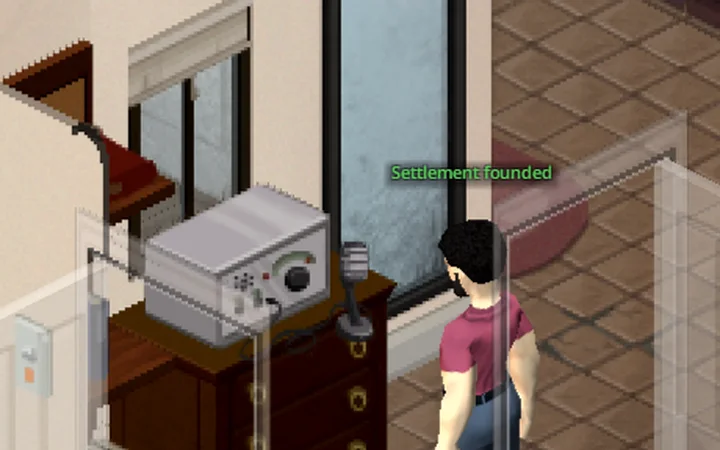
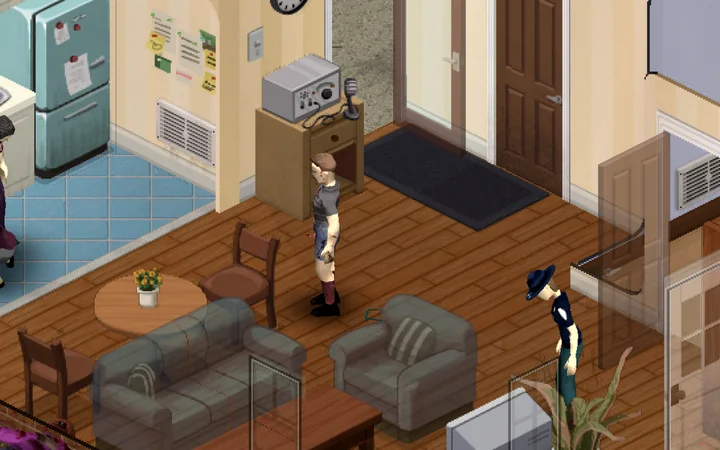
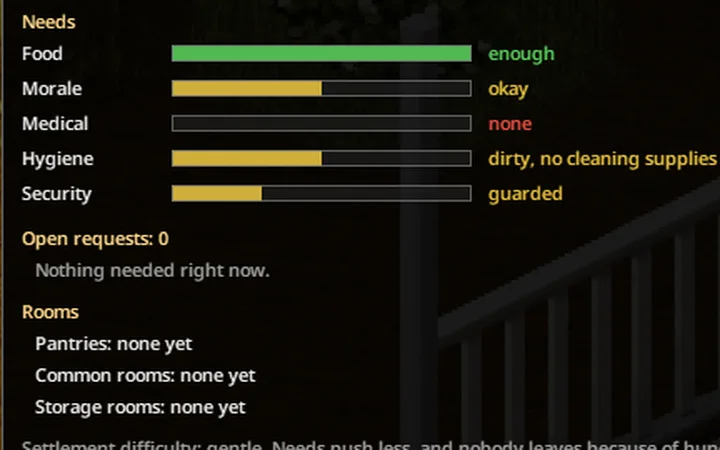
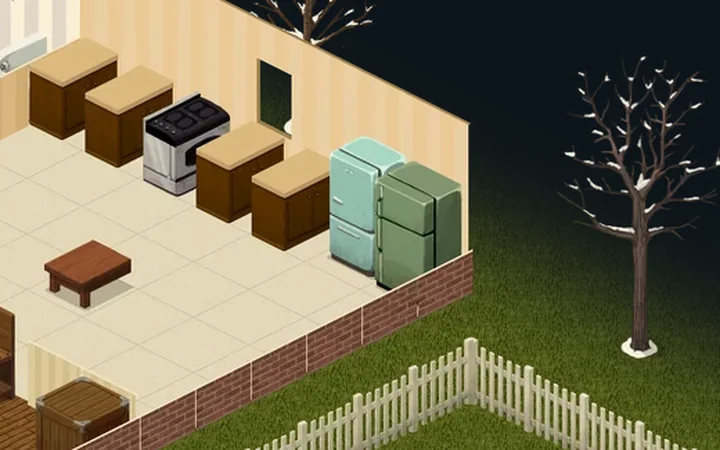
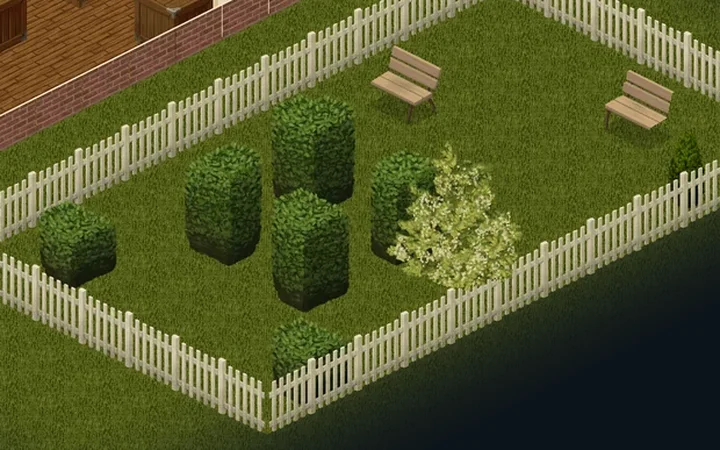
 Cook
 Handy
 Brave
 First Aider
 Organized
 Smoker
 Kitchen tools
 Workshop tools
 Medical supplies
 Guns, rounds
 Warm coats
 Books
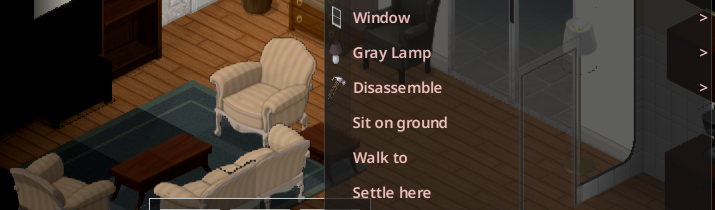
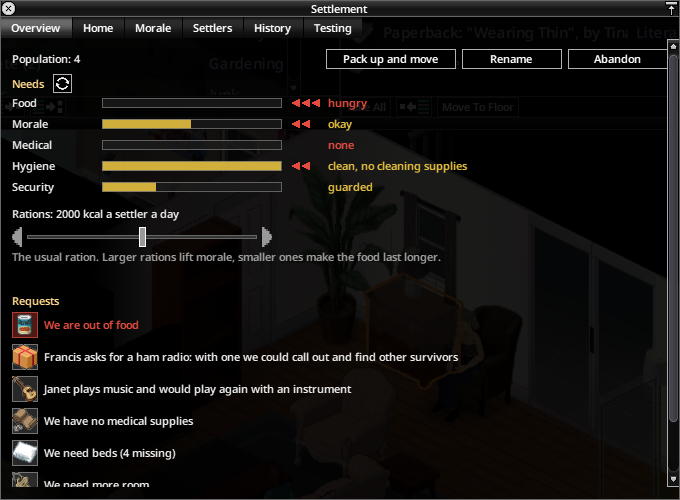
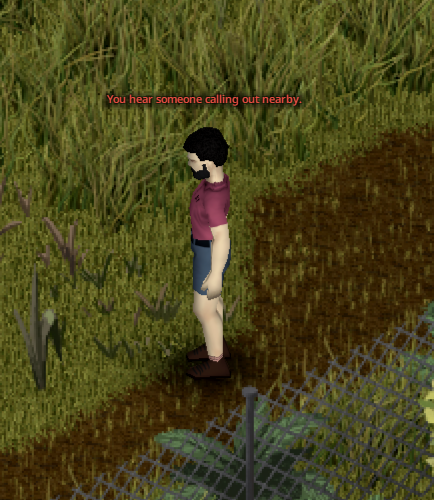
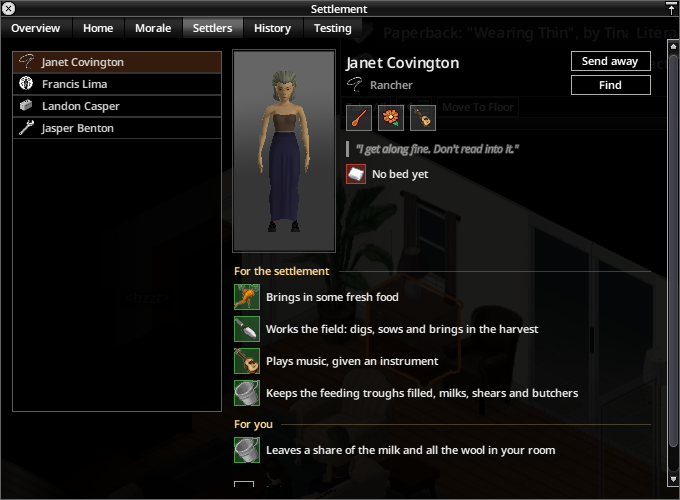
 Fisherman
 Engineer
 Construction Worker
 Metalworker
 Blacksmith
 Fitness Instructor
 Lumberjack
 Burglar


 Kitchen
 Bedroom
 Bathroom
 Sitting room
 Infirmary
 Workshop
 Armory
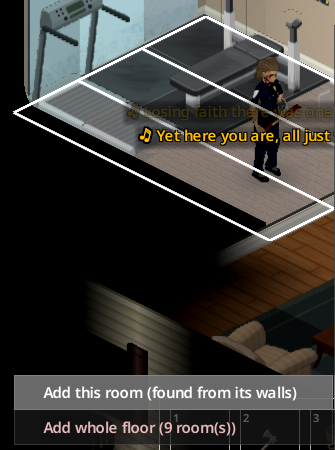
 Chrome Microwave
 Crafted Oven
 Green Oven
 Grey Oven
 Industrial Oven
 Large Modern Oven
 Modern Oven
 Red Oven
 White Microwave
 Build-in Trailer Fridge
 Chest Freezer
 Green Fridge
 Industrial Fridge
 Large Fridge
 Mini Fridge
 Plain Fridge
 Popsicle Freezer
 Red Fridge
 Steel Fridge
 White Fridge
 White Industrial Fridge

 Birchwood Corner Counter
 Birchwood Counter
 Birchwood Floating Corner Counter
 Birchwood Floating Counter
 Cantina Food Counter
 Corner A Counter
 Corner B Counter
 Crafted Counter
 Crafter Corner Counter
 Crude Metal Corner Counter
 Crude Metal Counter
 Dark Corner Counter
 Dark Counter
 Dark Floating Corner Counter
 Dark Floating Counter
 Dark Oak Corner Counter
 Dark Oak Floating Corner Counter
 Dark Oak Floating Counter
 Darkwood Floating Corner Counter
 Diner Corner Counter
 Diner Counter
 Employee Bank Counter
 Floating Burger Counter
 Floating Fries Counter
 Floating Icecream Counter
 Floating Milkshake Counter
 Floating Motel Corner Counter
 Floating Motel Counter
 Floating Spiffo Counter
 Floating Spiffo Logo Counter
 Floating Trailer Corner Counter
 Floating Trailer Counter
 Fossoil Corner Counter
 Fossoil Counter
 Gas2Go Corner Counter
 Gas2Go Counter
 Generic Shop Corner Counter
 Generic Shop Counter
 Glass Corner Display Counter
 Glass Display Counter
 Glass Theater Counter
 Green Corner Counter
 Green Counter
 Green Floating Corner Counter
 Green Floating Counter
 Greene 's Grocery Display Counter
 Grocery Trapezoid Counter
 Hardwood Floating Counter
 Low Motel Counter
 Middle Counter
 Modern Corner Counter
 Modern Counter
 Motel Corner Counter
 Motel Counter
 Oak bank Counter
 Oak Corner Counter
 Oak Counter
 Oak Employee Bank Counter
 Oak Floating Corner Counter
 Oak Floating Counter
 Oakwood Floating Corner Counter
 Oakwood Floating Counter
 Pie Store Corner Counter
 Pie Store Counter
 Pizzawhirled Corner Counter
 Pizzawhirled Counter
 Poorly Crafted Corner Counter
 Poorly Crafted Counter
 Quality Crafted Corner Counter
 Quality Crafted Counter
 Rounded Glass Display Counter
 Seahorse Coffee Corner Counter
 Seahorse Coffee Counter
 Shop Display Counter
 Spiffos Corner Counter
 Spiffos Counter
 Steel Corner Counter
 Steel Counter
 Steel Floating Corner Counter
 Steel Floating Counter
 Theater Corner Counter
 Theater Counter
 Trailer Counter
 White Corner Counter
 White Counter
 White Display Counter
 White Floating Corner Counter
 White Floating Counter
 Wooden Corner Counter
 Wooden Counter
 Zippee Corner Counter
 Zippee Counter
 Zippee Display Counter

 Extractor Hood
 Metal Dishwasher
 Small Chrome Toaster

 Chrome Sink
 Dark Industrial Sink
 Fancy Hanging Sink
 Industrial Sink
 Large Industrial Sink
 White Hanging Sink
 White Sink
 White Standing Sink

 Espresso Deluxe


 Full Jorge Foreguy Barbecue
 Jorge Foreguy Barbecue

 Baking Tray


 Kettle


 Saucepan

 Paring Knife
 Sushi Knife


 Can Opener - Old-Fashioned
 P38 Can Opener


 Bar Corner Counter
 Bar Counter
 Bar Tap Antique
 Bar Wall Bar
 Dark Bar Corner Counter
 Dark Bar Counter
 Dark Bar Wall Bar
 Dark Left Bar Wall Bar
 Dark Right Bar Wall Bar
 Leather Bar Seating
 Left Bar Wall Bar
 Oak Bar Counter
 Oak Corner Bar Counter
 Right Bar Wall Bar
 50s Seat
 Bar Stool
 Beach Chair
 Birchwood Bench
 Black Fancy Chair
 Black Office Chair
 Blue Bar Stool
 Blue Plastic Chair
 Blue Seat
 Blue Theatre Chair
 Branch Stool
 Brick Mall Bench
 Dark School Bench
 Dark Wooden Chair
 Darkblue Modern Chair
 Drum Stool
 Electric Chair
 Exceptionally crafted Chair
 Fancy Outdoors Bench
 Fancy Wooden Chair
 Folding Chair
 Foot Bench
 Green Dinner Chair
 Grey Chair
 Grey Plastic Chair
 Hanging Seat
 Light School Bench
 Log Bench
 Long Wooden Bench
 Low Hide Covered Stool
 Low Stool
 Makeshift Chair
 Mall Chair
 Modern Red Chair
 Modern White Chair
 Oakwood Bench
 Organs Stool
 Park Bench
 Piano Stool
 Pile o' Crepe Chair
 Plastic Chair
 Poor quality Chair
 Red Theatre Chair
 Red Wooden Chair
 Salon Chair
 Spiffos Dinner Chair
 Spiffos Lounge Seat
 Sports Bench
 Sturdy Bench
 Trailer Fixed Seat
 Waiting Chairs
 Whirled Seat
 White Simple Chair
 White Wooden Chair
 Wooden Bench
 Wooden Chair
 Wooden Stool

 Wall Clock
 Blue Cheap Sleeping Bag
 Blue Plaid Sleeping Bag
 Brown High Quality Sleeping Bag
 Bunk Beds
 Camo Sleeping Bag
 Crafted Bed
 Fancy Bed
 Gallery Bed
 Green 2 Cheap Sleeping Bag
 Green Cheap Sleeping Bag
 Green Plaid Sleeping Bag
 Green Sleeping Bag
 Hide Sleeping Bag
 Large Fancy Bed
 Large Modern Bed
 Large Oak Bed
 Light Wood Bed
 Makeshift Mattress
 Oak Bed
 Prisoners Bed
 Red Plaid Sleeping Bag
 Simple Bed
 Spiffo Spiffo Sleeping Bag
 Stretcher Bed
 Twin Beds

 Crafted Wooden Shelves
 Dark Wall Shelves
 Fancy Wooden Shop Shelves
 Hardwood Wall Shelves
 Lightwood Wall Shelves
 Low Shelves
 Oakwood Shelves
 T all Branch Shelves
 White Fancy Shelves

 Abe Lincoln Painting
 Apple Faced Man Painting
 Benjamin Franklin Painting
 Betty Painting
 Calvinist Painting
 Chromatic Accident Painting
 Configuration II Painting
 Configuration No. 10 Painting
 Desert Landscape Painting
 Dr. Oids Painting
 Flowers On Table Painting
 George Washington Painting
 Helianthus Painting
 Incognito Library Painting
 Island Beach Painting
 John Adams Painting
 Lakeside Painting
 Large 2 Painting
 Large Painting
 Layout I Painting
 Lighthouse Painting
 Lilly's Waterpond Painting
 Man With One Ear Painting
 Margarite Painting
 Monica Elisa Painting
 Mount Never Rest Painting
 Night With Stars Painting
 Nomad Above The Gloom Painting
 Omega Department Painting
 Painting
 Pink and Yelllow Paintings
 Purple and Blue Paintings
 Riverside Painting
 She's Got It Painting
 Sir Brakefire Painting
 Spiffo Painting
 Tall 2 Painting
 Tall Painting
 Thomas Jefferson Painting
 Two Frame Painting
 Violetta Painting
 Waterbeach Hills Painting
 Waterfall Painting
 Wide Painting

 Black Shag Carpet
 Blue Shag Carpet
 Bordeaux Rug
 Dark Green Rug
 Dark Grey Rug
 Dark Purple Rug
 Fancy Blue Rug
 Fancy Brown Rug
 Fancy Green Rug
 Fancy Orange Rug
 Grey Shag Carpet
 Pink Shag Carpet
 Rainbow Shag Carpet
 Rounded Bathroom Rug
 Rug
 Square Bathroom Rug
 Toddler Rug
 Victorian 1 Victorian 1 Rug
 Victorian 2 Rug
 Victorian 3 Rug
 Victorian 4 Rug
 White and Brown Shag Carpet
 White Shag Carpet

 Bouquet of Roses
 Cactus
 Cast Iron Plant
 Chinese Evergreen
 Dragon Tree
 Ficus
 Snake Plant
 Venus Fly Trap

 Corner B Mirror
 Large Mirror
 Large Wide Mirror
 Medicine Cabinet
 Middle Mirror
 Small Mirror
 Small Wide Mirror
 Tall Mirror
 Victorian 1 Mirror
 Wooden Framed Mirror

 Bar Wall Lamp
 Black Lamp
 Blue and Gold Lamp
 Blue Lamp
 Blue Vintage Lamp
 Dark Wall Lamp
 Double Fluorescent Wall Light
 Fancy Green Lamp
 Fluorescent Wall Light
 Globe Lamp
 Green Half Sphere Wall Lamp
 Green Vintage Lamp
 Grey Chandelier
 Grey Lamp
 Half Sphere Wall Lamp
 Large Lights
 Pink Wall Lamp
 Rainbow Lights
 Red and Gold Lamp
 Red Lamp
 Small Blue Lamp
 Small Lights
 Small Red Lamp
 Small White Lamp
 Striped Lamp
 Vintage Lamp
 White Lamp
 White Wall Lamp
 Yellow Lamp

 Childrens Drawing
 Doctor Degree Certificate
 Map of USA
 Surgeon Degree Certificate

 Lower Evangelical Banner
 Middle Evangelical Banner
 Movie Banner
 Operation Fort Knox Banner
 Orange and White Bunting
 Red, white and blue Bunting
 Red, white and green Bunting
 Stars n Stripes Flag
 Upper Evangelical Banner
 USA Flag

 Stag Antlers

 Cyberkiller 2 Large Poster
 Cyberkiller 2 Poster
 Cyberkiller 2 Wide Poster
 Cyberkiller Large Poster
 Cyberkiller Poster
 Cyberkiller Small Poster
 Dog Goblin 4 Wide Poster
 Dr Oids Large Poster
 Dr Oids Wide Poster
 Dr. Oids Poster
 Eye Test Poster
 Green Pie Poster
 Movie Poster
 Operation Fort Knox Large Poster
 Operation Fort Knox Poster
 Operation Fort Knox Wide Poster
 Organs Poster
 PAWS Poster
 PAWS Wide Poster
 Pink Pie Poster
 Pleistocene Land Large Poster
 Pleistocene Land Poster
 Pleistocene Land Wide Poster
 Poster
 Red Pie Poster
 Ruined Poster
 The Forgotten Element Large Poster
 The Forgotten Element Poster
 The Forgotten Element Wide Poster

 Female Statue
 Gallery Statue
 Horse Statue
 Male Bust
 Male Statue
 Pat Bren Statue
 Fancy Toilet
 Gallery Toilet
 Hanging Toilet
 Low Toilet
 Wooden Toilet
 Wall Shower

 White Clothing Dryer
 White Washing Machine
 Blue Rattan Couch
 Brown Lazy Couch
 Green Comfy Couch
 Light Blue Couch
 Purple Rattan Couch
 Red Comfy Couch
 Victorian C1 Couch
 Victorian C2 Couch
 Victorian C3 Couch
 Victorian C4 Couch
 Victorian C5 Couch
 Victorian C6 Couch
 White Lazy Couch
 Yellow Modern Couch
 Premium Technologies Television
 ValuTech Television
 Western Piano

 Blue Rattan Chair
 Brown Lazy Chair
 Fancy White Chair
 Green Comfy Chair
 Light Blue Chair
 Orange Ottoman
 Purple Rattan Chair
 Red Comfy Chair
 Rocking 2 Chair
 Rocking Chair
 Victorian 1 Chair
 Victorian 2 Chair
 Victorian 3 Chair
 Victorian 4 Chair
 Victorian 5 Chair
 Victorian 6 Chair
 White Lazy Chair
 Yellow Modern Chair

 Premium Technologies Radio
 ValuTech Radio

 Kaboom Arcade Machine


 Church Pew
 Decorated Altar
 Golden Cross
 Lectern Stand
 Wooden Cross


 Snare Drum
 Tom Drum

 Gym Mat
 Human Hamster Wheel

 Chalk Board
 Cork Noteboard
 Office Whiteboard
 Wide Office Whiteboard


 Banjo
 Bone Whistle
 Drumstick
 Flute
 Guitar Pick
 Harmonica
 Keytar
 Saxophone
 Trumpet
 Tuning Fork
 Violin
 Whistle

 Handheld Game Console
 VHS - Home
 VHS - Retail

 Catalog
 Comic Book
 HottieZ
 Leatherbound Book
 Magazine
 Magazine: HottieZ
 Magazine: TV Monthly
 Paperback
 Photo Book
 Picture Book
 RPG Manual

 Doodle
 Magazine: Alpine Explorers
 Magazine: American Bladecraft
 Magazine: American Homesteading
 Magazine: Ancient Tailoring
 Magazine: Angler USA - June 1993
 Magazine: Angler USA - May 1993
 Magazine: Armor in the Iron Age
 Magazine: Bloody Japanese Wrestling Deathmatch!
 Magazine: Blooms and Blossoms
 Magazine: Blunt Forge
 Magazine: Bottle Making at Home
 Magazine: Carlow Crystal Guide
 Magazine: Cowboy Living
 Magazine: Cropping for Cash
 Magazine: Cultures of Prehistory
 Magazine: Delicious Meals - June 1993
 Magazine: Early Indigenous Armor - An In-Depth Study
 Magazine: European Armor in the Late Medieval Era
 Magazine: Everyday Smithing - April 1993
 Magazine: Everyday Smithing - June 1993
 Magazine: Everyday Smithing - May 1993
 Magazine: FBI Incident Report: San Fernando Bank Robbery
 Magazine: Fun in the Woods!
 Magazine: Get Stuffed
 Magazine: Good Cooking - June 1993
 Magazine: Good Cooking - May 1993
 Magazine: Grandma's Kitchen
 Magazine: Growing Your Own
 Magazine: Herbal Remedy Growing
 Magazine: Home Security Monthly
 Magazine: Homespun
 Magazine: How to Use Generators
 Magazine: Iron Age Blacksmithing
 Magazine: Italian Delights
 Magazine: Kentucky Farmer - June 1993
 Magazine: Kentucky Farmer - May 1993
 Magazine: Laines Commercial Auto Manual
 Magazine: Laines Performance Auto Manual
 Magazine: Laines Standard Auto Manual
 Magazine: Leather Crafts
 Magazine: Legalize It!
 Magazine: Like Clockwork
 Magazine: Medieval Armory - June 1993
 Magazine: Medieval Armory - May 1993
 Magazine: Medieval Blacksmithing
 Magazine: Medieval Peasant Clothing
 Magazine: Modern Blacksmithing at Home
 Magazine: Murano Glass Manual
 Magazine: No Man's Land
 Magazine: Outdoor Gear, Done Right
 Magazine: Outfit Apocalypse
 Magazine: Pioneering Carvers
 Magazine: Punk Fashion - From Trash to Thrash
 Magazine: Real Gladiators
 Magazine: Real Spy Secrets - June 1993
 Magazine: Real Spy Secrets - May 1993
 Magazine: Revolting Peasants
 Magazine: Secrets of the Outback Outlaws
 Magazine: Small Game Hunting
 Magazine: Small-Scale Smithing
 Magazine: Sparky's Lighting Guide
 Magazine: Strange Histories - Siberian Bear Hunting
 Magazine: The Cheapskate's John Spiral - Chemical Warfare
 Magazine: The Cheapskate's John Spiral - Escaping Captivity
 Magazine: The Cheapskate's John Spiral - Forging New Identities
 Magazine: The Cheapskate's John Spiral - Homemade Explosives
 Magazine: The Cheapskate's John Spiral - Prison Defense
 Magazine: The Cheapskate's John Spiral - Street Violence
 Magazine: The Farmers Guide
 Magazine: The First Weapons
 Magazine: The Hunter
 Magazine: The Louisville Bruiser
 Magazine: Thyme Time
 Magazine: Tool Use of Early Man
 Magazine: Welder Monthly - April 1993
 Magazine: Welder Monthly - June 1993
 Magazine: Welder Monthly - March 1993
 Magazine: Welder Monthly - May 1993
 Magazine: Wilderness Survival
 Magazine: Wildlife Preserve
 Magazine: Woolly Yarns - June 1993
 Magazine: Woolly Yarns - May 1993
 Magazine: World Cooking
 Magazine: Zapper!
 Photograph of Judge Matt Hass (Autographed)
 Postcard

 Baking Tray with Chocolate Chip Cookies
 Baking Tray with Chocolate Cookies
 Baking Tray with Shortbread Cookies
 Baking Tray with Sugar Cookies
 Black Forest Cake Slice
 Blueberry Pie Slice
 Bowl of Noodle Soup
 Bowl of Ramen Noodles
 Bowl of Soup
 Bowl of Stew
 Box of Chocolates
 Bucket of Soup
 Bucket of Stew
 Burger
 Burrito
 Butterchunkers Bar
 Cake
 Cake Preparation
 Cake Slice
 Candied Apple
 Candied Fruit Slices
 Candy Cane
 Candy Corn
 Canned Fruit Beverage (Open)
 Canned Fruit Cocktail (Open)
 Canned Peaches (Open)
 Canned Pineapple (Open)
 Caramel Candies
 Carrot Cake Slice
 Cheese Cake Slice
 Cherry Pie Slice
 Chips - Barbecue
 Chips - Plain
 Chips - Salt & Vinegar
 Chips - Sour Cream & Onion
 Choco Cakes
 Chocolate Bread
 Chocolate Cake Slice
 Chocolate Candy
 Chocolate Chip Cookie
 Chocolate Cookie
 Chocolate Donut
 Chocolate-Covered Coffee Beans
 Cocoa Powder
 Crackle Bar
 Creamocle
 Crispy Rice Square
 Croissant
 Cupcake
 Danish
 Deux Bar
 Donut
 Dough
 Egg Sushi
 Fish Sushi
 Fries
 Frosted Donut
 Fruit Jam
 Fruit Muffin
 Fudgee Pop
 Galactic Dairy Bar
 Gingerbread Man
 Graham Crackers
 Gum
 Gummy Bears
 Gummy Fish Candy
 Gummy Worms
 Halloween Candy
 Hard Candies
 Hi His
 Hot Drink
 HotDrinkCopper
 HotDrinkGold
 HotDrinkMetal
 HotDrinkSilver
 HotDrinkTumbler
 Ice Cream
 Ice Cream Cone
 Ice Cream Sandwich
 Icing
 Jelly Donut
 Jelly Roll
 Jellybeans
 Jujubes
 Key Lime Pie Slice
 Lemon Bar
 Lemon Meringue Pie Slice
 Licorice
 Licorice Allsorts
 Lollipop
 Maki
 Maple Syrup
 Marmalade
 Marshmallows
 Milk Chocolate Bar
 Mint Candy
 Modjeska
 Muffin
 Nacho Cheese
 Novapops Candy
 Oatmeal Cookie
 Onigiri
 Opened Jar of Fish Roe
 Pancakes
 Peanut Butter
 Peppermint Candy
 Pizza
 Pizza Slice
 Plonkies
 Popsicle
 Pork Rinds
 Pot of Soup
 Pot of Stew
 Pumpkin Pie Slice
 Quagga Cakes
 Raspberry Shortbread Cookie
 Red Velvet Cake Slice
 Rock Candy
 Roy's Peanut Butter Pucks
 Salad
 Shortbread Cookie
 Smirkers Bar
 Smore
 SnikSnak Bar
 Sno Globes
 Strawberries
 Strawberry Cake Slice
 Sugar Cookie
 Taco
 Tato Dots
 Tin of Caviar
 Waffles
 Large Medical Bed
 Blue Hospital Curtain B
 Blue Hospital Curtain C
 Blue Hospital Curtain D
 Dentist Patient Chair
 Dentist Workstation
 First Aid Cabinet
 Medical Desk
 Medical Stool
 Mobile Bloodbag
 Patient Chair
 Weighing Scale
 White Microscope
 Wide Medical Cabinet
 Forceps
 Medical Shears
 Mortar and Pestle
 Scalpel
 Stethoscope
 Tweezers

 Antibiotics
 Antidepressants
 Bandage
 Bandage (Sterilized)
 Bandage - Adhesive
 Beta Blockers
 Black Sage
 Black Sage (Dried)
 Bottle of Disinfectant
 Box of Adhesive Bandages
 Box of Antibiotics
 Box of Bandages
 Box of Cold Packs
 Box of Cotton Balls
 Box of Suture Needles
 Caffeine Pills
 Cold Pack
 Comfrey
 Comfrey (Dried)
 Comfrey Poultice
 Common Mallow
 Common Mallow (Dried)
 Cotton Balls
 Cotton Balls Doused in Alcohol
 Denim Strips
 Ginseng
 Leather Strips
 Painkillers
 Plantain
 Plantain (Dried)
 Plantain Poultice
 Rag
 Rag (Sterilized)
 Sleeping Pills
 Splint
 Suture Needle
 Wild Garlic
 Wild Garlic (Dried)
 Wild Garlic Poultice
 Branch Workbench
 Key Duplicator
 Mobile Tool Counter
 Red Mobile Tool Cabinet
 Tool Bench
 Wood Pegboard
 Wood Top Workbench
 Workbench
 Block Anvil
 Electric Blower Forge
 Primitive Forge
 Stone Anvil
 Crude Hand Press
 Fancy Distaff
 Grinding Slab
 Hand Press
 Heckle Comb
 Modern Pottery Wheel
 Mortar Grinder
 Pottery Table
 Ripple Comb
 Scutching Board
 Simple Distaff
 Simple Loom
 Simple Pottery Wheel
 Softening Beam
 Spinning Wheel
 Stone Mill
 Stone Quern

 Smithing Hammer
 Stone Hammer

 Simple Wood Saw
 Small Hacksaw
 Wood Saw

 Ratchet Wrench
 Wrench

 Multitool

 Pliers

 Hand Drill
 Stone Drill

 Wooden Toolbox

 Welder Mask
 Welding Torch

 Bellows
 Bolt Cutters
 Brass Needle
 Calipers
 Carpentry Chisel
 Clay Sculpting Tool
 Crafted Paintbrush
 File
 Forged Needle
 Funnel
 Heading Tool
 Knapping Tool
 Knitting Needles
 Loupe
 Mason's Chisel
 Mason's Trowel
 Measuring Tape
 Metalworking Chisel
 Metalworking Punch
 Paintbrush
 Plastering Trowel
 Sheet Metal Snips
 Sledgehammer
 Small Brush
 Small File Set
 Small Punch and Chisel Set
 Steel Wool
 Thimble
 Tongs
 Vise Grips
 Whetstone
 Wood Clay Sculpting Tool
 Wooden Mallet
 Zip Ties

 Green garage door

 Tire Iron


 Beige Magazine Shop Shelves
 Beige Rack Shop Shelves
 Beige Wall Shop Shelves
 Big Wall Corner Shelves
 Big Wall Shelves
 Blue Wall Locker
 Cartboard Box
 Cartbox
 Comics Shop Shelves
 Corner A Shelves
 Corner B Shelves
 Crafted Wall Shelves
 Crate
 Crude Metal Wall Shelves
 Crude Tall Locker
 Crude Wall Locker
 Fancy Metal Crate
 Fossoil Low Shelves
 Gas2Go Low Shelves
 Generic Cooled Shelves
 Generic Shop Low Shelves
 Green Wall Locker
 Greene's Grocery Shelves
 Hardwood Wall Corner Shelves
 Large Metal Shelves
 Large Rental Shelves
 Large Shop Shelves
 Low Wide Shelves
 Metal Crate
 Metal Locker
 Metal Wall Shelves
 Middle Shelves
 Shoddy Wall Shelves
 Small Crate
 Small Rental Shelves
 Trapzoid Shop Shelves
 White Wall Shelves
 Wooden Shop Shelves
 Yellow Wall Locker
 Zippee Low Wall Shelves
 Zippee Wall Shelves

 China Cabinet
 Grey File Cabinet
 Pale Drawers
 Small Chest
 White File Cabinet

 Clothing Shop Shelves
 Dark Fancy Drawers
 Dark Fancy Wardrobe
 Fancy Drawers
 Fancy Oak Drawers
 Fancy Oak Wardrobe
 Fancy White Wardrobe
 Large Clothes Rack
 Light Wood Drawers
 Light Wood Wardrobe
 Lit Mirror And Drawers
 Long Shelves
 Mirror And Drawers
 Oak Wardrobe
 Open Wardrobe
 Small Clothes Rack
 White Wardrobe
 Military Crate
 Military Locker
 Standing Vault
 Wall Vault

 Silhouette Target


 MSR788 Rifle
 MSR7T Tactical Rifle

 Patrol Revolver


 Magnum

 Trapper Carbine

 MSR700 Rifle

 JS-2000 Shotgun
 JS-3T Tactical Shotgun
 Sawed-off Double Barrel Shotgun
 Sawed-off JS-2000 Shotgun

 Box of .30-30 Rounds
 Carton of .30-30 Rounds

 Box of 7.62x51mm Rounds
 Carton of 7.62x51mm Rounds

 Box of .357 Magnum Rounds
 Carton of .357 Magnum Rounds

 Box of .38 Special Rounds
 Carton of .38 Special Rounds

 Box of .44 Magnum Rounds
 Carton of .44 Magnum Rounds

 Box of .45 ACP Rounds
 Carton of .45 ACP Rounds

 Box of 5.56x45mm Rounds
 Carton of 5.56x45mm Rounds

 Box of 9x19mm Rounds
 Carton of 9x19mm Rounds

 Box of 12g Rounds
 Carton of 12g Rounds

 Cooking Pit
 Simple Cooking Pit

 Ornamental Bush

 David The Gnome
 Imitation Flamingo
 Pecking Imitation Flamingo

 Fancy Outdoor Lamp
 Flood Lights
 Lamp on Pillar
 Modern Outdoor Lamp
 Oval Outdoor Lamp
 Round Outdoor Lamp

 Brown Picknic Table

 Merry Go Round
 Playground Slide
 Playground Swingset

 Large Drying Rack
 Large Simple Drying Rack
 Medium Drying Rack
 Raised Plantbed
 Scarecrow
 Simple Small Drying Rack
 Small Drying Rack

 Bell Pepper
 Black Sage
 Broadleaf Plantain
 Cauliflower
 Chamomile
 Comfrey
 Common Mallow
 Cucumber
 Flax
 Habanero
 Hemp
 Hops
 Jalapeno
 Lavender
 Leek
 Lemongrass
 Lettuce
 Marigold
 Mint
 Poppies
 Pumpkin
 Roses
 Rye
 Spinach
 Sugar Beet
 Sunflower
 Tobacco
 Turnip
 Watermelon
 Wild Garlic
 Zucchini

 Double Stacked Hay
 Salt Lick
 Single Stacked Hay
 Tannin Barrel

 Huge Metal Trough
 Large Metal Trough
 Small Animal Trough
 Small Metal Trough

 Old Generator
 Red Generator
 Yellow Generator

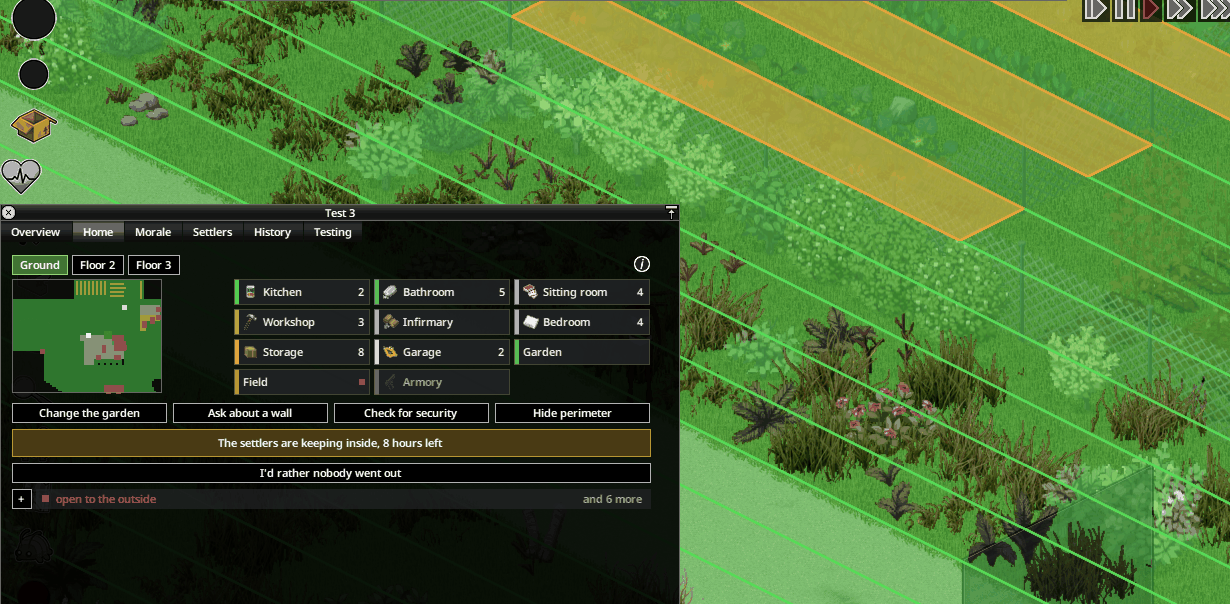
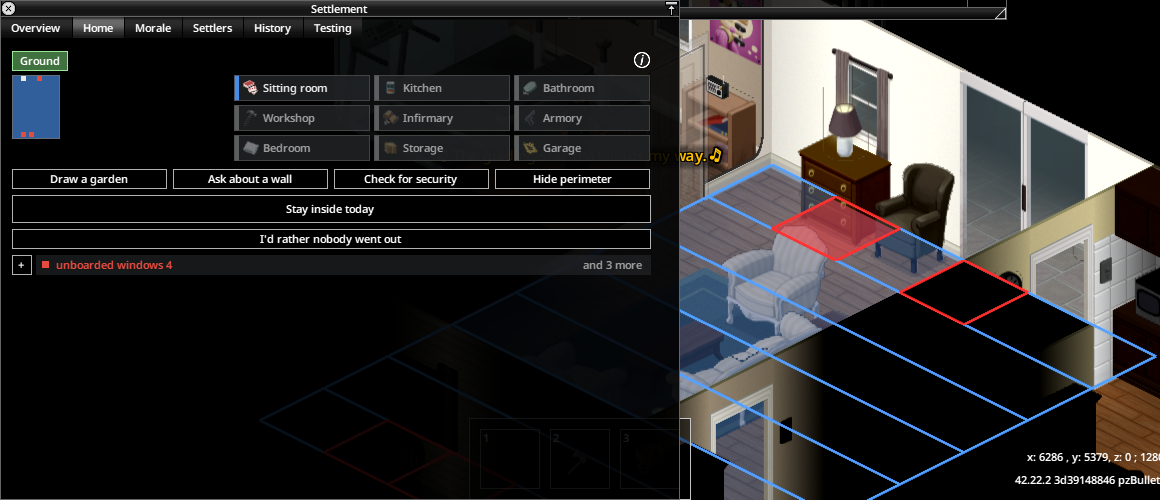
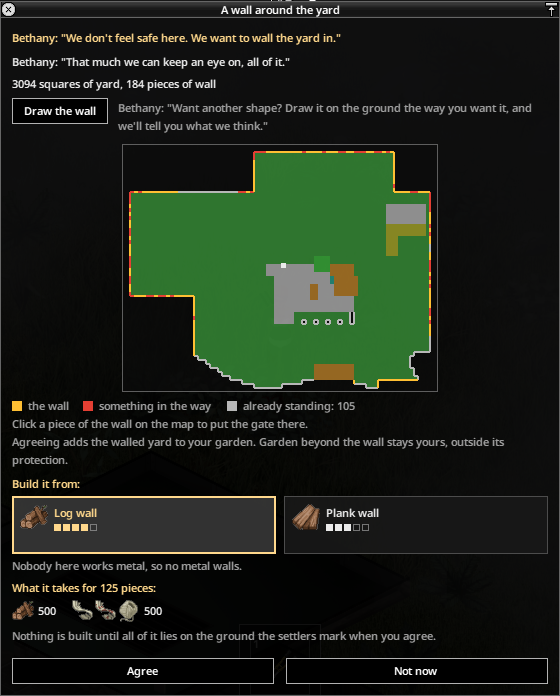
 Nutritionist
 Hunter
 Angler
 Herbalist
 Outdoorsman
 Light Eater
 Hearty Appetite
 Low Thirst
 High Thirst
 Bushcrafter
 Hiker
 Burglar
 Desensitized
 Cowardly
 Claustrophobic
 Crafty
 Tinkerer
 Inventive
 Vehicle Knowledge
 Sewer
 Mason
 Blacksmith (trait)
 All Thumbs
 Marksman
 Target Shooter
 Brawler, Baseball Player
 Keen Hearing
 Eagle Eyed
 Night Owl
 Cat's Eyes
 Pacifist
 Athletic, Fit, Runner, Graceful, Inconspicuous
 Unfit, Short of Breath, Clumsy, Conspicuous
 Strong, Stout
 Puny, Weak
 Adrenaline Junkie
 Deaf
 Hard of Hearing
 Resilient
 Prone to Illness
 Iron Gut
 Weak Stomach
 Restless Sleeper, Sleepyhead
 Wakeful
 Disorganized
 Hemophobic
 Music talent
 Tidy talent
 Fast Healer
 Slow Healer
 Agoraphobic
 Former Scout
 Short Sighted
 Fishing rod or net
 Trap
 Filled bottles, pots
 Axe and saw
 Planks, sheet metal
 Electronics scrap
 Petrol can
 Melee weapons
 Medical tools
 Broom or mop
 Cleaning supplies
 Needle and thread
 Axe
 Firewood, planks
 Board games, cards, treats
 Instruments
 VHS tapes, video games
 CDs
 Cigarettes
 Beer, wine, spirits
 Walkie-talkie
 Garden Fork
 Gardening Trowel
 Hand Fork
 Shovel
 Spade
 Wooden Spade
 Wooden Trowel
 Barley Seeds
 Basil
 Basil Seeds
 Bell Pepper Seeds
 Black Sage Seeds
 Broadleaf Plantain Seeds
 Broccoli Seeds
 Cabbage Seeds
 Carrot Seeds
 Cauliflower Seeds
 Chamomile
 Chamomile Seeds
 Chives
 Chives Seeds
 Cilantro
 Cilantro Seeds
 Comfrey Seeds
 Common Mallow Seeds
 Corn
 Corn (Dried)
 Cucumber Seeds
 Flax Seeds
 Garlic
 Garlic Seeds
 Ginger Root
 Green Peas
 Green Peas (Dried)
 Habanero Seeds
 Hemp
 Hemp Seeds
 Hops Seeds
 Jalapeno Seeds
 Kale Seeds
 Lavender Seeds
 Leek Seeds
 Lemon Grass Seeds
 Lemongrass
 Lettuce Seeds
 Marigold
 Marigold (Dried)
 Marigold Seeds
 Mint
 Mint Seeds
 Onion
 Onion Seeds
 Oregano
 Oregano Seeds
 Parsley
 Parsley Seeds
 Poppy Seeds
 Potato
 Potato Seeds
 Pumpkin Seeds
 Radish Seeds
 Rose Seeds
 Rosemary
 Rosemary Seeds
 Rye Seeds
 Sage
 Sage Seeds
 Seed Packet - Basil
 Seed Packet - Bell Pepper
 Seed Packet - Black Sage
 Seed Packet - Broadleaf Plantain
 Seed Packet - Broccoli
 Seed Packet - Cabbage
 Seed Packet - Carrot
 Seed Packet - Cauliflower
 Seed Packet - Chamomile
 Seed Packet - Chives
 Seed Packet - Cilantro
 Seed Packet - Comfrey
 Seed Packet - Common Mallow
 Seed Packet - Corn
 Seed Packet - Cucumber
 Seed Packet - Flax
 Seed Packet - Garlic
 Seed Packet - Green Peas
 Seed Packet - Habanero
 Seed Packet - Hemp
 Seed Packet - Hops
 Seed Packet - Jalapeno
 Seed Packet - Kale
 Seed Packet - Lavender
 Seed Packet - Leek
 Seed Packet - Lemongrass
 Seed Packet - Lettuce
 Seed Packet - Marigold
 Seed Packet - Mint
 Seed Packet - Onion
 Seed Packet - Oregano
 Seed Packet - Parsley
 Seed Packet - Poppy
 Seed Packet - Potato
 Seed Packet - Pumpkin
 Seed Packet - Radish
 Seed Packet - Rose
 Seed Packet - Rosemary
 Seed Packet - Rye
 Seed Packet - Sage
 Seed Packet - Soybeans
 Seed Packet - Spinach
 Seed Packet - Strawberry
 Seed Packet - Sugar Beet
 Seed Packet - Sunflower
 Seed Packet - Sweet Potato
 Seed Packet - Thyme
 Seed Packet - Tobacco
 Seed Packet - Tomato
 Seed Packet - Turnip
 Seed Packet - Watermelon
 Seed Packet - Wheat
 Seed Packet - Wild Garlic
 Seed Packet - Zucchini
 Soybeans
 Soybeans (Dried)
 Spinach Seeds
 Strawberry Seeds
 Sugar Beet Seeds
 Sunflower Seeds
 Sweet Potato
 Sweet Potato Seeds
 Thyme
 Thyme Seeds
 Tobacco Seeds
 Tomato Seeds
 Turnip Seeds
 Watermelon Seeds
 Wheat Seeds
 Wild Garlic Seeds
 Zucchini Seeds
 Fishing Net
 Fishing Rod
 Cage Trap
 Crate Trap
 Mouse Trap
 Snare Trap
 Stick Trap
 Scythe
 Stone-Blade Scythe
 Mildew Spray
 Pest Flies Spray
 Slug Repellent
 Carved Bucket
 Wooden Bucket
 Butterfly Knife
 Handguard Dagger
 Handiknife
 Large Knife
 Long Simple Metal Knife
 Long Stone Knife
 Machete Blade Knife
 Pocket Knife
 Railroad Spike Knife
 Scrap Metal Cleaver
 Scrap Metal Large Knife
 Small Knife
 Steak Knife
 Stone Knife
 Switchblade
 Shears
 Steel Sheet
 Gas Can
 Antique Table Leg - Chained
 Antique Table Leg with Nails
 Antique Table Leg with Sawblade
 Axe
 Barbell
 Baseball Bat
 Baseball Bat - Can-Reinforced
 Baseball Bat - Sheet Metal Reinforced
 Baseball Bat with Garden Fork Head
 Baseball Bat with Nails
 Baseball Bat with Railspike
 Baseball Bat with Rake Spikes
 Baseball Bat with Sawblade
 Baseball Bat with Spikes
 Block Mace
 Block Maul
 Bone Club
 Bone Club with Spikes
 Bone War Hatchet
 Brake Disc Scrap Metal Weapon
 Broken Acoustic Guitar Neck
 Broken Banjo Neck
 Broken Baseball Bat with Nails
 Broken Branch with Nails
 Broken Canoe Paddle
 Broken Electric Bass Neck
 Broken Electric Guitar Neck
 Broken Field Hockey Stick with Nails
 Broken Garden Tool Handle
 Broken Large Handle with Nails
 Broken Table Leg with Nails
 Bucket Maul - Metal Handle
 Bucket Maul - Wood Handle
 Canoe Paddle
 Canoe Paddle - Double-bladed
 Chair Leg with Nails
 Crafted Baseball Bat
 Crude Stone Axe
 Cudgel - Sheet Metal Reinforced
 Cudgel with Bone Spikes
 Cudgel with Brake Disc
 Cudgel with Garden Fork Head
 Cudgel with Nails
 Cudgel with Railspikes
 Cudgel with Sawblade
 Cudgel with Spade Head
 Cudgel with Spikes
 Dumbbell
 Engine Parts Maul
 Field Hockey Stick with Nails
 Field Hockey Stick with Sawblade
 Fireplace Poker
 Firewood with Nails
 Flint Saw
 Garden Fork Scrap Metal Weapon
 Golf Club
 Hand Axe
 Ice Axe
 Iron Bar
 Iron Bar Half
 Iron Pipe
 Iron Pipe with Railspike
 Jawbone
 Jawbone Club
 Jawbone Morningstar
 Jawbone War Axe
 Katana
 Kettle Maul - Metal Handle
 Kettle Maul - Wood Handle
 Large Animal Bone
 Large Branch
 Large Handle - Can-Reinforced
 Large Handle with Brake Disc
 Large Handle with Nails
 Large Handle with Railspike
 Large Handle with Rake Spikes
 Large Handle with Sawblade
 Large Hook
 Large Stone Axe
 Lead Pipe
 Long Mace
 Long Sharp Bone
 Long Spiked Club
 Long Stone Mace
 Mace
 Machete
 Metal Baseball Bat
 Metal Baseball Bat with Bolts
 Metal Baseball Bat with Sawblade
 Nightstick
 Plank with Brake Disc
 Plank with Nails
 Plank with Sawblade
 Rake-Head Scrap Metal Weapon
 Sawblade Axe
 Sawblade Hatchet
 Scrap Metal Chopper
 Scrap Metal Cleaver-Axe
 Scrap Metal Maul
 Scrap Metal Morningstar
 Scrap Metal Morningstar - Short
 Scrap Metal Sword
 Short Bat
 Short Bat - Can-Reinforced
 Short Bat with Nails
 Short Bat with Railspike
 Short Bat with Rake Spikes
 Short Bat with Sawblade
 Short Bat with Spikes
 Shortsword
 Simple Shortsword
 Simple Sword
 Snow Shovel
 Spade Head Scrap Metal Weapon
 Spear with Bone Head
 Spear with Fighting Knife
 Spear with Glass Head
 Spear with Hand Fork
 Spear with Hunting Knife
 Spear with Kitchen Knife
 Spear with Large Knife
 Spear with Long Bone Head
 Spear with Long Metal Head
 Spear with Long Simple Metal Head
 Spear with Long Stone Head
 Spear with Metal Head
 Spear with Scissors
 Spear with Scrap Knife
 Spear with Screwdriver
 Spear with Simple Metal Head
 Spear with Small Knife
 Spear with Steak Knife
 Spear with Stone Head
 Steel Bar
 Steel Bar Half
 Steel Rod
 Steel Rod Half
 Stone Mace
 Stone Maul
 Sturdy Bone Club
 Sturdy Bone Club with Spikes
 Sword
 Tree Branch
 Tree Branch - Can-Reinforced
 Tree Branch with Bone Spikes
 Tree Branch with Nails
 Tree Branch with Railspike
 Wooden Rod with Nails
 Wooden Spear
 Wooden Spear (Fire Hardened)

 Broom
 Dish Towel
 Dish Towel (Wet)
 Grill Brush
 Mop
 Rubber Gloves
 Sponge
 Toilet Brush
 Twig Broom

 Cleaning Liquid
 Soap
 Cowhide Coat
 Firefighter Jacket
 Hide Coat
 Jacket
 Jacket - Navy Blue
 Leather Coat
 Military Jacket - Officer
 Padded Jacket
 Padded Jacket - Hunting Camo
 Police Jacket
 Ranger Jacket
 Santa Jacket
 Santa Jacket - Green
 Sheepskin Coat
 Sheepskin Jacket
 Sheepskin Vest
 Sheriff Deputy Jacket
 Suit Jacket
 Bone Needle
 Aramid Thread
 Fishing Line
 Premium Fishing Line
 Sinew Thread
 Thread

 Broken Plank
 Firewood
 Firewood Bundle
 Log
 Log Stack - Four
 Log Stack - Three
 Log Stack - Two
 Twigs
 Twigs Bundle

 Chewing Tobacco
 Cigarette
 Cigarette Carton
 Cigarette Pack
 Cigarillo
 Pouch of Tobacco
 Rolled Cigarette
 Smoking Pipe with Tobacco